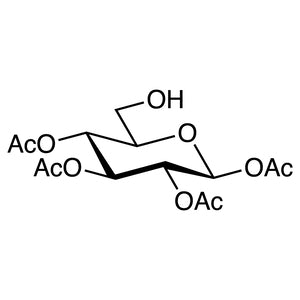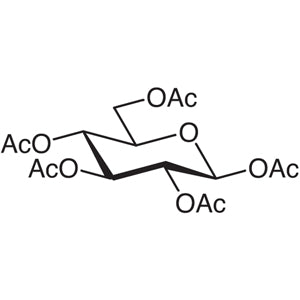
Penta-O-acetyl-beta-D-glucopyranose, also known as beta-D-glucose pentaacetate, is a glucose derivative in which all five hydroxyl groups are protected as acetate esters, with beta configuration at the anomeric carbon. It is one of the most classic and widely used starting materials in glycoscience and carbohydrate chemistry. It serves as a glycosyl donor, as a precursor to glycosyl halides and thioglycosides, and as an intermediate in the synthesis of glycosides, oligosaccharides, and glycoconjugates. Many laboratory routes in carbohydrate synthesis begin with this compound, which makes it a basic reagent for chemical biology research.
Chemists choose this material mainly because acetate protection makes glucose soluble in common organic solvents. Free glucose is very polar and hard to handle in conventional organic chemistry. The pentaacetate form is much easier to purify, analyse, and react. The anomeric acetate can be activated selectively with Lewis acids or replaced with a halide, which gives chemists control over the reactive centre. The acetate group at C-2 can also provide neighbouring group participation, which helps direct the formation of beta-glycosidic bonds. After synthesis, the acetate groups are easy to remove by mild basic methanolysis, so the protecting strategy is both effective and practical.
In Indonesian laboratories, this reagent is used mostly in university organic chemistry and chemical biology groups, natural product research institutes, and pharmaceutical development laboratories working on carbohydrate-based molecules. Researchers studying glycosides from local medicinal plants, or making sugar-modified derivatives for biological testing, often start from this protected glucose. It is also useful in teaching laboratories for showing protecting-group chemistry, glycosylation, and deprotection. Because it is supplied by TCI, research teams can expect consistent quality from batch to batch for reproducible synthetic work.
TCI brochures (PDF)
- Reagents for Glyco Chemistry & Biology 5th Edition · p. 37
- Pharmaceutical Ingredients for Research and Experimental Use 2026-03-09 · p. 50
- Reagents for Biological Research 2025-03-11 · p. 50
Related TCI products
- TCI A0522 497-76-7 Arbutin
- TCI G0225 604-68-2 Penta-O-acetyl-alpha-D-glucopyranose
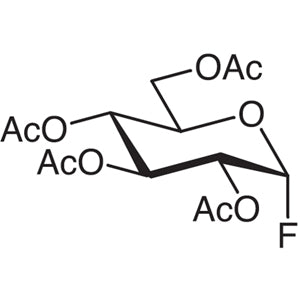
- TCI T1995 3934-29-0 2,3,4,6-Tetra-O-acetyl-alpha-D-glucopyranosyl Fluoride
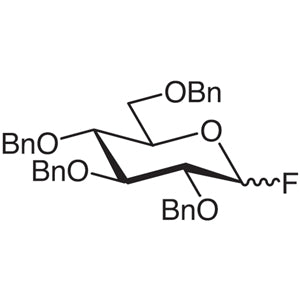
- TCI T1971 122741-44-0 2,3,4,6-Tetra-O-benzyl-D-glucopyranosyl Fluoride
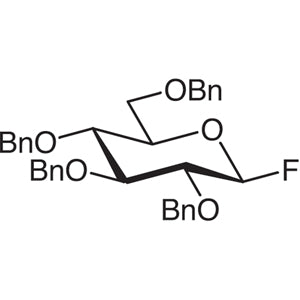
- TCI T1923 78153-79-4 2,3,4,6-Tetra-O-benzyl-beta-D-glucopyranosyl Fluoride
- TCI T1922 89025-46-7 2,3,4,6-Tetra-O-benzyl-alpha-D-glucopyranosyl Fluoride
- Glycosyl donor in glycosylation reactions: the anomeric acetate can be activated selectively with Lewis acids, so it couples efficiently with alcohol acceptors to form glycosidic bonds.
- Precursor for glycosyl halides: the anomeric acetate can be replaced with a halide, giving reactive glycosyl bromide or chloride donors for further carbohydrate coupling work.
- Preparation of thioglycosides: this compound is a standard starting point for making thioglycoside donors, which are stable and widely used in modern oligosaccharide assembly strategies.
- Stereoselective synthesis of beta-glycosides: the acetate at C-2 provides neighbouring group participation, which helps direct beta-glycosidic bond formation with good stereochemical control.
- Synthesis of oligosaccharides and glycoconjugates: its solubility in organic solvents and easy deprotection by mild basic methanolysis make it a practical intermediate for building complex carbohydrate structures.
| Brand | TCI (product code P0028) |
|---|---|
| CAS number | 604-69-3 |
| Molecular formula | — |
| Purity | — |
| Category | Chemistry > Chemical Biology > Glycoscience |
| Pack sizes | available in standard TCI pack sizes; please contact AMI Scientific for current options |
| Physical form | please refer to the TCI Certificate of Analysis and product documentation |
| Storage | keep tightly closed in a cool, dry place, following the supplier's label recommendations |
Store Penta-O-acetyl-beta-D-glucopyranose in its original tightly sealed container in a cool, dry, well-ventilated place, away from moisture, heat sources, and direct sunlight. Moisture can slowly hydrolyse acetate esters, so close the container promptly after each use and consider storing it with desiccant. Keep it apart from strong acids, strong bases, and oxidising agents. Handle the material in a well-ventilated area or fume hood, wearing gloves, safety glasses, and a lab coat. Avoid creating or breathing in dust, and avoid contact with skin and eyes. Always check the TCI Safety Data Sheet for detailed hazard, first-aid, and disposal information before use.
—
Product Categories
- GlycoscienceApplications Using Glyco-materialsGlyco-utilization [Applications Using Glyco-materials]
- GlycoscienceGlyco Building BlocksProtected Sugars [Oligosaccharides by Component Sugar]
- GlycoscienceGlyco Building BlocksGlycosyl Donors [Glyco Building Blocks]
- GlycoscienceMonosaccharides [Glycoscience]Glucoses [Glycoscience]
- Biochemicals and ReagentsCarbohydrates
- Biochemicals and ReagentsPharmaceutical Research Reagents (for Experimental Use)Cosmetic Research Reagents (for Experimental Use)
- Pharmaceutical Development and Drug Discovery ResearchPharmaceutical Research Reagents (for Experimental Use)Cosmetic Research Reagents (for Experimental Use)
Produk Terkait
-
Arbutin TCI A0522
Regular price From Rp 452.550,00Regular price -
Penta-O-acetyl-alpha-D-glucopyranose TCI G0225
Regular price From Rp 1.035.300,00Regular price -
2,3,4,6-Tetra-O-acetyl-alpha-D-glucopyranosylFluoride TCI T1995
Regular price Rp 3.312.750,00Regular price -
2,3,4,6-Tetra-O-benzyl-D-glucopyranosylFluoride TCI T1971
Regular price Rp 5.089.350,00Regular price -
2,3,4,6-Tetra-O-benzyl-beta-D-glucopyranosylFluoride TCI T1923
Regular price Rp 5.990.250,00Regular price -
2,3,4,6-Tetra-O-benzyl-alpha-D-glucopyranosylFluoride TCI T1922
Regular price Rp 4.584.300,00Regular price -
3,4,6-Tri-O-acetyl-2-deoxy-D-glucopyranose TCI T1931
Regular price Rp 2.094.750,00Regular price -
1,2,3,4-Tetra-O-acetyl-beta-D-glucopyranose TCI T2811
Regular price Rp 5.619.600,00Regular price