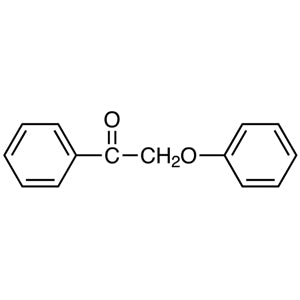
Phenoxyacetone from TCI is an aromatic ketone made up of a phenoxy group joined to acetone through an ether oxygen bridge. In the laboratory, it serves as a non-heterocyclic building block that offers two reactive sites in one molecule: the ketone carbonyl group and the neighbouring alpha carbon. Phenoxyacetone is often used as a starting material for building more complex molecules, including a range of heterocyclic compounds and amine derivatives, through condensation and reduction reactions.
Chemists choose phenoxyacetone because its ketone group takes part in many classic transformations. These include condensation with amines or hydrazines, reductive amination, Grignard addition, and reduction to a secondary alcohol. The alpha carbon next to the carbonyl also supports enolate chemistry for forming carbon-carbon bonds. The phenoxy group adds a stable aromatic portion and also affects the polarity of the molecule. Taken together, these features make phenoxyacetone a flexible reagent for planning multi-step synthetic routes in which each functional group can be addressed in turn.
In Indonesian laboratories, phenoxyacetone is useful to researchers in synthetic organic chemistry and medicinal chemistry at universities and research institutions. It fits well in projects that prepare compound libraries, study structure-activity relationships, or develop new synthetic methods. Graduate students and research staff can use this TCI reagent to make intermediates for heterocycle synthesis and amine preparation. It also works for teaching advanced carbonyl chemistry in research-oriented organic chemistry courses.
- Heterocycle synthesis: the ketone carbonyl condenses with hydrazines and amines, so phenoxyacetone is a practical precursor for building heterocyclic ring systems in multi-step routes.
- Reductive amination: the reactive ketone group can be converted into amine derivatives, which helps medicinal chemists who need phenoxy-containing amine intermediates for screening work.
- Grignard and organometallic addition: the carbonyl accepts organometallic nucleophiles to give tertiary alcohols, so chemists can extend the carbon framework in a controlled way.
- Enolate chemistry: the alpha carbon next to the carbonyl allows alkylation and aldol-type reactions, which makes the compound useful for carbon-carbon bond formation studies.
- Reduction studies: the ketone reduces to a secondary alcohol, making phenoxyacetone a convenient model substrate for testing reducing agents and conditions for selective carbonyl reduction.
| Brand | TCI (product code P0112) |
|---|---|
| CAS number | 621-87-4 |
| Molecular formula | — |
| Purity | — |
| Category | Chemistry > Building Blocks > Non-Heterocyclic Building Blocks |
| Pack sizes | as offered in the current TCI catalogue |
| Physical form | refer to the TCI product label and certificate of analysis |
| Storage | keep the container tightly closed in a cool, dry, well-ventilated place |
Store phenoxyacetone in its original, tightly sealed container in a cool, dry, well-ventilated area, away from heat sources, direct sunlight, and strong oxidising agents. If you transfer portions for routine use, use clean, compatible glass containers and label them clearly. Handle the compound in a fume hood while wearing suitable laboratory gloves, safety glasses, and a lab coat. Avoid breathing vapours and avoid contact with skin and eyes. Always check the TCI Safety Data Sheet for full hazard information, first-aid measures, and the correct disposal procedure under local regulations.
—
Produk Terkait
-
2-Phenoxyacetophenone TCI P2121
Regular price Rp 1.298.850,00Regular price -
4'-Phenoxyacetophenone TCI P1355
Regular price Rp 1.298.850,00Regular price -
4-BromophenoxyaceticAcid TCI B2746
Regular price From Rp 637.350,00Regular price -
2,4,6-TrichlorophenoxyaceticAcid TCI T1063
Regular price From Rp 3.232.950,00Regular price -
SodiumPhenoxyacetate TCI S0529
Regular price Rp 3.312.750,00Regular price -
EthylPhenoxyacetate TCI P1340
Regular price Rp 2.041.200,00Regular price -
PhenoxyacetylChloride TCI P0113
Regular price From Rp 1.565.550,00Regular price -
PhenoxyaceticAnhydride TCI P0111
Regular price From Rp 4.399.500,00Regular price