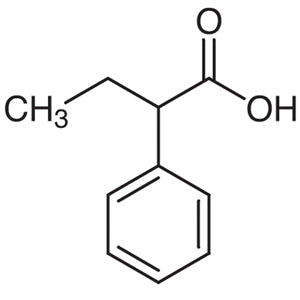
2-Phenylbutyric Acid from TCI is an aromatic carboxylic acid with a phenyl group and an ethyl group attached to the alpha carbon of the carboxylic acid group. It belongs to the non-heterocyclic building blocks and is widely used in organic synthesis and pharmaceutical chemistry, because the arylalkanoic acid framework appears in many active molecules. In the laboratory, chemists use it as a starting material for esters, amides, and other derivatives. Stereochemistry researchers also use it as a model compound, because the molecule has a chiral centre at the alpha carbon.
The main reason chemists choose 2-Phenylbutyric Acid is its carboxylic acid group, which can easily be converted into a wide range of derivatives, together with its chiral alpha carbon. The product is generally supplied as a racemic mixture. This makes it an ideal substrate for enantiomer resolution studies, whether by diastereomeric salt formation, enzymatic resolution, or chiral chromatography. The phenyl group absorbs UV light, which makes HPLC analysis easier. The ethyl group on the alpha carbon adds moderate steric hindrance, which is useful to study in esterification and amidation reactions.
In Indonesia, this compound is useful for university organic chemistry laboratories, pharmaceutical research and development teams, and research institutions working on synthetic methods and stereochemistry. Teaching laboratories can use it to show how carboxylic acids are converted into esters and amides. Research groups can use it as a reference substrate when building chiral separation methods or testing enzymatic resolution procedures. Because it comes from TCI, a well-known reagent brand, laboratories have a consistent source of this building block for repeated experiments and method development.
Related TCI products
- Ester synthesis: the carboxylic acid group reacts readily with alcohols, so the compound is a practical starting material for making esters for further synthetic work.
- Amide formation: its easily modified carboxylic acid group lets chemists couple it with amines, and the alpha ethyl group gives moderate steric hindrance that is worth studying.
- Enantiomer resolution studies: it is generally supplied as a racemic mixture with a chiral alpha carbon, which makes it an ideal substrate for diastereomeric salt formation and enzymatic resolution.
- Chiral chromatography method development: the phenyl group absorbs UV light, so HPLC detection is easier when developing and validating separations of its two enantiomers.
- Pharmaceutical chemistry research: the arylalkanoic acid framework appears in many active molecules, so the compound is a useful building block for exploring related structures and derivatives.
| Brand | TCI |
|---|---|
| CAS number | 90-27-7 |
| Molecular formula | — |
| Purity | — |
| Category | Chemistry > Building Blocks > Non-Heterocyclic Building Blocks |
| Pack sizes | as listed on the product page |
| Physical form | — |
| Storage | keep in a tightly closed original container in a cool, dry, well-ventilated place |
- Product code: P0164
Store 2-Phenylbutyric Acid in its original, tightly closed container in a cool, dry, well-ventilated area, away from direct sunlight, heat sources, and incompatible materials such as strong bases and strong oxidising agents. If you transfer the material, use clean, chemically resistant glass or suitable plastic containers with clear labels. Wear standard personal protective equipment, including a lab coat, safety glasses, and chemical-resistant gloves. Weigh and transfer the material in a fume hood or another well-ventilated space, and avoid breathing in dust or vapour and contact with skin or eyes. Read the supplier's Safety Data Sheet before use, and dispose of waste according to your institution's chemical waste procedures and local regulations.
—
Produk Terkait
-
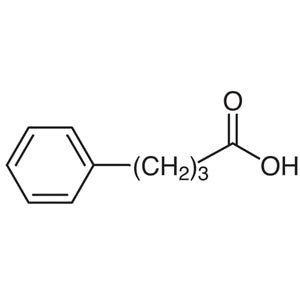
4-PhenylbutyricAcid TCI P0643
Regular price From Rp 2.094.750,00Regular price -
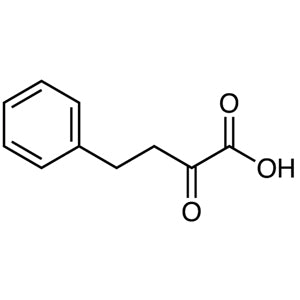
2-Oxo-4-phenylbutyricAcid TCI O0389
Regular price Rp 4.373.250,00Regular price -
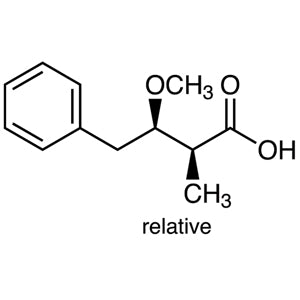
erythro-3-Methoxy-2-methyl-4-phenylbutyricAcid TCI M2415
Regular price Rp 3.949.050,00Regular price -
4-Bromo-2,2-diphenylbutyricAcid TCI B3597
Regular price From Rp 1.035.300,00Regular price -
2-Phenylbutyrophenone TCI P2269
Regular price Rp 2.121.000,00Regular price -
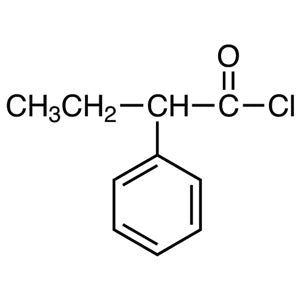
2-PhenylbutyrylChloride TCI P1665
Regular price From Rp 557.550,00Regular price -
Methyl3-Oxo-4-phenylbutyrate(mixtureofisomers) TCI M2396
Regular price From Rp 2.279.550,00Regular price -
Ethyl4-Phenylbutyrate TCI E1027
Regular price From Rp 689.850,00Regular price