

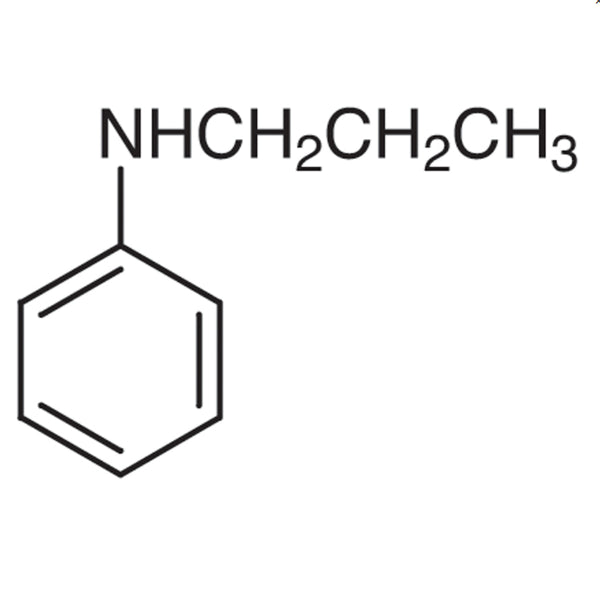
N-Propylaniline from TCI is a secondary aromatic amine. The nitrogen atom of its aniline core carries a propyl group, a straight three-carbon alkyl chain. As a non-heterocyclic building block, it provides a compact N-alkylarylamine fragment that is widely used in organic synthesis. In the laboratory, N-propylaniline is a starting material for tertiary amines, amides, substituted aromatic derivatives and dye intermediates. It is also a useful member of a homologous series for comparative studies.
Researchers choose N-propylaniline because its secondary N-H group stays reactive toward further alkylation, acylation, sulfonylation and coupling reactions. The propyl group adds a modest amount of lipophilicity without making the molecule much larger. The lone pair on nitrogen activates the benzene ring toward electrophilic substitution, so ring-substituted derivatives can be prepared fairly easily. Its chain length sits between the methyl and pentyl homologues. This makes it an important data point when researchers study how alkyl chain length affects physical properties and reactivity.
In Indonesia, N-propylaniline is relevant to university organic chemistry laboratories, research institutes and industrial R&D groups that need a reliable aromatic amine building block. Academic groups use it in synthesis coursework and research projects on amine chemistry. Development laboratories use it to build intermediate libraries and to explore dye-related chemistry. Because the material comes from TCI, a recognised reagent brand, laboratories can work with consistent, well-documented material for routine synthesis and comparative experiments.
- Synthesis of tertiary amines: the reactive secondary N-H group allows further N-alkylation, so researchers can build unsymmetrical tertiary arylamines from a compact starting fragment.
- Preparation of amides and sulfonamides: acylation or sulfonylation at nitrogen gives N-propyl-N-phenyl amides and sulfonamides that serve as intermediates in multistep organic synthesis.
- Substituted aromatic derivatives: the nitrogen lone pair activates the benzene ring toward electrophilic substitution, so ring-functionalised derivatives can be made with relative ease.
- Dye intermediate research: as an N-alkylarylamine, the compound is a practical starting point for preparing and studying intermediates used in dye chemistry.
- Homologous series studies: its propyl chain sits between the methyl and pentyl analogues, so it provides a key data point when comparing how alkyl chain length affects properties and reactivity.
| Brand | TCI (product code P0626) |
|---|---|
| CAS number | 622-80-0 |
| Molecular formula | — |
| Purity | — |
| Category | Chemistry > Building Blocks > Non-Heterocyclic Building Blocks |
| Pack sizes | as listed on the product page |
| Physical form | liquid at room temperature (confirm with the supplier documentation) |
| Storage | keep tightly closed in a cool, dry, well-ventilated place, away from light and incompatible materials |
Store N-propylaniline in its original, tightly sealed container in a cool, dry, well-ventilated area away from direct sunlight, heat sources and oxidising agents. Aromatic amines can discolour on exposure to air and light, so close the container promptly after each use. Glass or other chemically compatible containers are suitable. Handle the material in a fume hood and wear chemical-resistant gloves, safety glasses and a lab coat. Avoid skin contact and inhaling vapours. Read the Safety Data Sheet before use and dispose of waste according to local regulations.
—
Produk Terkait
-
2-Bromo-4-isopropylaniline TCI B4724
Regular price Rp 1.298.850,00Regular price -
N-Isopropylaniline TCI I0384
Regular price From Rp 1.035.300,00Regular price -
2-Isopropylaniline TCI I0318
Regular price From Rp 769.650,00Regular price -
N,N-Dipropylaniline TCI D1941
Regular price Rp 875.700,00Regular price


