

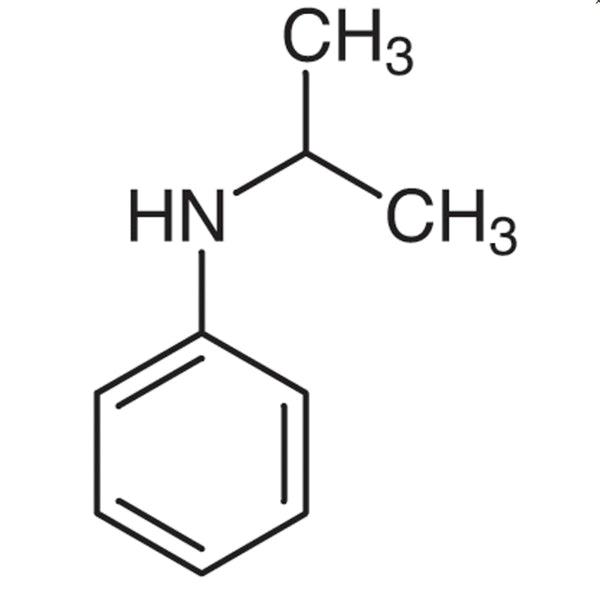
N-Isopropylaniline is a chemical compound widely used as a foundational material in various chemical reactions within laboratory settings. It belongs to the category of non-heterocyclic building blocks, making it a versatile reagent for the synthesis of complex organic compounds. This compound is commonly employed in organic chemistry laboratories for its ability to participate in multiple reaction types, including substitution, condensation, and nucleophilic reactions. Its role as a reactive intermediate is crucial in the development of aromatic and amine-based compounds, supporting a wide range of synthetic pathways.
The chemical properties of N-Isopropylaniline make it a preferred choice for laboratory applications. It exhibits moderate basicity, allowing it to react with various reagents under controlled conditions. Its solubility in organic solvents enhances its usability in different experimental setups, facilitating efficient processing and reaction optimization. The compound’s molecular structure is stable, yet it maintains high reactivity, which is essential for achieving desired chemical transformations. These characteristics make it a reliable and effective reagent for both research and industrial applications.
In Indonesian laboratories, N-Isopropylaniline is extensively used in chemical research, particularly in organic synthesis and analytical chemistry. It is a common component in studies involving the development of new compounds and the analysis of chemical structures. Its availability and reactivity make it a staple in both academic and industrial research environments, supporting a broad spectrum of scientific investigations.
- Organic synthesis where N-Isopropylaniline is used to create complex aromatic and amine-based compounds due to its reactivity and structural versatility.
- Analytical chemistry applications where the compound serves as a standard for qualitative and quantitative analysis in chromatographic and spectroscopic methods.
- Reagent in nucleophilic substitution reactions, providing a suitable electrophilic substrate for reaction mechanisms in synthetic pathways.
- Condensation reactions where it acts as a functional group donor, enabling the formation of new carbon-carbon bonds in organic molecules.
- Research in pharmaceutical development, where it is utilized as a building block for the synthesis of drug-related compounds and derivatives.
| Brand | TCI |
|---|---|
| CAS number | 768-52-5 |
| Molecular formula | — |
| Purity | — |
| Category | Chemistry > Building Blocks > Non-Heterocyclic Building Blocks |
| Pack sizes | Available in various quantities as per supplier specifications |
| Physical form | Liquid |
| Storage | Store in a cool, dry place away from moisture and direct sunlight |
N-Isopropylaniline should be stored in a cool, dry environment to maintain its chemical stability and prevent degradation. It is recommended to keep the compound in a tightly sealed container made of glass or high-density polyethylene to avoid contamination and evaporation. Due to its reactivity, it should be handled in a well-ventilated area, preferably under a fume hood, to minimize exposure. Avoid contact with strong oxidizing agents and incompatible materials. In laboratory settings, proper personal protective equipment such as gloves, goggles, and lab coats should be worn at all times when handling this compound. Regular monitoring of storage conditions ensures the compound remains safe and effective for use in chemical experiments.
—
Produk Terkait
-
2-Bromo-4-isopropylaniline TCI B4724
Regular price Rp 1.298.850,00Regular price -
2-Isopropylaniline TCI I0318
Regular price From Rp 769.650,00Regular price -
N-Propylaniline TCI P0626
Regular price Rp 2.889.600,00Regular price -
N,N-Dipropylaniline TCI D1941
Regular price Rp 875.700,00Regular price -
4-Isopropylaminodiphenylamine TCI P0327
Regular price From Rp 477.750,00Regular price -
Cyclopropylacetonitrile TCI C3877
Regular price From Rp 1.193.850,00Regular price -
Cyclopropylamine TCI C0981
Regular price From Rp 769.650,00Regular price


