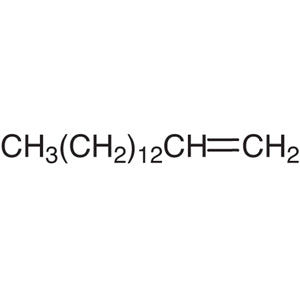
1-Pentadecene from TCI is a long-chain alkene with fifteen carbon atoms. Its double bond sits at the end of the chain, so it is classed as an alpha-olefin. As a non-heterocyclic building block, 1-pentadecene combines a long saturated hydrocarbon chain with a single reactive terminal vinyl group. In the laboratory, it is used to attach long alkyl chains to molecules or materials, as a model substrate in olefin catalysis research, and as a reference compound in hydrocarbon analysis.
1-Pentadecene is valued because it combines two properties. Its long aliphatic chain is strongly hydrophobic, and its terminal double bond is easier for catalysts to reach than the double bond in an internal alkene. The vinyl group at the end of the chain can undergo hydrosilylation, hydroformylation, epoxidation, hydroboration, metathesis and radical addition, and the regioselectivity of these reactions is fairly easy to control. Because the molecule has only one functional group, its reaction products are simpler to analyse. This makes it easier for researchers to judge how well a new catalyst or set of reaction conditions performs.
In Indonesia, 1-pentadecene is relevant to organic chemistry, catalysis, oleochemistry and materials laboratories at universities, research institutes and industrial R&D centres. Oleochemistry teams working with palm-based feedstocks can use it as a well-defined long-chain olefin model. Catalysis groups can use it to screen new catalyst systems. Materials researchers can use it to add hydrophobic alkyl chains to surfaces or polymers. Analytical laboratories can include it as a hydrocarbon reference when identifying long-chain olefins in complex samples.
Related TCI products
- Introducing long alkyl chains: the terminal vinyl group lets researchers attach a fifteen-carbon hydrophobic chain to target molecules, surfaces or polymers using well-established addition chemistry.
- Model substrate for olefin catalysis: with only one terminal double bond, it is a clean and predictable substrate for testing new hydroformylation, hydrosilylation, metathesis or hydroboration catalysts.
- Epoxidation and functionalisation studies: the reactive terminal alkene can be converted to epoxides and other derivatives, and the simple product mixtures are easy to characterise and compare.
- Radical addition research: the accessible vinyl group takes part in radical addition reactions with controllable regioselectivity, so it suits mechanistic and methodology studies of radical chemistry.
- Reference compound in hydrocarbon analysis: as a well-defined alpha-olefin, it can serve as a reference for identifying and comparing long-chain olefins during chromatographic analysis of hydrocarbon samples.
| Brand | TCI (product code P0627) |
|---|---|
| CAS number | 13360-61-7 |
| Molecular formula | — |
| Purity | — |
| Category | Chemistry > Building Blocks > Non-Heterocyclic Building Blocks |
| Pack sizes | see the available options on the product page |
| Physical form | liquid at room temperature |
| Storage | keep tightly closed in a cool, dark and well-ventilated place |
Store 1-pentadecene in its original tightly sealed container, or in a clean glass container with a chemically resistant closure. Keep it in a cool, dark and well-ventilated area away from heat, sparks, open flames and strong oxidising agents. Because the terminal double bond can slowly oxidise, keep exposure to air and light to a minimum and reseal the container promptly after use. Handle it in a fume hood or well-ventilated area, and wear safety glasses, chemical-resistant gloves and a lab coat. Avoid contact with skin and eyes, and avoid inhaling vapour. Always read the supplier's Safety Data Sheet before use, and dispose of waste according to local regulations.
—
Produk Terkait
-
1-Pentadecene[StandardMaterialforGC] TCI S0345
Regular price Rp 2.837.100,00Regular price -
1-Octadecene TCI O0008
Regular price From Rp 452.550,00Regular price -
9-Vinylanthracene TCI V0130
Regular price From Rp 2.545.200,00Regular price -
5-Vinylbicyclo[221]hept-2-ene(stabilizedwithBHT) TCI V0062
Regular price From Rp 769.650,00Regular price -
1,3,5-Undecatriene(mixtureofisomers) TCI U0062
Regular price From Rp 3.155.250,00Regular price -
1-Undecene TCI U0052
Regular price From Rp 2.068.500,00Regular price -
1-Undecene TCI U0025
Regular price Rp 1.060.500,00Regular price -
1,10-Undecadiene TCI U0024
Regular price From Rp 2.491.650,00Regular price
![13360-61-7 1-Pentadecene [Standard Material for GC] - AMI Scientific](http://amiscientific.com/cdn/shop/files/TCI2510S0345.jpg?v=1769057675&width=533)


![3048-64-4 5-Vinylbicyclo[2.2.1]hept-2-ene (stabilized with BHT) - AMI Scientific](http://amiscientific.com/cdn/shop/files/TCI2510V0062.jpg?v=1767145572&width=533)