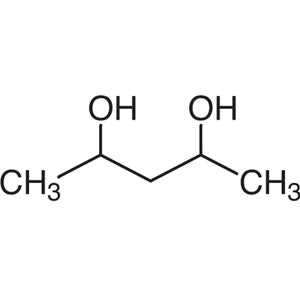
2,4-Pentanediol from TCI (product code P0670) is a simple aliphatic diol with two secondary hydroxyl groups on carbons 2 and 4 of a five-carbon chain. Chemistry laboratories know it as a versatile non-heterocyclic building block. It is used to form six-membered cyclic acetals and ketals, as a starting material for ester and ether synthesis, and as a model compound for studying reactions of 1,3-diols. Because its structure is so simple, it fits easily into many different synthetic routes.
The two hydroxyl groups are separated by a single carbon, so 2,4-Pentanediol forms stable 1,3-dioxane rings with aldehydes and ketones. Chemists often use this to protect carbonyl groups during multi-step synthesis. The molecule also has two stereogenic centres, which means it can exist as a meso form or as a pair of enantiomers. This makes it useful for stereochemistry studies, conformational analysis, and developing methods to separate diastereomers. Researchers who need a well-defined, predictable diol scaffold often choose it for these reasons.
In Indonesian laboratories, 2,4-Pentanediol is useful to organic synthesis research groups that need a reliable diol for protecting-group strategies and for building larger molecules. Polymer chemistry laboratories use it as a diol comonomer in polyester or polyurethane formulations. University and institutional research groups working on stereochemistry, conformational behaviour, or diastereomer separation also benefit from having this TCI reagent on hand for teaching, method development, and exploratory synthesis.
TCI brochures (PDF)
- Biomaterials Research Reagents 2025-02-19 · p. 20
Related TCI products
- TCI P0050 111-29-5 1,5-Pentanediol
- TCI D2619 57987-55-0 2,4-Diethyl-1,5-pentanediol (DL- and meso- mixture)
- TCI C2534 59719-74-3 1,3-Cyclopentanediol (cis- and trans- mixture)
- TCI A1531 5001-18-3 1,3-Adamantanediol
- TCI D1946 24892-49-7 2,4-Dimethyl-2,4-pentanediol
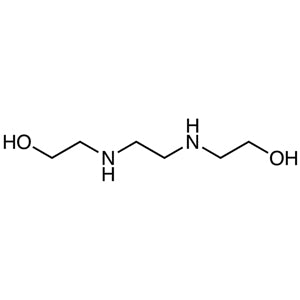
- TCI B3807 4439-20-7 N,N'-Bis(2-hydroxyethyl)ethylenediamine
- Carbonyl protection: the 1,3-diol arrangement reacts with aldehydes or ketones to form stable 1,3-dioxane rings, so it works well as a protecting group for carbonyls in multi-step synthesis.
- Cyclic acetal and ketal formation: its two secondary hydroxyl groups, one carbon apart, readily form six-membered cyclic acetals and ketals, which makes it a practical reagent for synthetic studies.
- Ester and ether synthesis: as a simple non-heterocyclic diol, it is a convenient starting material for making diesters, monoesters, and ethers in organic synthesis work.
- Stereochemistry and conformational studies: it has two stereogenic centres and exists as meso and enantiomeric forms, so it is a useful model for studying stereochemical behaviour and conformational analysis.
- Polymer chemistry research: as a diol, it can serve as a comonomer in polyester or polyurethane formulations, so polymer laboratories can use it to study how a branched diol affects the final material.
| Brand | TCI (product code P0670) |
|---|---|
| CAS number | 625-69-4 |
| Molecular formula | — |
| Purity | — |
| Category | Chemistry > Building Blocks > Non-Heterocyclic Building Blocks |
| Pack sizes | TCI standard pack sizes; please confirm the available options with AMI Scientific |
| Physical form | — |
| Storage | keep tightly closed in a cool, dry, well-ventilated place, following the TCI label and Safety Data Sheet |
- Chemical type: aliphatic 1,3-diol with two secondary hydroxyl groups and two stereogenic centres
Store 2,4-Pentanediol in its original, tightly sealed TCI container in a cool, dry, well-ventilated area, away from heat, ignition sources, and strong oxidising agents. Hydroxyl compounds can absorb moisture, so reseal the container promptly after each use to protect reagent quality. Use glass or other chemically compatible containers if you transfer the material. Handle it in a fume hood or another well-ventilated workspace, and wear standard laboratory protective equipment, including safety glasses, chemical-resistant gloves, and a lab coat. Avoid contact with skin and eyes, and do not inhale vapours. Before use, always read the product label and the TCI Safety Data Sheet for hazard information, first-aid measures, and disposal guidance, and follow your institution's chemical waste procedures.
—
Product Categories
Produk Terkait
-
1,5-Pentanediol TCI P0050
Regular price From Rp 505.050,00Regular price -
2,4-Diethyl-1,5-pentanediol(DL-andmeso-mixture) TCI D2619
Regular price From Rp 928.200,00Regular price -
1,3-Cyclopentanediol(cis-andtrans-mixture) TCI C2534
Regular price Rp 3.870.300,00Regular price -
1,3-Adamantanediol TCI A1531
Regular price From Rp 1.749.300,00Regular price -
2,4-Dimethyl-2,4-pentanediol TCI D1946
Regular price From Rp 7.605.150,00Regular price -
N,N'-Bis(2-hydroxyethyl)ethylenediamine TCI B3807
Regular price Rp 3.498.600,00Regular price -
trans-2-Butene-1,4-diol TCI B3384
Regular price From Rp 2.757.300,00Regular price -
2,2'-Bis(hydroxymethyl)diphenylEther TCI B1643
Regular price From Rp 3.763.200,00Regular price