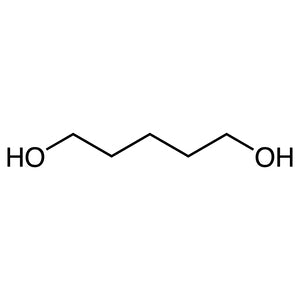
1,5-Pentanediol is a straight-chain aliphatic diol with a primary hydroxyl group at each end of a five-carbon chain. TCI supplies it as a non-heterocyclic building block for chemistry laboratories. It is important in polymer chemistry as a monomer for polyesters and polyurethanes. In organic synthesis it is a starting material for many bifunctional derivatives, such as dihalides, dialdehydes and cyclic ethers like tetrahydropyran, which forms through cyclization. This makes it a dependable everyday reagent for both synthetic and materials research.
Chemists choose this compound because its two primary hydroxyl groups are reactive and symmetrical. Both ends of the molecule can be esterified, oxidized or substituted easily, often in a single step. The five-carbon chain gives the resulting polymers a distinctive flexibility that sets them apart from polymers made with even-numbered-chain diols. The compound is also highly polar, mixes with water and many polar solvents, and is hygroscopic. Because of these properties, researchers also use it as a solvent, humectant or additive in formulation work, in addition to its role as a synthetic intermediate.
In Indonesia, 1,5-pentanediol is useful to polymer chemistry and materials laboratories developing polyesters, polyurethanes or coatings. It also serves researchers working on cosmetic and topical pharmaceutical formulations, who value its polarity, water miscibility and moisture-retaining behaviour. University organic chemistry groups and industrial R&D teams use it as a symmetrical bifunctional starting material when preparing dihalides, dialdehydes or cyclic ethers. Its versatility makes it a practical diol to keep on the reagent shelf.
- Polyester synthesis: the two symmetrical primary hydroxyl groups react readily with diacids or diesters, and the five-carbon chain gives the resulting polyester backbone distinctive flexibility.
- Polyurethane development: as a diol monomer or chain component it reacts with isocyanates at both ends, giving researchers control over the flexibility of polyurethane and coating materials.
- Preparation of bifunctional derivatives: its reactive primary hydroxyl ends can be substituted or oxidized together, making it a convenient starting material for dihalides and dialdehydes in organic synthesis.
- Cyclic ether formation: the five-carbon spacing between the hydroxyl groups allows intramolecular cyclization to tetrahydropyran, which is useful for teaching and research on ring-forming reactions.
- Formulation research: its high polarity, miscibility with water and polar solvents, and hygroscopic nature suit it as a solvent, humectant or additive in cosmetic and topical pharmaceutical formulations.
| Brand | TCI (product code P0050) |
|---|---|
| CAS number | 111-29-5 |
| Molecular formula | — |
| Purity | — |
| Category | Chemistry > Building Blocks > Non-Heterocyclic Building Blocks |
| Pack sizes | available in several TCI pack sizes; see the product listing for current options |
| Physical form | liquid at room temperature; polar, water-miscible and hygroscopic |
| Storage | keep tightly closed in a dry place, protected from moisture |
Because 1,5-pentanediol is hygroscopic, keep it in its original tightly sealed container, or in a well-closed glass or compatible chemical-resistant bottle, so it does not absorb moisture from the air. Store it in a cool, dry, well-ventilated area away from direct sunlight, heat sources and strong oxidizing agents. Follow good laboratory practice when handling it: wear safety glasses, chemical-resistant gloves and a lab coat, avoid contact with the skin and eyes, and work in a well-ventilated space. Wipe up spills promptly and dispose of waste according to local regulations. Always read the TCI Safety Data Sheet for detailed hazard and handling information before use.
—
Produk Terkait
-
2,4-Pentanediol TCI P0670
Regular price From Rp 3.100.650,00Regular price -
2,4-Diethyl-1,5-pentanediol(DL-andmeso-mixture) TCI D2619
Regular price From Rp 928.200,00Regular price -
1,3-Cyclopentanediol(cis-andtrans-mixture) TCI C2534
Regular price Rp 3.870.300,00Regular price -
1,3-Adamantanediol TCI A1531
Regular price From Rp 1.749.300,00Regular price -
2,4-Dimethyl-2,4-pentanediol TCI D1946
Regular price From Rp 7.605.150,00Regular price -
N,N'-Bis(2-hydroxyethyl)ethylenediamine TCI B3807
Regular price Rp 3.498.600,00Regular price -
trans-2-Butene-1,4-diol TCI B3384
Regular price From Rp 2.757.300,00Regular price -
2,2'-Bis(hydroxymethyl)diphenylEther TCI B1643
Regular price From Rp 3.763.200,00Regular price