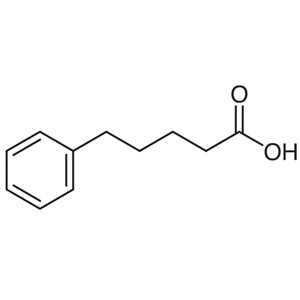
5-Phenylvaleric Acid is a chemical compound widely used as a foundational material in the synthesis of complex organic compounds. It plays a crucial role in laboratory settings by serving as a building block for the creation of more intricate molecular structures. This compound is essential in organic chemistry research, enabling scientists to develop new substances, including pharmaceuticals, industrial chemicals, and synthetic materials. Its versatility makes it a key component in various chemical reactions, supporting innovation in both academic and industrial laboratories.
The compound is valued for its stable molecular structure and moderate reactivity, which facilitate efficient chemical reactions under controlled conditions. Its chemical properties can be tailored through the use of different catalysts, solvents, and temperature settings, making it adaptable to a wide range of experimental needs. This flexibility allows researchers to manipulate its behavior in various synthetic pathways, enhancing its utility in laboratory applications. Additionally, its predictable chemical behavior ensures consistency in experimental outcomes, which is vital for scientific research.
In Indonesian laboratories, 5-Phenylvaleric Acid is extensively used in organic chemistry research, particularly in academic institutions and research centers. It is a fundamental component in the development of new compounds, contributing to advancements in pharmaceutical and industrial chemistry. Its widespread application highlights its importance in the scientific community, supporting both educational and research initiatives in Indonesia.
- Organic synthesis of aromatic compounds due to its ability to form stable intermediates in reaction pathways.
- Development of pharmaceuticals as a precursor in the synthesis of drug molecules with complex structures.
- Industrial chemical production as a building block for the creation of various synthetic materials.
- Research in hydrocarbon chain formation due to its structural compatibility with carbon-based molecules.
- Educational use in teaching organic chemistry principles through hands-on experimentation and synthesis techniques.
| Brand | TCI |
|---|---|
| CAS number | 2270-20-4 |
| Molecular formula | — |
| Purity | — |
| Category | Chemistry > Building Blocks > Non-Heterocyclic Building Blocks |
| Pack sizes | Available in various quantities as per supplier specifications |
| Physical form | Solid or liquid, depending on the specific product variant |
| Storage | Store in a cool, dry place away from direct sunlight and moisture |
5-Phenylvaleric Acid should be stored in a cool, dry environment to maintain its chemical stability. It is recommended to keep it in airtight containers to prevent exposure to moisture and air, which could affect its reactivity. The compound should be stored away from heat sources and direct sunlight to avoid degradation. In laboratory settings, it is important to handle the substance with appropriate personal protective equipment, such as gloves and safety goggles, to ensure safety. Proper ventilation should be maintained when working with this compound to minimize inhalation risks. Regular monitoring of storage conditions is essential to maintain its quality and effectiveness for research purposes.
—
Produk Terkait
-
Methyl5-Phenylvalerate TCI P1324
Regular price From Rp 3.843.000,00Regular price -
4-MethylvalericAcid TCI M0750
Regular price Rp 1.565.550,00Regular price -
2-MethylvalericAcid TCI M0610
Regular price From Rp 689.850,00Regular price -
3-MethylvalericAcid TCI M0569
Regular price Rp 1.803.900,00Regular price -
3-Hydroxy-3-methylvalericAcid TCI H0626
Regular price From Rp 2.545.200,00Regular price -
2,2-DimethylvalericAcid TCI D2320
Regular price From Rp 4.293.450,00Regular price