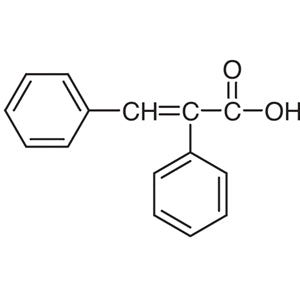
Alpha-Phenylcinnamic Acid (TCI P1300), with CAS number 91-48-5, is a versatile organic compound widely used in laboratory settings as a building block for various chemical syntheses. It serves as a key intermediate in the production of aromatic and heterocyclic compounds, playing a crucial role in substitution and catalytic reactions. Its presence in synthetic pathways allows chemists to create complex molecular structures, including pharmaceuticals, dyes, and industrial chemicals. This compound is particularly valued for its stability and reactivity, making it an essential tool in organic chemistry research.
The compound's non-polar nature enables it to dissolve in organic solvents such as ethyl acetate and chloroform, which is advantageous for controlling reaction rates and selectivity in synthetic processes. Its chemical stability under standard laboratory conditions further enhances its utility, allowing for consistent results in repeated experiments. These properties make it a preferred choice for researchers aiming to achieve precise and reproducible outcomes in their synthetic work.
In Indonesian laboratories, Alpha-Phenylcinnamic Acid is commonly used in organic chemistry research, especially in academic institutions and research centers. It is frequently employed in projects focused on the development of new compounds for medical and industrial applications. Its availability and reliability make it a staple in the chemical supply chain, supporting both educational and applied research efforts.
Related TCI products
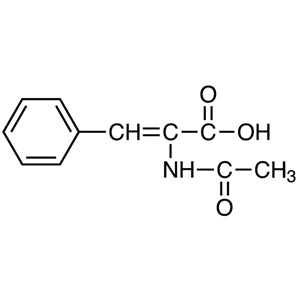
- TCI A0014 5469-45-4 alpha-Acetamidocinnamic Acid
- TCI T3420 819050-88-9 alpha,alpha,alpha',alpha'-Tetramethyl-1,3-benzenedipropionic Acid
- TCI T3122 90-17-5 alpha-(Trichloromethyl)benzyl Acetate
- TCI B2950 29270-30-2 alpha-Bromo-2-chlorophenylacetic Acid
- TCI B1253 5443-49-2 alpha-Bromocinnamaldehyde
- TCI B0984 4870-65-9 alpha-Bromophenylacetic Acid
- Aromatic Compound Synthesis: Alpha-Phenylcinnamic Acid is ideal for synthesizing aromatic compounds due to its stable molecular structure and reactivity, enabling the creation of complex aromatic derivatives.
- Heterocyclic Compound Development: Its role in heterocyclic synthesis makes it suitable for producing compounds with ring structures, essential in pharmaceutical and material science research.
- Catalytic Reaction Studies: The compound’s reactivity supports catalytic processes, making it useful in studies involving transition metal catalysts and reaction mechanisms.
- Pharmaceutical Research: Its use in the synthesis of drug-related compounds makes it a valuable material for medicinal chemistry and drug development projects.
- Industrial Chemical Production: Its non-polar nature and solubility in organic solvents make it suitable for the production of industrial chemicals and dyes.
| Brand | TCI |
|---|---|
| CAS number | 91-48-5 |
| Molecular formula | — |
| Purity | — |
| Category | Chemistry > Building Blocks > Non-Heterocyclic Building Blocks |
| Pack sizes | Available in various quantities as per standard laboratory supply |
| Physical form | Solid |
| Storage | Store in a cool, dry place away from light and moisture |
Alpha-Phenylcinnamic Acid should be stored in a cool, dry environment, away from direct light and moisture to maintain its chemical stability. It is recommended to use airtight containers made of glass or polyethylene to prevent contamination and degradation. Due to its non-polar nature, it is important to handle it with care during transfer and mixing to avoid exposure to incompatible substances. In laboratory settings, proper ventilation and personal protective equipment should be used when handling this compound to ensure safety and compliance with standard chemical handling protocols. Regular inspection of storage conditions is advised to ensure the integrity of the material remains intact for experimental use.
—
Produk Terkait
-
alpha-AcetamidocinnamicAcid TCI A0014
Regular price Rp 1.087.800,00Regular price -
alpha,alpha,alpha',alpha'-Tetramethyl-1,3-benzenedipropionicAcid TCI T3420
Regular price Rp 3.472.350,00Regular price -
alpha-(Trichloromethyl)benzylAcetate TCI T3122
Regular price From Rp 795.900,00Regular price -
alpha-Bromo-2-chlorophenylaceticAcid TCI B2950
Regular price Rp 1.988.700,00Regular price -
alpha-Bromocinnamaldehyde TCI B1253
Regular price Rp 980.700,00Regular price -
alpha-BromophenylaceticAcid TCI B0984
Regular price From Rp 795.900,00Regular price -
DL-alpha-Amino-epsilon-caprolactamHydrochloride TCI A2331
Regular price Rp 3.446.100,00Regular price -
DL-alpha-Amino-epsilon-caprolactam TCI A1003
Regular price From Rp 1.803.900,00Regular price