

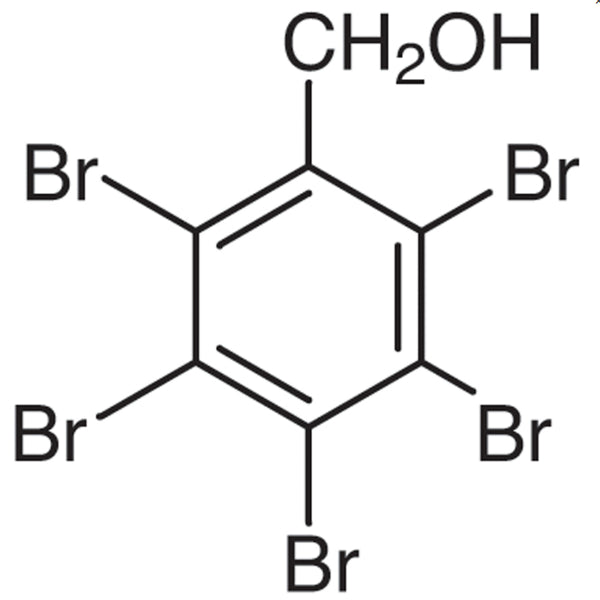
Pentabromobenzyl Alcohol from TCI is a benzyl alcohol derivative in which all five hydrogen positions on the benzene ring have been replaced by bromine atoms. The result is a very bromine-rich aromatic molecule that carries a single reactive hydroxymethyl group. In the laboratory, it serves as a building block for attaching the pentabromobenzyl unit to other molecules. It is used mainly in research on bromine-based flame retardants and in polymer chemistry, where chemists need a dense, halogen-rich aromatic fragment that can be built into larger structures.
The main appeal of this compound is that it combines a high bromine content with an alcohol group that is easy to modify. The hydroxyl group can be esterified, for example into polymerizable acrylates or methacrylates. It can also be etherified, or converted into leaving groups such as halides and sulfonates. This lets researchers bond the pentabromobenzyl unit covalently into polymer chains, an approach that generally helps reduce additive migration out of the finished material. The fully substituted ring also gives a heavy, relatively rigid molecule, which is useful when designing materials with specific structural requirements.
In Indonesia, Pentabromobenzyl Alcohol is relevant to research laboratories working in polymer science, materials science, and environmental chemistry. Materials researchers can use it to synthesize brominated monomers and reactive flame-retardant intermediates for testing in new polymer formulations. University chemistry departments may use it in synthetic coursework and research on functional-group transformations of halogenated aromatics. Environmental chemistry groups may also find it useful as a reference brominated aromatic compound when studying the behavior of bromine-containing substances.
TCI brochures (PDF)
- Polymer Additives 2026-04-16 · p. 5
- Flame retardant research: its very high bromine content makes it a useful starting point for building brominated flame-retardant structures and testing how they perform in materials.
- Synthesis of polymerizable monomers: the hydroxyl group can be esterified into acrylates or methacrylates, so the pentabromobenzyl unit can be built directly into polymer chains.
- Reactive (non-migrating) additive design: bonding the brominated unit covalently into a polymer backbone generally helps reduce additive migration compared with simple physical blending.
- Functional-group transformation studies: the alcohol can be converted into ethers, halides, or sulfonates, which makes it a flexible intermediate for organic synthesis and for teaching.
- Environmental and analytical chemistry: as a well-defined brominated aromatic compound, it can serve as a reference material in studies of how bromine-containing substances behave.
| Brand | TCI (product code P1457) |
|---|---|
| CAS number | 79415-41-1 |
| Molecular formula | — |
| Purity | refer to the TCI certificate of analysis and product documentation |
| Category | Chemistry > Building Blocks > Non-Heterocyclic Building Blocks |
| Pack sizes | as offered by TCI for product code P1457; please confirm with AMI Scientific when ordering |
| Physical form | — |
| Storage | keep in a tightly closed original container in a cool, dry place, following the TCI Safety Data Sheet |
Store Pentabromobenzyl Alcohol in its original tightly sealed container, in a cool, dry, well-ventilated area away from direct sunlight, heat sources, and incompatible materials such as strong oxidizing agents. Label containers clearly and keep them in a designated chemical storage cabinet. When handling, wear standard laboratory protective equipment, including gloves, safety glasses, and a lab coat. Work in a fume hood to avoid breathing in dust or vapors. Avoid contact with skin and eyes, and wash hands thoroughly after use. Always check the TCI Safety Data Sheet for specific hazard information, and dispose of waste as halogenated chemical waste according to local regulations and your institution's procedures.
—
Produk Terkait
-
4-BromobenzylAlcohol TCI B1372
Regular price From Rp 1.590.750,00Regular priceRp 1.111.950,00Sale price From Rp 1.590.750,00 -
2-BromobenzylAlcohol TCI B1294
Regular price From Rp 1.829.100,00Regular priceRp 1.278.900,00Sale price From Rp 1.829.100,00 -
3-BromobenzylAlcohol TCI B1287
Regular price From Rp 980.700,00Regular priceRp 685.650,00Sale price From Rp 980.700,00 -
PentabromobenzylAcrylate TCI P1877
Regular price From Rp 1.908.900,00Regular priceRp 1.334.550,00Sale price From Rp 1.908.900,00 -
2,3,5,6-Tetrabromo-p-cresol TCI T1430
Regular price From Rp 2.147.250,00Regular priceRp 1.501.500,00Sale price From Rp 2.147.250,00 -
4-IodobenzylAlcohol TCI I0810
Regular price From Rp 2.889.600,00Regular priceRp 2.020.200,00Sale price From Rp 2.889.600,00 -
2-IodobenzylAlcohol TCI I0858
Regular price Rp 1.035.300,00Regular priceRp 723.450,00Sale price Rp 1.035.300,00 -
3-IodobenzylAlcohol TCI I0866
Regular price From Rp 1.510.950,00Regular priceRp 1.056.300,00Sale price From Rp 1.510.950,00


