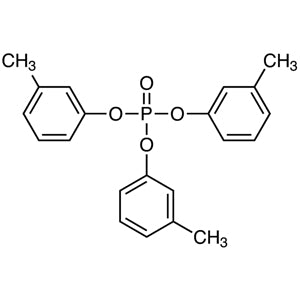
Tri-m-cresyl Phosphate from TCI is an organophosphate ester: a phosphoric acid molecule in which all three hydroxyl groups are bonded to m-cresyl (3-methylphenyl) groups. In industry, triaryl phosphates as a class have long been used as flame retardants and plasticizers. In energy materials research, this compound is drawing interest as an electrolyte additive for lithium-ion batteries. In the laboratory, it serves as a test component for studying how phosphorus-based additives affect the safety, stability, and performance of battery cells.
The main reason researchers choose this material is its phosphorus content. Organophosphate compounds are known to suppress the chain reactions that drive combustion, so they may help make the organic electrolytes commonly used in batteries less flammable. Its three methyl-substituted aromatic rings make the molecule relatively large and much less volatile than light carbonate solvents. The meta position of the methyl groups sets it apart from the ortho and para isomers. This difference matters in structure–property studies, because toxicological profiles and physical behaviour can vary between isomers.
In Indonesia, research on batteries and electric vehicles continues to grow in universities, research institutes, and industrial development laboratories. In these settings, Tri-m-cresyl Phosphate is typically used in electrolyte formulation studies, flammability comparisons, and electrochemical characterisation of experimental cells. Researchers looking at locally relevant energy storage solutions can use this TCI reagent to explore phosphorus-based additive strategies alongside conventional electrolyte systems and other candidate additives.
- Lithium-ion electrolyte additive studies: its phosphorus-based organophosphate structure makes it a good candidate for testing how additives change electrolyte behaviour and overall battery cell performance.
- Flammability reduction research: organophosphates are known to suppress combustion chain reactions, so this compound suits experiments aimed at lowering the flammability of organic battery electrolytes.
- Battery cell safety and stability evaluation: researchers can add it to test electrolytes to see how a phosphorus additive affects cell safety, stability, and electrochemical performance over time.
- Structure–property studies of cresyl phosphate isomers: its meta-substituted methyl groups set it apart from the ortho and para isomers, which makes it useful for comparing physical and toxicological behaviour.
- Flame retardant and plasticizer reference work: triaryl phosphates have long been used industrially in these roles, so this compound works as a reference material for related materials science investigations.
| Brand | TCI (product code P1472) |
|---|---|
| CAS number | 563-04-2 |
| Molecular formula | — |
| Purity | — |
| Category | Materials Science > Battery Materials > Battery Additives |
| Pack sizes | Available in the pack sizes TCI offers for this product |
| Physical form | — |
| Storage | Follow the conditions on the TCI label and Safety Data Sheet |
- Chemical class: Organophosphate ester (triaryl phosphate, m-cresyl substituted)
Store Tri-m-cresyl Phosphate in its original tightly closed container, in a cool, dry, well-ventilated area away from direct sunlight, heat sources, and incompatible materials such as strong oxidizing agents. Glass or chemically resistant containers with secure caps are suitable for keeping working portions. Because toxicological profiles can differ between cresyl phosphate isomers, handle this compound with care. Wear suitable gloves, safety glasses, and a laboratory coat, and work in a fume hood or a well-ventilated space. Avoid skin contact, inhaling vapours, and swallowing. Always read the TCI Safety Data Sheet before use, and dispose of waste according to local regulations and your institution's procedures.
—
Produk Terkait
-
TCI B5774 5,10-Bis(4,4,5,5-tetramethyl-1,3,2-dioxaborolan-2-yl)naphtho[1,2-c:5,6-c']bis([1,2,5]oxadiazole)
Regular price Rp 10.255.350,00Regular price -
Dihydroiodide TCI B6569
Regular price From Rp 1.936.200,00Regular price -
Trifluoromethanesulfonate TCI B7003
Regular price From Rp 1.936.200,00Regular price
![5,10-Bis(4,4,5,5-tetramethyl-1,3,2-dioxaborolan-2-yl)naphtho[1,2-c:5,6-c']bis([1,2,5]oxadiazole) - TCI B5774 - AMI Scientific](http://amiscientific.com/cdn/shop/files/TCI2510B5774.jpg?v=1769180228&width=533)