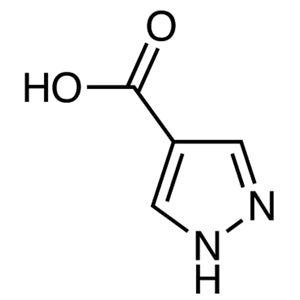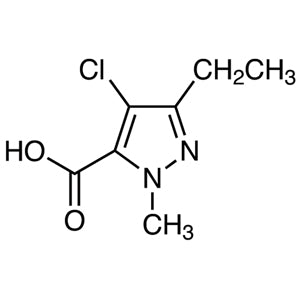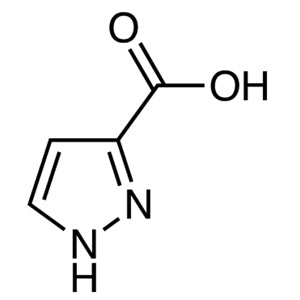
Pyrazole-3-carboxylic Acid is a chemical compound widely used as a building block in the synthesis of heterocyclic compounds. This material plays a crucial role in laboratory settings where the creation of complex molecules with specific biological activities is required. Its core structure, based on the pyrazole ring, contains two nitrogen atoms, making it a versatile starting point for chemical modifications. Due to its structural stability and controlled reactivity, it is a key component in various organic reactions, enabling the development of pharmaceuticals and other specialized chemical products.
The compound's chemical properties allow it to participate in substitution and condensation reactions with a variety of functional groups. This reactivity, combined with its ability to form stable intermediates, makes it a preferred choice for researchers aiming to design new molecules. Its compatibility with different chemical environments and its predictable behavior in synthetic pathways contribute to its popularity in both academic and industrial research.
In Indonesian laboratories, Pyrazole-3-carboxylic Acid is commonly used in scientific research across universities and research institutions. It is a fundamental reagent in projects related to drug development, chemical synthesis, and material science. Its availability and reliability make it an essential tool for scientists working on innovative chemical solutions and biological applications.
Related TCI products
- TCI P1978 37718-11-9 Pyrazole-4-carboxylic Acid
- TCI D5759 5744-59-2 1,5-Dimethyl-1H-pyrazole-3-carboxylic Acid
- TCI D5468 5744-56-9 1,3-Dimethyl-1H-pyrazole-5-carboxylic Acid
- TCI C3644 127892-62-0 4-Chloro-3-ethyl-1-methyl-1H-pyrazole-5-carboxylic Acid
- TCI T3668 1040377-03-4 1-(Tetrahydro-2H-pyran-4-yl)-4-(4,4,5,5-tetramethyl-1,3,2-dioxaborolan-2-yl)-1H-pyrazole
- TCI T3408 449758-17-2 1-(Tetrahydro-2H-pyran-2-yl)-1H-pyrazole
- Drug development research utilizes Pyrazole-3-carboxylic Acid as a core structure for synthesizing bioactive compounds due to its reactivity and structural versatility.
- Organic chemistry experiments benefit from its ability to undergo substitution and condensation reactions, making it ideal for creating complex molecular frameworks.
- Pharmaceutical research leverages its role in the synthesis of heterocyclic compounds with potential therapeutic applications.
- Academic laboratories use it as a foundational reagent in teaching and research projects involving chemical synthesis and molecular design.
- Material science studies incorporate it for the development of new chemical compounds with specific functional properties.
| Brand | TCI |
|---|---|
| CAS number | 1621-91-6 |
| Molecular formula | — |
| Purity | — |
| Category | Chemistry > Building Blocks > Heterocyclic Building Blocks |
| Pack sizes | Available in standard laboratory quantities |
| Physical form | Solid powder |
| Storage | Store in a cool, dry place away from moisture and direct sunlight |
Pyrazole-3-carboxylic Acid should be stored in a cool, dry environment to maintain its chemical integrity. It is recommended to keep it in a sealed container to prevent exposure to moisture, which could affect its stability. Due to its solid form, it is best stored in airtight containers made of glass or polyethylene to avoid any chemical interactions. Laboratory personnel should handle the compound with care, using appropriate personal protective equipment such as gloves and safety goggles. It is important to ensure that storage areas are well-ventilated to minimize any potential risks associated with its handling. Proper labeling of storage containers is also essential for safe and efficient laboratory management.
—
Produk Terkait
-
Pyrazole-4-carboxylicAcid TCI P1978
Regular price From Rp 610.050,00Regular price -
1,5-Dimethyl-1H-pyrazole-3-carboxylicAcid TCI D5759
Regular price From Rp 2.041.200,00Regular price -
1,3-Dimethyl-1H-pyrazole-5-carboxylicAcid TCI D5468
Regular price From Rp 2.518.950,00Regular price -
4-Chloro-3-ethyl-1-methyl-1H-pyrazole-5-carboxylicAcid TCI C3644
Regular price From Rp 795.900,00Regular price -
1-(Tetrahydro-2H-pyran-4-yl)-4-(4,4,5,5-tetramethyl-1,3,2-dioxaborolan-2-yl)-1H-pyrazole TCI T3668
Regular price From Rp 769.650,00Regular price -
1-(Tetrahydro-2H-pyran-2-yl)-1H-pyrazole TCI T3408
Regular price From Rp 743.400,00Regular price -
1-Benzyl-1H-pyrazole-4-carboxaldehyde TCI B5404
Regular price From Rp 1.273.650,00Regular price -
5-Amino-1-(p-tolyl)pyrazole-4-carbonitrile TCI A3039
Regular price Rp 3.312.750,00Regular price