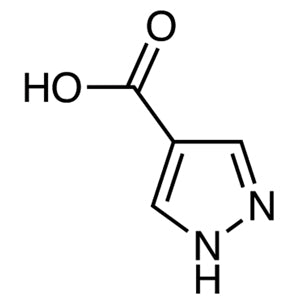
TCI P1978 Pyrazole-4-carboxylic Acid is a simple heterocyclic compound built on a five-membered pyrazole ring with two adjacent nitrogen atoms and a carboxylic acid group at the 4-position. In organic chemistry and medicinal chemistry laboratories, it serves as a building block for assembling more complex molecules. The pyrazole ring is a motif that appears often in pharmaceutical compounds, agrochemicals, and functional materials, so synthetic researchers looking for a dependable heterocyclic starting point often choose this material.
The main advantage of Pyrazole-4-carboxylic Acid is that it has two reactive sites. The carboxylic acid group can be converted into amides, esters, or other acyl derivatives through standard coupling reactions. The NH atom on the pyrazole ring can be alkylated or arylated, which lets researchers build structural diversity from one core. Because the molecule combines pyrazole nitrogen atoms with a carboxylate group, it is also an attractive ligand for metal-organic frameworks (MOFs) and coordination polymers. Its compact, symmetrical structure makes synthetic routes easier to design and plan.
In Indonesia, medicinal chemistry research, bioactive compound synthesis, and porous materials development are growing at many universities and research institutions. Pyrazole-4-carboxylic Acid fits well in these settings, whether it is used to prepare compound libraries for biological screening, to make intermediates for final-year and postgraduate research projects, or to study new coordination materials. Supplied under the TCI brand, it gives Indonesian laboratories a recognized source of a versatile heterocyclic building block for routine and exploratory synthesis.
Related TCI products
- TCI P1862 1621-91-6 Pyrazole-3-carboxylic Acid
- TCI D5759 5744-59-2 1,5-Dimethyl-1H-pyrazole-3-carboxylic Acid
- TCI D5468 5744-56-9 1,3-Dimethyl-1H-pyrazole-5-carboxylic Acid
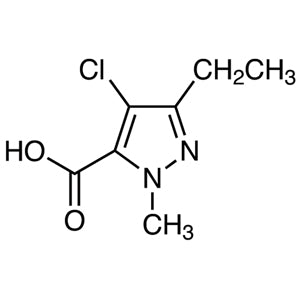
- TCI C3644 127892-62-0 4-Chloro-3-ethyl-1-methyl-1H-pyrazole-5-carboxylic Acid
- TCI T3668 1040377-03-4 1-(Tetrahydro-2H-pyran-4-yl)-4-(4,4,5,5-tetramethyl-1,3,2-dioxaborolan-2-yl)-1H-pyrazole
- TCI T3408 449758-17-2 1-(Tetrahydro-2H-pyran-2-yl)-1H-pyrazole
- Amide library synthesis: the carboxylic acid group couples readily with a wide range of amines using standard coupling reagents, so it is well suited to making diverse amide series for structure-activity studies.
- Medicinal chemistry scaffold development: the pyrazole ring is a common motif in drug-like molecules, so this compound is a sensible starting core for designing and optimizing new bioactive candidates.
- N-functionalization studies: the free NH on the pyrazole ring can be alkylated or arylated, which lets researchers add substituents and widen structural diversity from a single building block.
- Metal-organic framework and coordination polymer research: the pyrazole nitrogen atoms and the carboxylate group can both coordinate to metals, making this compound a useful bridging ligand for porous materials work.
- Ester and acyl derivative preparation: the carboxylic acid converts easily into esters and other acyl derivatives, providing useful intermediates for multistep synthetic routes in academic and industrial laboratories.
| Brand | TCI (product code P1978) |
|---|---|
| CAS number | 37718-11-9 |
| Molecular formula | — |
| Purity | — |
| Category | Chemistry > Building Blocks > Heterocyclic Building Blocks |
| Pack sizes | offered in standard TCI pack sizes; please ask AMI Scientific which sizes are available |
| Physical form | see the TCI product documentation and Certificate of Analysis |
| Storage | keep tightly closed in a cool, dry place, following the manufacturer's label and Safety Data Sheet |
Store Pyrazole-4-carboxylic Acid in its original, tightly sealed container in a cool, dry, well-ventilated area, away from direct sunlight, heat sources, moisture, and incompatible substances such as strong oxidizing agents and strong bases. After each use, reseal the container right away to limit moisture uptake and contamination. Handle the material in a fume hood or a well-ventilated workspace, and wear standard personal protective equipment, including safety glasses, chemical-resistant gloves, and a laboratory coat. Do not inhale dust, and avoid contact with skin and eyes. Label every container clearly, and always read the Safety Data Sheet from TCI before use for specific hazard, first-aid, and disposal information.
—
Produk Terkait
-
Pyrazole-3-carboxylicAcid TCI P1862
Regular price Rp 557.550,00Regular priceRp 405.300,00Sale price Rp 557.550,00 -
1,5-Dimethyl-1H-pyrazole-3-carboxylicAcid TCI D5759
Regular price From Rp 2.041.200,00Regular price -
1,3-Dimethyl-1H-pyrazole-5-carboxylicAcid TCI D5468
Regular price From Rp 2.518.950,00Regular price -
4-Chloro-3-ethyl-1-methyl-1H-pyrazole-5-carboxylicAcid TCI C3644
Regular price From Rp 795.900,00Regular price -
1-(Tetrahydro-2H-pyran-4-yl)-4-(4,4,5,5-tetramethyl-1,3,2-dioxaborolan-2-yl)-1H-pyrazole TCI T3668
Regular price Rp 822.150,00Regular priceRp 590.100,00Sale price Rp 822.150,00 -
1-(Tetrahydro-2H-pyran-2-yl)-1H-pyrazole TCI T3408
Regular price Rp 795.900,00Regular priceRp 572.250,00Sale price Rp 795.900,00 -
1-Benzyl-1H-pyrazole-4-carboxaldehyde TCI B5404
Regular price From Rp 1.273.650,00Regular price -
5-Amino-1-(p-tolyl)pyrazole-4-carbonitrile TCI A3039
Regular price Rp 3.312.750,00Regular price