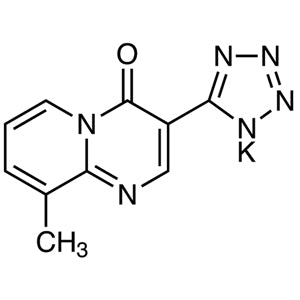
TCI P1995 Pemirolast Potassium Hydrate is the hydrated potassium salt of pemirolast. Pemirolast is an antiallergic compound built on a pyridopyrimidinone skeleton that carries a tetrazole group. It is known as a mast cell stabilizer: it inhibits the release of allergic mediators such as histamine from mast cells. In the laboratory, this TCI reagent is a pharmaceutical research reagent for experimental use. It is used in allergy and immunology studies and in formulation development work, where researchers need a well-characterized reference compound.
Researchers choose pemirolast because it works differently from conventional antihistamines. It does not block histamine receptors. Instead, it prevents mast cell degranulation from the start, which stops mediator release before it can begin. This makes pemirolast a useful comparator when evaluating new antiallergic candidates, because it lets researchers tell mediator-release inhibition apart from receptor antagonism. The potassium salt form is generally chosen because it improves the compound's solubility in water, which matches its use in eye drop preparations. The 1 g pack is enough for a series of in vitro assays and analytical method development work.
In Indonesia, this reagent is relevant to pharmacology and immunology laboratories in faculties of pharmacy and medicine, and to research teams developing ophthalmic formulations. Researchers testing the antiallergic potential of local medicinal plants can use pemirolast as a reference compound to benchmark plant extracts against a known mast cell stabilizer. It also fits academic research projects and postgraduate theses that study allergic response mechanisms, as well as laboratories building analytical methods for antiallergic active ingredients.
TCI brochures (PDF)
- Immune System, Inflammation, Allergy Research Reagents 2025-05-26 · p. 4
- Pharmaceutical Ingredients for Research and Experimental Use 2026-03-09 · p. 36
- Mast cell stabilization assays: pemirolast inhibits the release of histamine and other mediators from mast cells, so it is a suitable reference for in vitro degranulation studies.
- Screening of new antiallergic candidates: because it acts by a different mechanism from receptor-blocking antihistamines, pemirolast is a useful comparator for classifying how new compounds work.
- Evaluation of local medicinal plant extracts: researchers studying Indonesian plants for antiallergic activity can use pemirolast as a known positive control against which extract activity is benchmarked.
- Ophthalmic formulation development: the water-soluble potassium salt form matches the compound's use in eye drop preparations, which supports formulation research on ophthalmic dosage forms.
- Analytical method development: the 1 g pack provides enough material to develop and test analytical methods for identifying and measuring this antiallergic active ingredient in research samples.
| Brand | TCI (product code P1995) |
|---|---|
| CAS number | — |
| Molecular formula | — |
| Purity | — |
| Category | Life Science > Biochemicals and Reagents > Pharmaceutical Research Reagents (for Experimental Use) |
| Pack sizes | 1 g |
| Physical form | refer to the manufacturer's certificate of analysis and product label |
| Storage | follow the storage conditions stated on the TCI label and safety data sheet |
- Product name: Pemirolast Potassium Hydrate (hydrated potassium salt of pemirolast)
Store Pemirolast Potassium Hydrate in its original, tightly closed container, protected from moisture, heat, and direct light, and follow the storage conditions printed on the TCI label. Because this is a hydrated salt, keep the container sealed between uses to limit changes in water content. Handle the reagent in a clean, well-ventilated area using gloves, a laboratory coat, and eye protection, and avoid creating or breathing in dust. Use clean, dry spatulas and glassware to prevent contamination. This product is intended for experimental research use only and must not be used for human or veterinary treatment. Consult the safety data sheet before use and dispose of waste according to local laboratory regulations.
—
Product Categories
- Biochemicals and ReagentsPharmaceutical Research Reagents (for Experimental Use)Anti-allergic Ingredients (for Research and Experimental Use)
- Cell BiologyImmune System, Inflammation, Allergy ResearchChemical Mediator Release Inhibitors
- Pharmaceutical Development and Drug Discovery ResearchPharmaceutical Research Reagents (for Experimental Use)Anti-allergic Ingredients (for Research and Experimental Use)
Produk Terkait
-
PemirolastPotassium TCI P2547
Regular price From Rp 3.710.700,00Regular priceRp 2.610.300,00Sale price From Rp 3.710.700,00 -
Ibudilast TCI I0740
Regular price From Rp 1.961.400,00Regular priceRp 1.387.050,00Sale price From Rp 1.961.400,00 -
Tranilast TCI T2935
Regular price From Rp 3.285.450,00Regular priceRp 2.313.150,00Sale price From Rp 3.285.450,00 -
Amlexanox TCI A2401
Regular price From Rp 2.227.050,00Regular priceRp 1.572.900,00Sale price From Rp 2.227.050,00 -
CromolynDisodiumSalt TCI C2521
Regular price From Rp 3.419.850,00Regular priceRp 2.406.600,00Sale price From Rp 3.419.850,00 -
Zafirlukast TCI Z0029
Regular price Rp 5.194.350,00Regular priceRp 3.647.700,00Sale price Rp 5.194.350,00 -
Bilastine TCI B5392
Regular price From Rp 6.811.350,00Regular priceRp 4.778.550,00Sale price From Rp 6.811.350,00 -
Alcaftadine TCI A3237
Regular price Rp 3.949.050,00Regular priceRp 2.777.250,00Sale price Rp 3.949.050,00