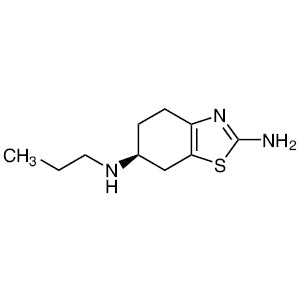
Pramipexole Dihydrochloride Monohydrate is a chemical compound widely used in pharmacological and biochemical research. It serves as a key reagent in experimental studies, particularly in the development of pharmaceuticals and the investigation of pharmacological effects. This compound is a selective agonist for dopamine D2 receptors, making it essential for understanding the mechanisms of drugs related to the dopaminergic system. Its role in laboratory settings is critical for analyzing the behavior of neuroactive substances and their impact on cellular processes.
The compound's chemical stability and solubility in organic solvents such as ethyl acetate and acetone make it a preferred choice for researchers. Its resistance to degradation ensures reliable results over extended periods, supporting long-term experiments and repeated testing. Additionally, its high purity level guarantees accurate and reproducible outcomes, which are vital for scientific validation. These properties make it a trusted material in both academic and industrial research environments.
In Indonesian laboratories, Pramipexole Dihydrochloride Monohydrate is commonly used in studies related to Parkinson’s therapy, motor disorders, and other neurological conditions. Its application extends to pharmacological research aimed at developing new treatments and understanding disease mechanisms. Researchers rely on its consistent performance to generate credible data, contributing to advancements in medical science and drug discovery.
TCI brochures (PDF)
- Pharmaceutical Ingredients for Research and Experimental Use 2026-03-09 · p. 29
- Parkinson’s Disease Research – Pramipexole Dihydrochloride Monohydrate is ideal for studying the effects of dopamine agonists in Parkinson’s therapy, helping to evaluate treatment efficacy and mechanisms of action.
- Neurological Disorder Studies – Its use in investigating motor and neurological conditions allows researchers to explore the role of dopamine receptors in disease progression and potential therapeutic interventions.
- Pharmacological Mechanism Analysis – The compound supports experiments on how drugs interact with the dopaminergic system, providing insights into receptor activation and signal transduction pathways.
- Drug Development Testing – It is frequently used in the early stages of pharmaceutical research to screen for compounds that may modulate dopamine receptor activity.
- Toxicity and Bioavailability Studies – Its stability and solubility make it suitable for assessing the safety and absorption profiles of new drug candidates in experimental models.
| Brand | TCI |
|---|---|
| CAS number | 191217-81-9 |
| Molecular formula | — |
| Purity | — |
| Category | Life Science > Biochemicals and Reagents > Pharmaceutical Research Reagents |
| Pack sizes | Available in various quantities as per supplier specifications |
| Physical form | Solid, crystalline powder |
| Storage | Store in a cool, dry place away from moisture and light |
Pramipexole Dihydrochloride Monohydrate should be stored in a cool, dry environment to maintain its chemical stability and prevent degradation. It is recommended to keep the compound in airtight containers to minimize exposure to moisture and air, which can affect its integrity. Due to its solubility in organic solvents, it should be handled in a well-ventilated area to avoid inhalation of vapors. Researchers should wear appropriate personal protective equipment, such as gloves and safety goggles, when handling the compound. It is important to ensure that the storage area is secure and inaccessible to unauthorized personnel to prevent accidental exposure. Proper labeling of containers is also essential to ensure safe handling and use in laboratory settings.
—
Product Categories
- Biochemicals and ReagentsPharmaceutical Research Reagents (for Experimental Use)Neurotransmitter Agent Ingredients (for Research and Experimental Use)
- Biochemicals and Reagents
- Pharmaceutical Development and Drug Discovery ResearchPharmaceutical Research Reagents (for Experimental Use)Neurotransmitter Agent Ingredients (for Research and Experimental Use)
Produk Terkait
-
Pramipexole TCI P2879
Regular price Rp 2.623.950,00Regular priceRp 1.850.100,00Sale price Rp 2.623.950,00 -
TrifluoperazineDihydrochloride TCI T2849
Regular price From Rp 2.147.250,00Regular priceRp 1.517.250,00Sale price From Rp 2.147.250,00 -
PirenzepineDihydrochloride TCI P2457
Regular price From Rp 1.908.900,00Regular priceRp 1.350.300,00Sale price From Rp 1.908.900,00 -
LomerizineDihydrochloride TCI L0245
Regular price From Rp 2.491.650,00Regular priceRp 1.757.700,00Sale price From Rp 2.491.650,00 -
GBR12909Dihydrochloride TCI G0541
Regular price From Rp 5.352.900,00Regular priceRp 3.759.000,00Sale price From Rp 5.352.900,00 -
FluphenazineDihydrochloride TCI F1240
Regular price From Rp 2.730.000,00Regular priceRp 1.924.650,00Sale price From Rp 2.730.000,00 -
EltoprazineDihydrochloride TCI E1357
Regular price From Rp 3.683.400,00Regular priceRp 2.591.400,00Sale price From Rp 3.683.400,00 -
1-Adamantanamine TCI A2318
Regular price From Rp 1.723.050,00Regular priceRp 1.220.100,00Sale price From Rp 1.723.050,00