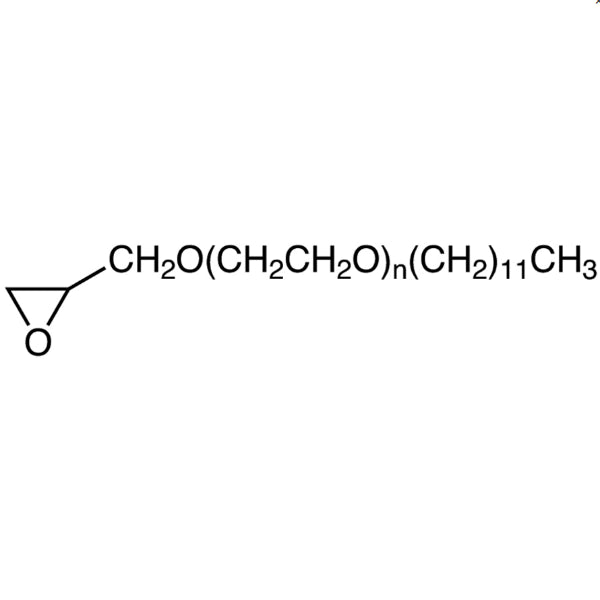
Polyethylene Glycol Glycidyl Lauryl Ether (PEG Glycidyl Lauryl Ether), with the CAS number 86630-59-3, is a chemical compound widely used in scientific and industrial applications. This reagent is a key component in polymer and macromolecule research, playing a crucial role in the synthesis of complex compounds and polymer modification. In the laboratory, it functions as a reactive agent that facilitates the formation of chemical bonds, particularly in epoxide reactions. Its versatility makes it an essential tool for researchers working in materials science, pharmaceuticals, and organic chemistry.
The compound's reactive nature, derived from its epoxide group and polyethylene glycol backbone, makes it a preferred choice for various applications. The combination of a hydrophilic polyethylene glycol chain and a hydrophobic lauryl group provides unique solubility and functional properties. These characteristics enable it to interact effectively with a wide range of molecules, making it suitable for surface modification, copolymer synthesis, and the creation of compounds with specific functional properties. Its stability and reactivity ensure consistent performance in diverse experimental conditions.
In Indonesian laboratories, this compound is frequently used in material science and organic chemistry research. It supports studies on polymer functionalization, drug delivery systems, and the development of advanced materials. Researchers and students rely on its reliability and adaptability to meet the demands of modern scientific investigations. Its presence in academic and industrial settings underscores its importance in advancing chemical innovation.
Related TCI products
- Surface modification in material science due to its hydrophilic and hydrophobic dual functionality, enabling tailored surface properties for biomedical and industrial applications.
- Copolymer synthesis in polymer chemistry as a versatile monomer that can be integrated into various polymer matrices for enhanced material properties.
- Organic synthesis in pharmaceutical research for the creation of complex molecules with specific functional groups and reactivity profiles.
- Drug delivery system development in pharmaceutical laboratories for the encapsulation and controlled release of therapeutic agents.
- Functional material creation in nanotechnology and advanced materials research for the design of smart and responsive materials.
| Brand | TCI |
|---|---|
| CAS number | 86630-59-3 |
| Molecular formula | — |
| Purity | — |
| Category | Materials Science > Polymer/Macromolecule Reagents > Monomers |
| Pack sizes | Available in various quantities as per supplier specifications |
| Physical form | Liquid |
| Storage | Store in a cool, dry place away from direct sunlight and incompatible materials |
This compound should be stored in a cool, dry environment, away from direct sunlight and sources of heat. It is recommended to keep it in a sealed container to prevent moisture absorption and contamination. Due to its reactive nature, it should be handled in a well-ventilated area, ideally with appropriate personal protective equipment such as gloves and safety goggles. Avoid contact with incompatible substances like strong acids or bases. Ensure that storage conditions maintain the integrity of the compound and minimize the risk of degradation or unintended chemical reactions. Proper labeling and storage practices are essential to ensure safe handling and long-term stability.
—
Product Categories
Produk Terkait
-
AllylGlycidylEther TCI A0221
Regular price From Rp 477.750,00Regular price -
4-tert-ButylphenylGlycidylEther TCI B4831
Regular price From Rp 2.279.550,00Regular price -
BenzylGlycidylEther TCI B2108
Regular price From Rp 1.510.950,00Regular price -
tert-ButylGlycidylEther TCI B1840
Regular price Rp 1.220.100,00Regular price -
ButylGlycidylEther TCI B0697
Regular price From Rp 530.250,00Regular price -
PolyethyleneGlycolDiglycidylEther(n=approx4) TCI P3184
Regular price From Rp 1.193.850,00Regular price -
PolyethyleneGlycolDiglycidylEther(n=approx.13) TCI P3183
Regular price From Rp 1.087.800,00Regular price -
PolyethyleneGlycolDiglycidylEther(n=approx.9) TCI P3180
Regular price From Rp 1.060.500,00Regular price