


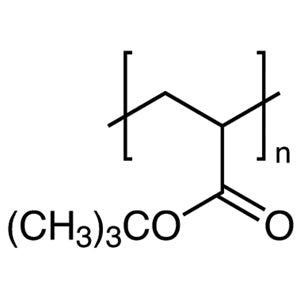
Poly(tert-butyl Acrylate) is a polymer compound widely used in chemical and materials science experiments within laboratories. It is derived from the monomer tert-butyl acrylate and serves as a key reagent in the synthesis of various polymers. This material is essential for studying polymer properties such as reactivity, structure, and functional behavior. Its versatility makes it a valuable tool for researchers exploring new materials and chemical applications.
The chemical stability and processability of Poly(tert-butyl Acrylate) make it a preferred choice in laboratory settings. It exhibits high melting and boiling points, allowing it to be used in controlled temperature environments. Its resistance to degradation ensures long-term reliability in experiments. These properties contribute to its effectiveness in both academic and industrial research.
In Indonesian laboratories, Poly(tert-butyl Acrylate) is commonly used in material science and organic chemistry research. It supports the development of composite materials and polymers with specific properties, such as water resistance and chemical stability. Its role in long-term experiments and its compatibility with various laboratory techniques make it a standard reagent in many research projects.
TCI brochures (PDF)
- Biomaterials Research Reagents 2025-02-19 · p. 5
Related TCI products
- TCI P2584 25232-27-3 Poly(tert-butyl Acrylate) Number Average Molecular Wt. 50000
- TCI P2583 25232-27-3 Poly(tert-butyl Acrylate) Number Average Molecular Wt. 25000
- TCI P2559 25154-86-3 Poly[2-(Dimethylamino)ethyl Methacrylate] Number Average Molecular Wt. 50000
- TCI P2558 25154-86-3 Poly[2-(Dimethylamino)ethyl Methacrylate] Number Average Molecular Wt. 25000
- TCI P2556 25154-86-3 Poly[2-(Dimethylamino)ethyl Methacrylate] Number Average Molecular Wt. 10000
- TCI P0473 9003-39-8 Polyvinylpyrrolidone K 90 Average Molecular Wt. 360000
- Polymer synthesis and modification for creating specialty materials with tailored properties.
- Organic chemistry experiments involving polymerization reactions and functional group analysis.
- Development of composite materials with enhanced mechanical and chemical resistance.
- Research into polymer stability and degradation behavior under different environmental conditions.
- Formulation of coatings and adhesives that require controlled polymer cross-linking and curing.
| Brand | TCI |
|---|---|
| CAS number | 25232-27-3 |
| Molecular formula | — |
| Purity | — |
| Category | Materials Science > Polymer/Macromolecule Reagents > Polymers |
| Pack sizes | As per supplier specifications |
| Physical form | Solid or liquid, depending on formulation |
| Storage | Store in a cool, dry place away from direct sunlight |
Poly(tert-butyl Acrylate) should be stored in a cool, dry environment to maintain its chemical stability. It is recommended to use sealed containers to prevent exposure to moisture and air. Due to its potential reactivity, it should be handled in a well-ventilated area, with appropriate personal protective equipment. Avoid contact with incompatible substances and ensure proper disposal in accordance with local regulations. Regular monitoring of storage conditions is advised to ensure the material remains suitable for use in laboratory applications.
—
Produk Terkait
-
Poly(tert-butylAcrylate)NumberAverageMolecularWt.50000 TCI P2584
Regular price Rp 4.320.750,00Regular priceRp 3.020.850,00Sale price Rp 4.320.750,00 -
Poly(tert-butylAcrylate)NumberAverageMolecularWt.25000 TCI P2583
Regular price Rp 4.320.750,00Regular priceRp 3.020.850,00Sale price Rp 4.320.750,00 -
Poly[2-(Dimethylamino)ethylMethacrylate]NumberAverageMolecularWt.50000 TCI P2559
Regular price Rp 4.479.300,00Regular priceRp 3.132.150,00Sale price Rp 4.479.300,00 -
Poly[2-(Dimethylamino)ethylMethacrylate]NumberAverageMolecularWt.25000 TCI P2558
Regular price Rp 4.479.300,00Regular priceRp 3.132.150,00Sale price Rp 4.479.300,00 -
Poly[2-(Dimethylamino)ethylMethacrylate]NumberAverageMolecularWt.10000 TCI P2556
Regular price Rp 4.479.300,00Regular priceRp 3.132.150,00Sale price Rp 4.479.300,00 -
PolyvinylpyrrolidoneK90AverageMolecularWt.360000 TCI P0473
Regular price From Rp 530.250,00Regular priceRp 370.650,00Sale price From Rp 530.250,00 -
PolyvinylpyrrolidoneK30AverageMolecularWt40000 TCI P0472
Regular price From Rp 530.250,00Regular priceRp 370.650,00Sale price From Rp 530.250,00 -
PolyvinylpyrrolidoneK15AverageMolecularWt10000 TCI P0471
Regular price From Rp 584.850,00Regular priceRp 408.450,00Sale price From Rp 584.850,00


