


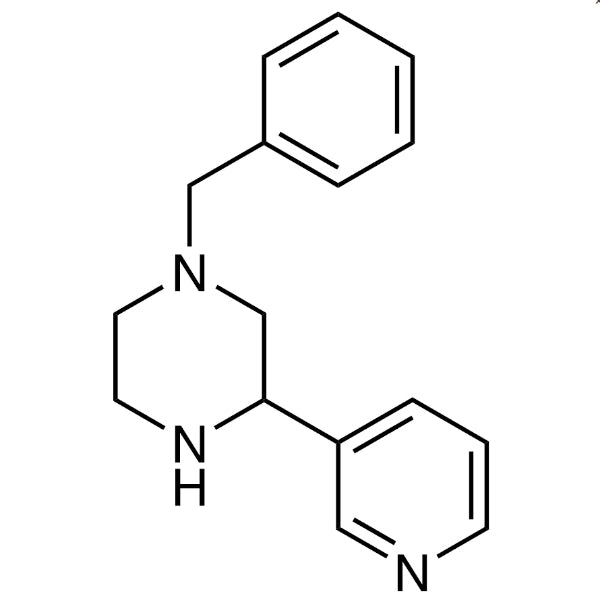
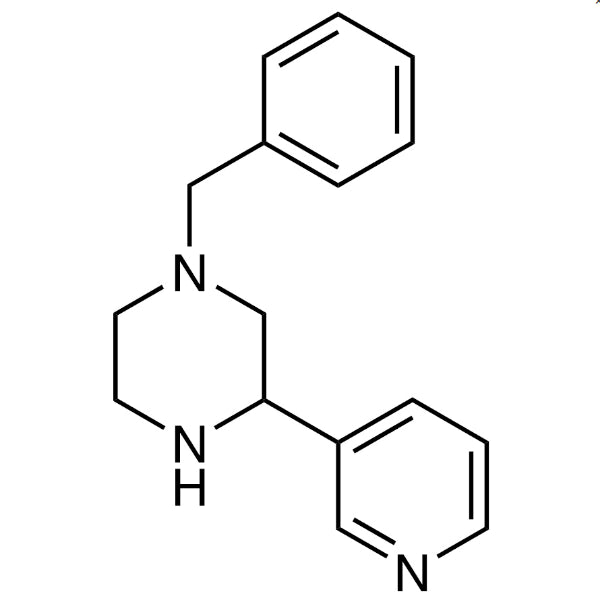
1-Benzyl-3-(pyridin-3-yl)piperazine is a chemical compound widely used in synthetic reactions and scientific research within laboratory settings. It belongs to the category of heterocyclic building blocks, which are essential for constructing complex molecular structures. This compound is particularly valuable for its ability to participate in various chemical transformations, making it a versatile tool for researchers. Its presence in laboratory workflows supports the development of new compounds with potential applications in pharmaceutical and material science fields.
The compound is preferred due to its stable heterocyclic structure and high reactivity toward a range of chemical reactions. It exhibits good solubility in organic solvents, which simplifies its handling and integration into synthetic processes. These properties make it a reliable choice for researchers aiming to synthesize bioactive molecules. Its chemical versatility allows it to be used in multiple experimental setups, contributing to the efficiency and success of laboratory projects.
In Indonesian laboratories, 1-Benzyl-3-(pyridin-3-yl)piperazine is commonly used in pharmaceutical and chemical research. It plays a key role in the development of new drugs and materials, supporting both academic and industrial research initiatives. Its relevance in these contexts highlights its importance as a fundamental building block in the pursuit of scientific innovation.
Advantages (TCI brochure)
- Carbon-substituted (3-position) piperazine building block for expanding structural diversity
TCI brochures (PDF)
Related TCI products
- TCI M3245 883738-27-0 1-Methyl-4-[3-(4,4,5,5-tetramethyl-1,3,2-dioxaborolan-2-yl)benzyl]piperazine
- TCI T2984 115473-15-9 5,6,7,7a-Tetrahydrothieno[3,2-c]pyridin-2(4H)-one Hydrochloride
- TCI T1667 6969-71-7 1,2,4-Triazolo[4,3-a]pyridin-3(2H)-one
- TCI P3218 31052-93-4 2-Phenyl-[1,2,4]triazolo[1,5-a]pyridin-6-amine
- TCI P3198 15264-63-8 5-(Pyridin-4-yl)-1,3,4-oxadiazole-2(3H)-thione
- TCI P2666 66521-66-2 4-(Pyridin-3-yl)pyrimidin-2-amine
- Synthetic chemistry research for the development of bioactive compounds due to its reactivity and structural versatility.
- Pharmaceutical drug discovery projects as a key intermediate in the synthesis of potential therapeutic agents.
- Organic chemistry experiments requiring heterocyclic building blocks for molecular complexity.
- Material science applications in the creation of advanced polymers and functional materials.
- Academic research in chemical synthesis and molecular design for educational and experimental purposes.
From the TCI brochure
- Building block for drug discovery research
| Brand | TCI |
|---|---|
| CAS number | 205059-22-9 |
| Molecular formula | — |
| Purity | — |
| Category | Chemistry > Building Blocks > Heterocyclic Building Blocks |
| Pack sizes | Available in various quantities as per supplier specifications |
| Physical form | Solid (as per standard product description) |
| Storage | Store in a cool, dry place away from direct sunlight and moisture |
This compound should be stored in a cool, dry environment to maintain its chemical stability. It is recommended to keep it in a tightly sealed container to prevent exposure to moisture and air. Proper ventilation is essential when handling this material to ensure a safe laboratory environment. Avoid contact with incompatible substances to prevent unwanted reactions. Always use appropriate personal protective equipment, such as gloves and safety goggles, when working with this compound. Regular monitoring of storage conditions will help preserve its quality and ensure safe usage in laboratory settings.
References cited in the TCI brochure
- Robin Gueret. Visible-Light-Driven CarboxyLic Amine Protocol (CLAP) for the Synthesis of 2-Substituted Piperazines under Batch and Flow Conditions Organic Letters, 2020. doi:10.1021/acs.orglett.0c01759
Produk Terkait
-
1-Methyl-4-[3-(4,4,5,5-tetramethyl-1,3,2-dioxaborolan-2-yl)benzyl]piperazine TCI M3245
Regular price From Rp 1.829.100,00Regular price -
5,6,7,7a-Tetrahydrothieno[3,2-c]pyridin-2(4H)-oneHydrochloride TCI T2984
Regular price From Rp 717.150,00Regular price -
1,2,4-Triazolo[4,3-a]pyridin-3(2H)-one TCI T1667
Regular price Rp 477.750,00Regular price -
2-Phenyl-[1,2,4]triazolo[1,5-a]pyridin-6-amine TCI P3218
Regular price Rp 5.062.050,00Regular price -
5-(Pyridin-4-yl)-1,3,4-oxadiazole-2(3H)-thione TCI P3198
Regular price From Rp 848.400,00Regular price -
4-(Pyridin-3-yl)pyrimidin-2-amine TCI P2666
Regular price From Rp 1.881.600,00Regular price -
3-(Tetrahydro-2H-pyran-4-yl)-1H-pyrazolo[3,4-b]pyridin-5-amine TCI O0699
Regular price Rp 5.062.050,00Regular price -
Oxazolo[4,5-b]pyridin-2(3H)-one TCI O0408
Regular price From Rp 1.167.600,00Regular price
![883738-27-0 1-Methyl-4-[3-(4,4,5,5-tetramethyl-1,3,2-dioxaborolan-2-yl)benzyl]piperazine - AMI Scientific](http://amiscientific.com/cdn/shop/files/TCI2510M3245.jpg?v=1768205872&width=533)
![883738-27-0 1-Methyl-4-[3-(4,4,5,5-tetramethyl-1,3,2-dioxaborolan-2-yl)benzyl]piperazine - AMI Scientific](http://amiscientific.com/cdn/shop/files/TCI2510M3245_a076a757-1c0f-4f19-8e0d-d99f5073b984.jpg?v=1769056954&width=533)
![115473-15-9 5,6,7,7a-Tetrahydrothieno[3,2-c]pyridin-2(4H)-one Hydrochloride - AMI Scientific](http://amiscientific.com/cdn/shop/files/TCI2510T2984.jpg?v=1767143601&width=533)
![6969-71-7 1,2,4-Triazolo[4,3-a]pyridin-3(2H)-one - AMI Scientific](http://amiscientific.com/cdn/shop/files/TCI2510T1667.jpg?v=1767142000&width=533)
![31052-93-4 2-Phenyl-[1,2,4]triazolo[1,5-a]pyridin-6-amine - AMI Scientific](http://amiscientific.com/cdn/shop/files/TCI2510P3218.jpg?v=1767137256&width=533)


![2251054-52-9 3-(Tetrahydro-2H-pyran-4-yl)-1H-pyrazolo[3,4-b]pyridin-5-amine - AMI Scientific](http://amiscientific.com/cdn/shop/files/TCI2510O0699.jpg?v=1767132287&width=533)
![60832-72-6 Oxazolo[4,5-b]pyridin-2(3H)-one - AMI Scientific](http://amiscientific.com/cdn/shop/files/TCI2510O0408.jpg?v=1767131877&width=533)