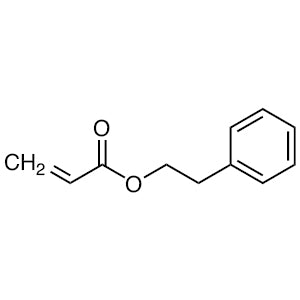
2-Phenylethyl Acrylate from TCI is an acrylate monomer with a phenylethyl group on its ester portion. TCI classifies it as a non-heterocyclic building block. The compound pairs a readily polymerizable acrylate double bond with an aromatic ring, and that ring shapes the optical and mechanical properties of the resulting polymers. In the laboratory, the monomer is used to synthesize acrylate homopolymers and copolymers and serves as a Michael acceptor in organic synthesis. It is also used in research on UV-curable resins.
Because of the phenyl ring, polymers made from this monomer tend to have a higher refractive index than simple aliphatic acrylates. This makes the monomer attractive for research on optical materials, lenses, and transparent coatings. An ethylene spacer between the aromatic ring and the ester gives the side chain some flexibility, so researchers can balance stiffness and flexibility in the films they make. Its acrylate reactivity works with conventional free-radical polymerization and with controlled techniques such as ATRP and RAFT, giving chemists room to design polymer architectures with well-defined structures.
In Indonesia, this monomer suits polymer chemistry and materials science laboratories at universities that develop coatings and related functional materials. Research groups working on optical polymers, transparent films, and UV-curable formulations can use it as a reference aromatic acrylate when comparing structure and properties against aliphatic monomers. Synthetic organic chemistry laboratories can also use it as a Michael acceptor in teaching and research projects, so one reagent can serve both polymer work and small-molecule synthesis.
TCI brochures (PDF)
- Biomaterials Research Reagents 2025-02-19 · p. 9
- Monomers 2025-05-28 · p. 5
Related TCI products
- TCI P2714 3683-12-3 2-Phenylethyl Methacrylate (stabilized with HQ)
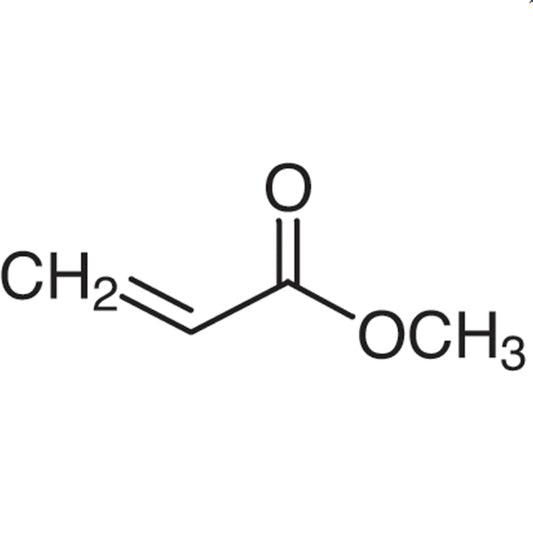
- TCI A0145 96-33-3 Methyl Acrylate (stabilized with MEHQ)
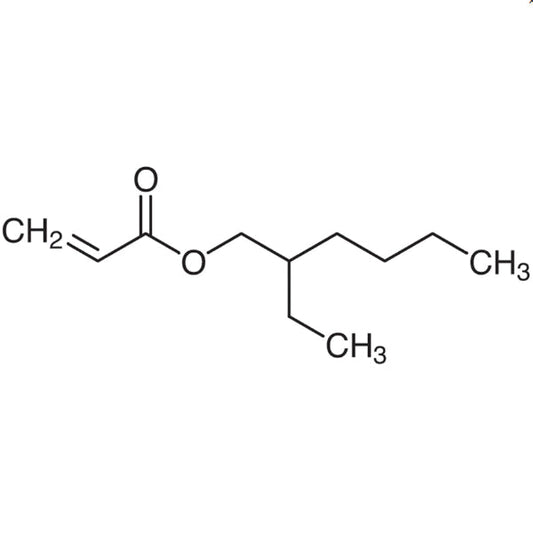
- TCI A0144 103-11-7 2-Ethylhexyl Acrylate Monomer (stabilized with MEHQ)
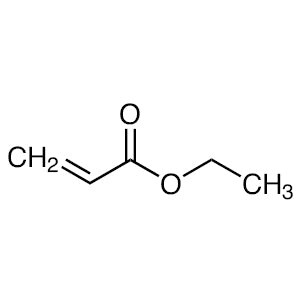
- TCI A0143 140-88-5 Ethyl Acrylate (stabilized with MEHQ)
- TCI A0142 141-32-2 Butyl Acrylate (stabilized with MEHQ)
- TCI U0117 31098-20-1 3-Sulfopropyl Acrylate Potassium Salt
- Homopolymer and copolymer synthesis: the reactive acrylate double bond polymerizes readily, so researchers can prepare acrylate polymers with aromatic side chains for property studies.
- High refractive index optical materials: the phenyl ring raises the refractive index compared with simple aliphatic acrylates, which makes it relevant for lens and optical material research.
- Transparent coating development: the aromatic ring and the flexible ethylene spacer let researchers tune the balance between stiffness and flexibility in transparent coating films.
- UV-curable resin research: as a reactive acrylate monomer, it can be included in experimental UV-curable formulations to study curing behavior and the properties of the final film.
- Controlled radical polymerization and Michael additions: its acrylate reactivity suits ATRP and RAFT techniques and lets it act as a Michael acceptor in organic synthesis.
| Brand | TCI (product code P2888) |
|---|---|
| CAS number | 3530-36-7 |
| Molecular formula | — |
| Purity | — |
| Category | Chemistry > Building Blocks > Non-Heterocyclic Building Blocks |
| Pack sizes | available in TCI's standard pack sizes; please confirm the options when you order |
| Physical form | please refer to the TCI product documentation and Certificate of Analysis |
| Storage | follow the storage conditions on the TCI label and Safety Data Sheet |
Store 2-Phenylethyl Acrylate in its original, tightly closed TCI container. Keep it in a cool, dark, well-ventilated place away from heat, direct sunlight, ignition sources, and polymerization initiators, because acrylate monomers can polymerize unexpectedly. Always follow the specific storage temperature and stabilizer information on the label and Safety Data Sheet. Handle the material in a fume hood and wear chemical-resistant gloves, safety goggles, and a lab coat. Avoid contact with skin and eyes and avoid inhaling vapors, since acrylates can irritate and sensitize. Keep containers closed when not in use and dispose of waste according to institutional and local chemical waste regulations.
—
Produk Terkait
-
2-PhenylethylMethacrylate(stabilizedwithHQ) TCI P2714
Regular price From Rp 1.298.850,00Regular price -
MethylAcrylate(stabilizedwithMEHQ) TCI A0145
Regular price From Rp 477.750,00Regular price -
2-EthylhexylAcrylateMonomer(stabilizedwithMEHQ) TCI A0144
Regular price From Rp 505.050,00Regular price -
EthylAcrylate(stabilizedwithMEHQ) TCI A0143
Regular price From Rp 477.750,00Regular price -
ButylAcrylate(stabilizedwithMEHQ) TCI A0142
Regular price From Rp 505.050,00Regular price -
3-SulfopropylAcrylatePotassiumSalt TCI U0117
Regular price Rp 1.565.550,00Regular price -
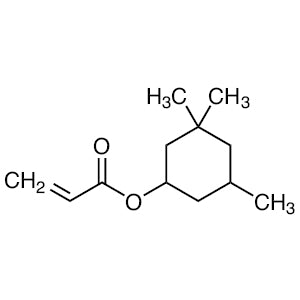
3,3,5-TrimethylcyclohexylAcrylate(cis-andtrans-mixture)(stabilizedwithMEHQ) TCI T3984
Regular price From Rp 1.510.950,00Regular price -
4-BenzoylphenylAcrylate TCI A3715
Regular price From Rp 1.590.750,00Regular price