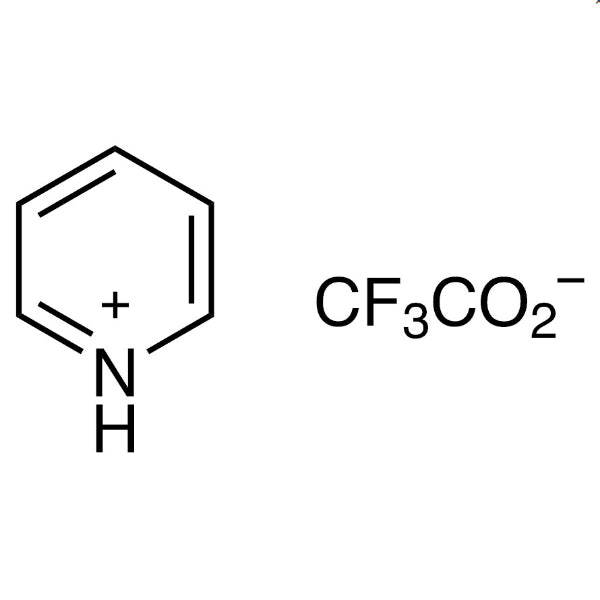
Pyridinium Trifluoroacetate (TCI P2920) is a salt formed from pyridine and trifluoroacetic acid. In organic reactions it acts as a controlled source of weak acid. Laboratories know this reagent mainly for two areas of work. The first is nucleic acid chemistry, especially the preparation and activation of phosphoramidite compounds for oligonucleotide synthesis. The second is Pfitzner–Moffatt-type alcohol oxidation, where it is the acid catalyst used together with DMSO and a carbodiimide. Because of this, it is a useful reagent in both synthetic organic chemistry and chemical biology laboratories.
The main advantage of this reagent is that its acidity is mild and predictable. Free trifluoroacetic acid is too strong for many sensitive groups, such as acetal protecting groups, trityl groups, and phosphorus(III) bonds. In the pyridinium salt form, the proton is released in a more controlled way. Reactions can therefore proceed selectively without damaging other parts of the molecule. It is also a solid, so it is easier to weigh accurately than a manual mixture of liquid pyridine and TFA. This gives more consistent results from one experiment to the next and helps with reproducibility across batches and between researchers.
In Indonesia, this reagent suits biotechnology laboratories, synthetic molecular biology groups, and nucleoside chemistry research. It is useful for preparing phosphoramidite monomers and for related steps in oligonucleotide work. University research groups, research institutes, and industrial R&D laboratories that work on nucleic acid chemistry or selective oxidation of alcohols can use it as a dependable, easy-to-handle acid source. It also fits teaching and method-development settings, where reproducible conditions and careful control of acidity matter for good results.
TCI brochures (PDF)
- Coupling Activators for Oligonucleotide Synthesis 2025-06-30 · p. 2
- Nucleosides, Nucleotides, Nucleic Acids and Related Reagents 2026-03-23 · p. 15
- Phosphoramidite preparation: its mild, controlled acidity supports the preparation of phosphoramidite compounds without damaging sensitive phosphorus(III) bonds in the molecule.
- Phosphoramidite activation for oligonucleotide synthesis: it acts as a predictable weak acid source, which helps activation proceed selectively and consistently during oligonucleotide assembly work.
- Pfitzner–Moffatt-type alcohol oxidation: it serves as the acid catalyst together with DMSO and a carbodiimide, giving controlled conditions for converting alcohols selectively.
- Reactions involving acid-sensitive protecting groups: it is gentler than free trifluoroacetic acid, so it helps preserve acetal and trityl protecting groups elsewhere in the molecule.
- Nucleoside and monomer chemistry: as a solid it can be weighed accurately, so it gives reproducible acid stoichiometry when preparing nucleoside-based monomers in research laboratories.
| Brand | TCI (product code P2920) |
|---|---|
| CAS number | 464-05-1 |
| Molecular formula | — |
| Purity | — |
| Category | Chemistry > Chemical Biology > Nucleic Acid Chemistry |
| Pack sizes | please refer to the available TCI pack options on the product listing |
| Physical form | solid (pyridinium salt of trifluoroacetic acid) |
| Storage | keep the container tightly closed in a cool, dry place and follow the manufacturer's label and SDS |
Store Pyridinium Trifluoroacetate in its original, tightly sealed container. Keep it in a cool, dry, well-ventilated area, away from moisture, strong bases, and strong oxidizing agents. Reseal the container promptly after each use to protect the reagent's quality. When handling it, wear standard laboratory protective equipment, including gloves, safety glasses, and a lab coat. Weigh and transfer the material in a fume hood or another well-ventilated area, and avoid inhaling dust or letting it touch your skin and eyes. Always read the manufacturer's Safety Data Sheet before use, and dispose of residues according to local chemical waste regulations.
—
Product Categories
Produk Terkait
-
N-MethylaniliniumTrifluoroacetate TCI M0801
Regular price Rp 1.643.250,00Regular priceRp 1.164.450,00Sale price Rp 1.643.250,00 -
Yttrium(III)Trifluoroacetate TCI Y0028
Regular price From Rp 2.332.050,00Regular priceRp 1.646.400,00Sale price From Rp 2.332.050,00 -
CesiumTrifluoroacetate TCI T4207
Regular price From Rp 2.677.500,00Regular priceRp 1.887.900,00Sale price From Rp 2.677.500,00 -
AllylTrifluoroacetate TCI T1765
Regular price From Rp 1.087.800,00Regular priceRp 775.950,00Sale price From Rp 1.087.800,00 -
IsopropylTrifluoroacetate TCI T1761
Regular price Rp 1.670.550,00Regular priceRp 1.183.350,00Sale price Rp 1.670.550,00 -
SodiumTrifluoroacetate TCI T1336
Regular price From Rp 689.850,00Regular priceRp 497.700,00Sale price From Rp 689.850,00 -
VinylTrifluoroacetate(stabilizedwithTBC) TCI T1216
Regular price Rp 6.573.000,00Regular priceRp 4.611.600,00Sale price Rp 6.573.000,00 -
PhenylTrifluoroacetate TCI T0741
Regular price Rp 1.298.850,00Regular priceRp 924.000,00Sale price Rp 1.298.850,00