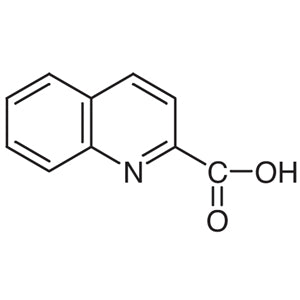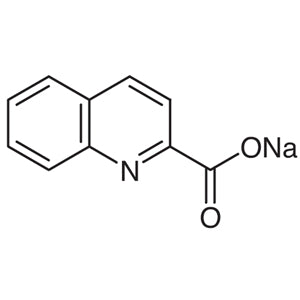
TCI Q0004 Quinaldic Acid Sodium Salt is the sodium salt of quinoline-2-carboxylic acid, registered under CAS number 16907-79-2. It has the same heterocyclic quinoline framework as quinaldic acid, but its carboxyl group is already in the sodium carboxylate form. In the laboratory, the compound serves three main roles. It is a heterocyclic building block for organic synthesis, a ready-to-use source of the quinaldate anion, and a metal-complexing reagent in analytical chemistry and coordination chemistry. Because it is supplied by TCI, researchers get a recognised reagent for both routine work and research.
The main advantage of the sodium salt is that it dissolves in water more readily than the free acid. Researchers can prepare ligand solutions directly in aqueous media without first neutralising the acid with a base. This shortens the workflow and gives better control over solution pH, which helps reproducibility in sensitive analytical procedures. The quinaldate anion keeps its bidentate chelating ability through the quinoline nitrogen atom and the carboxylate oxygen. As a result, the salt works well for precipitating or complexing metal ions in analytical methods and for preparing defined metal complexes in synthetic work.
In Indonesia, sodium quinaldate is useful for analytical chemistry laboratories that determine metals in aqueous solutions. It also suits coordination chemistry laboratories that synthesise and study metal–ligand complexes, and organic synthesis groups that need a quinoline-based heterocyclic building block. University research laboratories, government testing facilities, and industrial quality control units can use it in teaching, method development, and applied research. AMI Scientific supplies this TCI product to laboratories across Indonesia that need a dependable, water-compatible source of the quinaldate ligand.
Related TCI products
- Metal ion determination in analytical chemistry: the quinaldate anion chelates metal ions through its nitrogen and oxygen donor atoms, so it can be used to precipitate or complex metals in aqueous samples.
- Coordination chemistry and complex synthesis: the bidentate N,O-chelating behaviour of quinaldate makes this salt a convenient ligand source for preparing and studying metal–ligand complexes in solution.
- Heterocyclic building block for organic synthesis: the quinoline-2-carboxylate framework provides a ready heterocyclic scaffold for building more elaborate molecules in medicinal and synthetic chemistry research.
- Aqueous ligand solution preparation: its better water solubility than the free acid lets chemists prepare ligand stock solutions directly, with no neutralisation step and with simpler pH control.
- Teaching and method development: the simple aqueous handling and well-known chelating behaviour make it suitable for demonstrations of complex formation and for developing new metal-analysis procedures.
| Brand | TCI (product code Q0004) |
|---|---|
| CAS number | 16907-79-2 |
| Molecular formula | — |
| Purity | — |
| Category | Chemistry > Building Blocks > Heterocyclic Building Blocks |
| Pack sizes | please contact AMI Scientific for the TCI pack sizes currently available |
| Physical form | — |
| Storage | follow the conditions stated on the TCI label and Safety Data Sheet |
- Chemical identity: sodium salt of quinoline-2-carboxylic acid (sodium quinaldate)
Store Quinaldic Acid Sodium Salt in its original, tightly closed TCI container in a cool, dry, well-ventilated area, away from direct sunlight, moisture, and incompatible materials such as strong oxidising agents. Reseal the container promptly after each use to protect the contents from humidity. When handling the material, wear standard laboratory protective equipment: safety glasses, chemical-resistant gloves, and a laboratory coat. Weigh and transfer the powder carefully to avoid creating dust, and work in a fume hood or a well-ventilated area where possible. Avoid contact with skin and eyes, and do not inhale any dust. Label prepared aqueous solutions clearly with the date and concentration. Always read the TCI Safety Data Sheet for specific hazard information, first-aid measures, and disposal requirements, and dispose of waste according to local regulations.
—
Produk Terkait
-
QuinaldicAcid TCI Q0003
Regular price From Rp 1.510.950,00Regular price