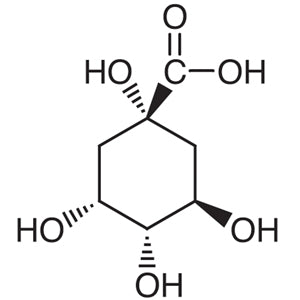
D-(-)-Quinic Acid from TCI, product code Q0009, is a naturally occurring cyclitol acid: a carboxylic acid on a cyclohexane ring that carries several hydroxyl groups. The compound, registered under CAS number 77-95-2, is found in cinchona bark, coffee beans and many other plants. Because nature supplies it as a single enantiomer, D-(-)-quinic acid is an important member of the "chiral pool." In the laboratory it serves both as a chiral resolution reagent and as a starting material for asymmetric synthesis.
The main strength of D-(-)-quinic acid is its cyclohexane framework, which has several chiral centres with fixed configurations. This framework gives chemists a ready-made stereochemical template, so they do not have to build chirality from scratch. Its acidic carboxyl group can form diastereomeric salts with racemic amines, and those salts can then be separated by crystallisation. The hydroxyl groups can be protected or modified selectively, which suits stepwise synthetic routes that need control at each stage. Its many polar groups also make the compound readily soluble in water, which simplifies work in aqueous systems and in some purification steps.
In Indonesia, D-(-)-quinic acid is relevant to organic synthesis and medicinal chemistry laboratories that need chiral starting materials. University research groups working on natural product chemistry and stereoselective methods can use it as a dependable, well-defined building block. Pharmaceutical research and development teams can use it to resolve racemic amine intermediates. Teaching laboratories can also use it to show how chiral pool compounds and diastereomeric salt formation work in practice.
TCI brochures (PDF)
- Chiral Auxiliaries and Optical Resolving Agents 2025-06-17 · p. 6
Related TCI products
- TCI T1702 3019-58-7 (2R,3R)-Tartranilic Acid [for optical resolution]
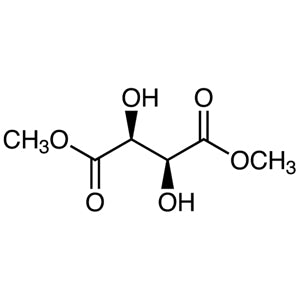
- TCI T1659 13171-64-7 Dimethyl D-(-)-Tartrate
- TCI T1521 60646-30-2 (S)-(+)-2,2,2-Trifluoro-1-(9-anthryl)ethanol [ee Determination Reagent by NMR]
- TCI T1520 53531-34-3 (R)-(-)-2,2,2-Trifluoro-1-(9-anthryl)ethanol [e.e. Determination Reagent by NMR]
- TCI T1444 29739-88-6 N-(p-Toluenesulfonyl)-L-phenylalanyl Chloride [Optical Resolving Reagent for Alcohols]
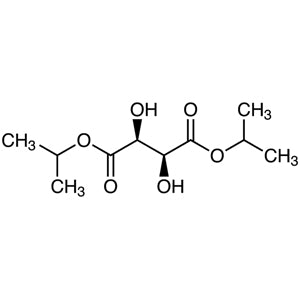
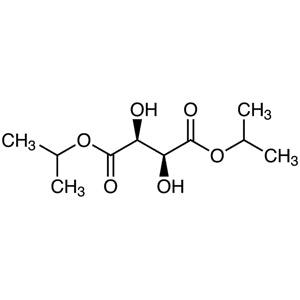
- TCI T1387 62961-64-2 Diisopropyl D-(-)-Tartrate
- Chiral resolution of racemic amines: the acidic carboxyl group forms diastereomeric salts with amine enantiomers, and these salts can then be separated by crystallisation into enantiomerically enriched fractions.
- Asymmetric synthesis starting material: as a single-enantiomer chiral pool compound, it provides a cyclohexane framework with fixed chiral centres, so chemists do not have to build stereochemistry from scratch.
- Stepwise synthesis of complex targets: its several hydroxyl groups can be protected or modified selectively, which allows controlled, sequential transformations in multistep organic synthesis routes.
- Medicinal chemistry research: laboratories that design chiral drug candidates can use its defined stereochemical template to prepare enantiopure intermediates and structurally related analogues for further study.
- Natural product and teaching studies: because it occurs in cinchona bark and coffee beans, it is a practical example for studying plant-derived chiral compounds and demonstrating chiral pool concepts.
| Brand | TCI (product code Q0009) |
|---|---|
| CAS number | 77-95-2 |
| Molecular formula | — |
| Purity | — |
| Category | Chemistry > Asymmetric Synthesis > Chiral Resolution Reagents |
| Pack sizes | Available in the pack sizes listed on the product page; contact AMI Scientific for current options |
| Physical form | Refer to the TCI certificate of analysis and product documentation |
| Storage | Keep in a tightly closed container in a cool, dry place; follow the label and SDS |
Store D-(-)-Quinic Acid in its original, tightly sealed container in a cool, dry, well-ventilated area, away from direct sunlight, heat sources and incompatible substances such as strong oxidising agents. Because the compound is highly polar and water-soluble, keep moisture out by resealing the container promptly after each use. Weigh and transfer it with clean, dry tools to avoid contamination. Wear standard laboratory protective equipment, including safety glasses, gloves and a lab coat, and avoid breathing in dust or letting it touch your skin or eyes. Always read the Safety Data Sheet (SDS) supplied with the product for specific hazard, first-aid and disposal guidance, and follow your institution's chemical safety procedures.
—
Product Categories
Produk Terkait
-
(2R,3R)-TartranilicAcid[foropticalresolution] TCI T1702
Regular price From Rp 1.298.850,00Regular price -
DimethylD-(-)-Tartrate TCI T1659
Regular price From Rp 584.850,00Regular price -
(S)-(+)-2,2,2-Trifluoro-1-(9-anthryl)ethanol[eeDeterminationReagentbyNMR] TCI T1521
Regular price From Rp 1.644.300,00Regular price -
(R)-(-)-2,2,2-Trifluoro-1-(9-anthryl)ethanol[e.e.DeterminationReagentbyNMR] TCI T1520
Regular price Rp 2.571.450,00Regular price -
N-(p-Toluenesulfonyl)-L-phenylalanylChloride[OpticalResolvingReagentforAlcohols] TCI T1444
Regular price From Rp 875.700,00Regular price -
DiisopropylD-(-)-Tartrate TCI T1387
Regular price From Rp 1.881.600,00Regular price -
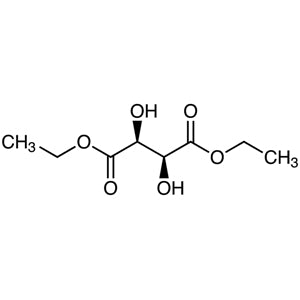
DiethylD-(-)-Tartrate TCI T1195
Regular price From Rp 1.115.100,00Regular price -
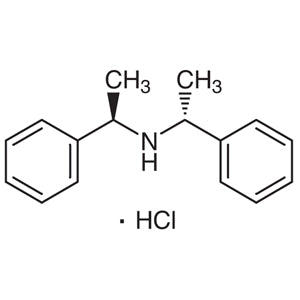
(R,R)-(+)-Bis(alpha-methylbenzyl)amineHydrochloride TCI B2034
Regular price Rp 4.743.900,00Regular price
![3019-58-7 (2R,3R)-Tartranilic Acid [for optical resolution] - AMI Scientific](http://amiscientific.com/cdn/shop/files/TCI2510T1702.jpg?v=1767142061&width=533)
![60646-30-2 (S)-(+)-2,2,2-Trifluoro-1-(9-anthryl)ethanol [e.e. Determination Reagent by NMR] - AMI Scientific](http://amiscientific.com/cdn/shop/files/TCI2510T1521.jpg?v=1767141776&width=533)
![60646-30-2 (S)-(+)-2,2,2-Trifluoro-1-(9-anthryl)ethanol [e.e. Determination Reagent by NMR] - AMI Scientific](http://amiscientific.com/cdn/shop/files/TCI2510T1521_7c166274-ef1b-4925-8be6-53863c4594b4.jpg?v=1772424133&width=533)
![53531-34-3 (R)-(-)-2,2,2-Trifluoro-1-(9-anthryl)ethanol [e.e. Determination Reagent by NMR] - AMI Scientific](http://amiscientific.com/cdn/shop/files/TCI2510T1520.jpg?v=1767141772&width=533)
![29739-88-6 N-(p-Toluenesulfonyl)-L-phenylalanyl Chloride [Optical Resolving Reagent for Alcohols] - AMI Scientific](http://amiscientific.com/cdn/shop/files/TCI2510T1444.jpg?v=1767141615&width=533)