


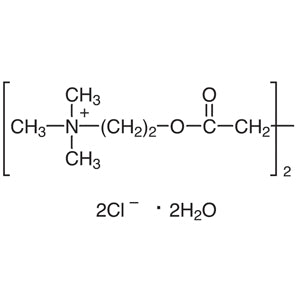
Succinylcholine Chloride Dihydrate from TCI is the dihydrate chloride salt of succinylcholine, a compound also known as suxamethonium. Structurally, the molecule consists of two choline units linked through a succinic acid diester, with a quaternary ammonium group at each end. In the laboratory, this compound is recognised as a depolarising neuromuscular blocking agent. For this reason, it is used in pharmacological research, in studies of nicotinic acetylcholine receptors, and in investigations of cholinesterase enzymes. This product is intended strictly for research and experimental use and is not for clinical use in humans or animals.
Researchers choose this compound because its mechanism of action is well documented and because its structure closely resembles two acetylcholine molecules joined together. This similarity makes it a useful reference compound in studies of how ligands interact with nicotinic receptors. Its ester bonds are hydrolysed by butyrylcholinesterase, so the compound is often used as a substrate for measuring that enzyme's activity. The dihydrate form is a readily water-soluble salt, which makes it practical for preparing stock solutions and buffered working solutions without complicated dissolution steps.
In Indonesia, this material is relevant to pharmacology laboratories at universities, biomedical research institutes, and academic groups that study neurotransmission and enzyme kinetics. Typical users include teams working on receptor pharmacology, cholinesterase assays, and comparative studies of cholinergic compounds. Because it comes from TCI, laboratories can rely on a consistent, well-identified reagent for repeat experiments and for method development. AMI Scientific supplies this product to research laboratories that need a documented reference compound for experimental work only.
TCI brochures (PDF)
- Neurotransmission Research Reagents 2026-07-17 · p. 1
- Quaternary Ammonium Salts 2025-11-10 · p. 4
- Neuromuscular pharmacology research: as a well-documented depolarising neuromuscular blocking agent, it serves as a reference compound for studying neuromuscular transmission in experimental models.
- Nicotinic acetylcholine receptor studies: because its structure resembles two linked acetylcholine molecules, it is useful as a comparison ligand when investigating how ligands bind to and interact with nicotinic receptors.
- Butyrylcholinesterase activity assays: its ester bonds are hydrolysed by butyrylcholinesterase, so it is commonly used as a substrate for measuring that enzyme's activity under controlled laboratory conditions.
- Cholinesterase enzyme kinetics: researchers use it to compare how different cholinesterases handle choline esters, which supports work on enzyme specificity and on the effects of inhibitors.
- Stock and buffer solution preparation for assays: the water-soluble dihydrate salt dissolves easily, so it is practical for preparing reproducible stock solutions and buffered working solutions for routine experiments.
| Brand | TCI (product code S0149) |
|---|---|
| CAS number | 6101-15-1 |
| Molecular formula | — |
| Purity | — |
| Category | Chemistry > Synthetic Reagents > Acids, Bases [Synthetic Reagents] |
| Pack sizes | see the product page or contact AMI Scientific for available pack sizes |
| Physical form | water-soluble dihydrate chloride salt |
| Storage | follow the storage conditions on the TCI label and Safety Data Sheet |
Store Succinylcholine Chloride Dihydrate in its original, tightly closed container, as specified on the TCI label and Safety Data Sheet. Keep the container in a cool, dry, well-ventilated area away from moisture and incompatible substances. Reseal the container promptly after each use so the hydrated salt stays stable. Because this is a pharmacologically active compound, handle it only in a laboratory setting, wearing gloves, safety glasses, and a lab coat. Avoid inhaling dust and avoid contact with skin or eyes. Label all prepared solutions clearly and dispose of waste according to institutional and local regulations. This product is for research use only and is not for clinical use in humans or animals.
—
Produk Terkait
-
AcetylcholineChloride TCI A0084
Regular price From Rp 1.405.950,00Regular priceRp 998.550,00Sale price From Rp 1.405.950,00 -
TrospiumChloride TCI T3305
Regular price From Rp 2.994.600,00Regular priceRp 2.109.450,00Sale price From Rp 2.994.600,00 -
MethacholineChloride TCI M0073
Regular price From Rp 2.068.500,00Regular priceRp 1.461.600,00Sale price From Rp 2.068.500,00 -
CholineChloride TCI C0329
Regular price From Rp 582.750,00Regular priceRp 423.150,00Sale price From Rp 582.750,00 -
AcetylcholineIodide TCI A0085
Regular price Rp 2.942.100,00Regular priceRp 2.072.700,00Sale price Rp 2.942.100,00 -
AcetylcholineBromide TCI A0083
Regular price Rp 2.464.350,00Regular priceRp 1.738.800,00Sale price Rp 2.464.350,00


