

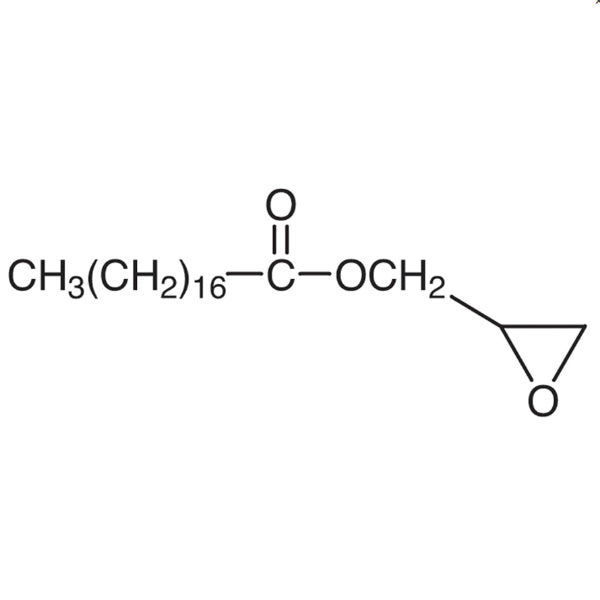
Glycidyl Stearate (TCI S0366, CAS 7460-84-6) is a chemical compound widely used in various chemical reactions and molecular synthesis processes. As a key component in heterocyclic building blocks, it plays a crucial role in the development of organic compounds, polymers, and industrial chemicals. Its unique structure allows it to participate in nucleophilic reactions, esterification, and chain coupling, making it a versatile reagent in synthetic chemistry. This compound is commonly found in chemical laboratories, especially in research focused on the synthesis of active biological compounds and functional materials.
Glycidyl Stearate is valued for its chemical stability under specific conditions, although it remains sensitive to moisture and air exposure. Its solubility varies depending on the solvent used, which facilitates separation and purification processes in chemical reactions. This property makes it an ideal choice for reactions requiring precise control over reactivity and stability. Additionally, its ability to interact with a wide range of functional groups enhances its utility in complex synthetic pathways.
In Indonesian laboratories, Glycidyl Stearate is extensively used in both fundamental and applied chemical research. It is frequently employed in studies involving the synthesis of bioactive compounds, polymer science, and industrial chemical applications. Its availability and chemical versatility make it a preferred choice for researchers aiming to explore new synthetic routes and material development.
- Organic Synthesis: Glycidyl Stearate is widely used in the synthesis of organic compounds due to its ability to participate in nucleophilic and esterification reactions, providing a reliable building block for complex molecule formation.
- Polymer Science: It serves as a functional monomer in polymer synthesis, contributing to the development of thermoplastic and elastomeric materials with tailored properties.
- Industrial Chemistry: Its chemical versatility makes it suitable for the production of various industrial chemicals, including surfactants and lubricants, where controlled reactivity is essential.
- Bioactive Compound Research: Glycidyl Stearate is frequently used in the synthesis of bioactive molecules, aiding in the development of pharmaceuticals and agrochemicals with specific biological activities.
- Material Development: It is employed in the creation of advanced materials, such as coatings and adhesives, due to its ability to form stable chemical bonds with different functional groups.
| Brand | TCI |
|---|---|
| CAS number | 7460-84-6 |
| Molecular formula | — |
| Purity | — |
| Category | Chemistry > Building Blocks > Heterocyclic Building Blocks |
| Pack sizes | Available in various quantities as per supplier specifications |
| Physical form | Solid at room temperature |
| Storage | Should be stored in a dry, cool, and well-ventilated area away from moisture and air exposure |
Glycidyl Stearate should be stored in a dry, cool, and well-ventilated environment to prevent degradation due to moisture and air exposure. It is recommended to use airtight containers made of materials such as glass or high-density polyethylene to maintain its chemical stability. Handling should be done with appropriate personal protective equipment, including gloves and safety goggles, to ensure safety during use. The compound is sensitive to humidity, so it should be kept in a controlled environment to maintain its effectiveness. Regular monitoring of storage conditions is advised to ensure optimal performance in laboratory applications.
—
Produk Terkait
-
AllylGlycidylEther TCI A0221
Regular price From Rp 477.750,00Regular priceRp 333.900,00Sale price From Rp 477.750,00 -
4-tert-ButylphenylGlycidylEther TCI B4831
Regular price From Rp 2.279.550,00Regular priceRp 1.593.900,00Sale price From Rp 2.279.550,00 -
BenzylGlycidylEther TCI B2108
Regular price From Rp 1.510.950,00Regular priceRp 1.056.300,00Sale price From Rp 1.510.950,00 -
tert-ButylGlycidylEther TCI B1840
Regular price Rp 1.220.100,00Regular priceRp 852.600,00Sale price Rp 1.220.100,00 -
Glycidyl4-tert-Butylbenzoate TCI B1387
Regular price Rp 5.062.050,00Regular priceRp 3.555.300,00Sale price Rp 5.062.050,00 -
ButylGlycidylEther TCI B0697
Regular price From Rp 530.250,00Regular priceRp 370.650,00Sale price From Rp 530.250,00 -
GlycidylMethacrylate(stabilizedwithMEHQ) TCI M0590
Regular price From Rp 477.750,00Regular priceRp 333.900,00Sale price From Rp 477.750,00 -
GlycidylAcrylate(stabilizedwithMEHQ) TCI G0497
Regular price Rp 4.506.600,00Regular priceRp 3.151.050,00Sale price Rp 4.506.600,00


