


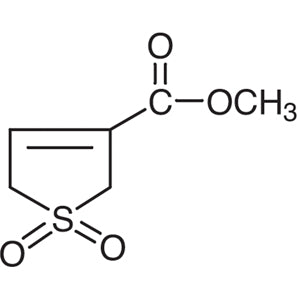
Methyl 3-Sulfolene-3-carboxylate is a chemical compound widely used in organic reactions, particularly in the synthesis of heterocyclic compounds. As a building block in chemical research, it plays a crucial role in the development of complex molecules with specific functional properties. Its unique molecular structure enables various substitution and reaction mechanisms, making it a versatile tool for chemists. This compound is commonly found in laboratories where the creation of new materials or pharmaceuticals is the primary focus.
The compound's chemical stability under controlled conditions makes it a preferred choice for researchers. However, it is highly sensitive to moisture and air exposure, which requires careful handling during storage and use. These characteristics make it suitable for reactions that demand precise environmental control. Its reactivity in different chemical conditions also allows for the exploration of diverse molecular structures, supporting innovation in both academic and industrial research settings.
In Indonesian laboratories, Methyl 3-Sulfolene-3-carboxylate is frequently used in organic chemistry research, especially in the development of new compounds with potential medical or industrial applications. Due to its availability and reliability, it is a commonly selected material for experiments that require a stable yet reactive starting compound. Its role in advancing chemical synthesis is well-recognized among researchers in the region.
Related TCI products
- TCI D0557 77-79-2 3-Sulfolene
- TCI B5501 147804-30-6 tert-Butyl 1-Oxa-6-azaspiro[2.5]octane-6-carboxylate
- TCI B5385 114214-49-2 tert-Butyl 6-Oxa-3-azabicyclo[3.1.0]hexane-3-carboxylate
- TCI B5248 122684-34-8 tert-Butyl 3-Carbamoylpyrrolidine-1-carboxylate
- TCI B5032 1041026-70-3 tert-Butyl 2,6-Diazaspiro[3.3]heptane-2-carboxylate
- TCI B5002 877399-74-1 tert-Butyl 4-[4-(4,4,5,5-Tetramethyl-1,3,2-dioxaborolan-2-yl)pyrazol-1-yl]piperidine-1-carboxylate
- Organic synthesis of heterocyclic compounds due to its reactive functional groups and structural versatility.
- Development of pharmaceutical intermediates where precise molecular modifications are required.
- Creation of advanced materials with specific chemical properties through controlled reaction conditions.
- Research in medicinal chemistry for the design of novel therapeutic agents with targeted biological activity.
- Exploration of chemical reactivity in diverse reaction environments for structural innovation.
| Brand | TCI |
|---|---|
| CAS number | 67488-50-0 |
| Molecular formula | — |
| Purity | — |
| Category | Chemistry > Building Blocks > Heterocyclic Building Blocks |
| Pack sizes | Available in various quantities as per standard laboratory supply formats |
| Physical form | Solid, typically in crystalline or powder form |
| Storage | Requires dry, cool, and well-ventilated conditions to prevent degradation |
Methyl 3-Sulfolene-3-carboxylate should be stored in a dry, cool, and well-ventilated area away from moisture and air exposure. It is recommended to use airtight containers made of materials such as glass or high-density polyethylene to maintain its stability. Due to its sensitivity, it should be handled in a controlled environment with minimal exposure to humidity and oxygen. Laboratory personnel should wear appropriate personal protective equipment, including gloves and safety goggles, when working with this compound. Proper labeling and storage conditions are essential to ensure safety and maintain the compound's chemical integrity during use and storage.
—
Produk Terkait
-
3-Sulfolene TCI D0557
Regular price From Rp 530.250,00Regular priceRp 386.400,00Sale price From Rp 530.250,00 -
tert-Butyl1-Oxa-6-azaspiro[2.5]octane-6-carboxylate TCI B5501
Regular price From Rp 3.074.400,00Regular priceRp 2.165.100,00Sale price From Rp 3.074.400,00 -
tert-Butyl6-Oxa-3-azabicyclo[3.1.0]hexane-3-carboxylate TCI B5385
Regular price From Rp 742.350,00Regular priceRp 534.450,00Sale price From Rp 742.350,00 -
tert-Butyl3-Carbamoylpyrrolidine-1-carboxylate TCI B5248
Regular price From Rp 1.113.000,00Regular priceRp 793.800,00Sale price From Rp 1.113.000,00 -
tert-Butyl2,6-Diazaspiro[3.3]heptane-2-carboxylate TCI B5032
Regular price Rp 3.285.450,00Regular priceRp 2.313.150,00Sale price Rp 3.285.450,00 -
tert-Butyl4-[4-(4,4,5,5-Tetramethyl-1,3,2-dioxaborolan-2-yl)pyrazol-1-yl]piperidine-1-carboxylate TCI B5002
Regular price From Rp 1.749.300,00Regular priceRp 1.239.000,00Sale price From Rp 1.749.300,00 -
tert-Butyl3-(Aminomethyl)azetidine-1-carboxylate TCI B4271
Regular price From Rp 2.862.300,00Regular priceRp 2.017.050,00Sale price From Rp 2.862.300,00 -
Benzyl3-Oxopiperazine-1-carboxylate TCI B4100
Regular price From Rp 1.378.650,00Regular priceRp 979.650,00Sale price From Rp 1.378.650,00


