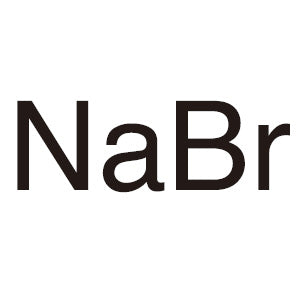
Sodium Bromide (NaBr) is an inorganic compound widely used in chemical experiments and laboratory settings. It is a white crystalline solid that is odorless and highly soluble in water. This compound plays a crucial role in various chemical reactions, particularly in organic synthesis and redox reactions, where it serves as a source of bromide ions. Its stability and compatibility with other reagents make it a reliable choice for laboratory applications. Sodium Bromide is commonly found in both academic and industrial laboratories, supporting a range of analytical and synthetic processes.
The chemical properties of Sodium Bromide make it a preferred choice for laboratory use. Its high solubility in water allows it to be easily incorporated into aqueous solutions and reaction mixtures. Sodium Bromide is chemically stable under normal conditions, meaning it does not readily react with other substances unless under specific conditions. This stability ensures consistent performance in experiments, reducing the risk of unexpected side reactions. Additionally, its non-toxic and non-corrosive nature makes it safe to handle, contributing to its widespread use in laboratory environments.
In Indonesian laboratories, Sodium Bromide is routinely used in chemical research, qualitative analysis, and organic synthesis. It is a common component in high school and university chemistry practical sessions, as well as in scientific research conducted by educational institutions and research organizations. Its versatility and reliability make it an essential reagent for a variety of laboratory tasks, from basic experiments to advanced chemical processes.
TCI brochures (PDF)
- Sodium Electrolytes 2025-09-19 · p. 1
- Metallic Salts 2025-11-06 · p. 5
- Organic synthesis where bromide ions are required for substitution or elimination reactions.
- Redox reactions as a source of bromide ions, facilitating electron transfer processes.
- Qualitative analysis to detect the presence of bromide ions in solution.
- Catalytic processes where sodium bromide acts as a catalyst in certain chemical transformations.
- Analytical chemistry for preparing standard solutions and conducting titration experiments.
| Brand | TCI |
|---|---|
| CAS number | 7647-15-6 |
| Molecular formula | — |
| Purity | — |
| Category | Chemistry > Catalysis and Inorganic Chemistry > Metallic Salts |
| Pack sizes | Available in various quantities as per standard laboratory reagent packaging |
| Physical form | White crystalline solid |
| Storage | Store in a cool, dry place away from moisture and direct sunlight |
Sodium Bromide should be stored in a cool, dry place to maintain its chemical stability. It is advisable to keep it in airtight containers to prevent moisture absorption, which can affect its solubility and purity. As a non-toxic and non-corrosive compound, it is generally safe to handle, but standard laboratory safety precautions should still be followed. Avoid exposure to high temperatures and direct sunlight to ensure long-term stability. Proper labeling and storage in designated chemical cabinets are recommended to ensure safe handling and prevent accidental contamination.
—
Produk Terkait
-
PotassiumBromide TCI P1747
Regular price Rp 477.750,00Regular priceRp 333.900,00Sale price Rp 477.750,00 -
LithiumBromide TCI L0210
Regular price Rp 689.850,00Regular priceRp 481.950,00Sale price Rp 689.850,00 -
CalciumBromide TCI C3811
Regular price From Rp 1.458.450,00Regular priceRp 1.019.550,00Sale price From Rp 1.458.450,00 -
CesiumBromide TCI C2202
Regular price From Rp 2.466.450,00Regular priceRp 1.724.100,00Sale price From Rp 2.466.450,00 -
ZincBromide TCI Z0013
Regular price From Rp 610.050,00Regular priceRp 426.300,00Sale price From Rp 610.050,00 -
StrontiumBromide TCI T4155
Regular price From Rp 2.359.350,00Regular priceRp 1.649.550,00Sale price From Rp 2.359.350,00 -
Thallium(I)Bromide TCI T4083
Regular price From Rp 2.862.300,00Regular priceRp 2.001.300,00Sale price From Rp 2.862.300,00 -
Tin(II)Bromide[forPerovskiteprecursor] TCI T3573
Regular price From Rp 1.565.550,00Regular priceRp 1.094.100,00Sale price From Rp 1.565.550,00