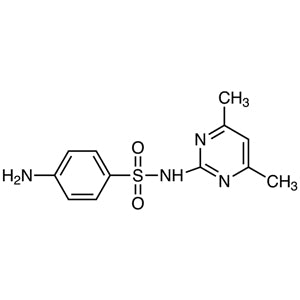
Sulfamethazine Sodium Salt (TCI S0583) is a chemical compound widely used in laboratory settings, particularly in the fields of biochemistry and pharmaceutical analysis. As a sodium salt of sulfamethazine, it belongs to the sulfonamide class of antibiotics and is recognized for its antimicrobial properties. This compound plays a crucial role in various research applications, including the synthesis of other compounds and as a reference standard in chemical analysis. Its stability and high purity make it a reliable choice for scientific investigations.
The compound is valued for its chemical stability and excellent solubility in organic solvents, which facilitates its use in a wide range of laboratory procedures. Its reactivity ensures compatibility with various chemical reactions, making it a versatile reagent. The availability in multiple packaging options allows for flexibility in both small-scale and large-scale laboratory operations. These properties collectively enhance its utility in diverse scientific contexts.
In Indonesian laboratories, Sulfamethazine Sodium Salt is commonly used in pharmaceutical research, quality control testing, and microbiological analysis. Its role in antibiotic research and drug development is significant, supporting the evaluation of antimicrobial efficacy and the formulation of new therapeutic agents. Its consistent performance and reliability make it an essential component in the analytical toolkit of many research facilities.
TCI brochures (PDF)
- Antimicrobials and Antitumor Agents for Research and Experimental Use 2025-04-24 · p. 6
- Pharmaceutical Ingredients for Research and Experimental Use 2026-03-09 · p. 6
- Pharmaceutical research and development where it serves as a key reagent in the synthesis of antibiotics and related compounds.
- Quality control testing of pharmaceutical products to ensure purity and consistency in drug formulations.
- Microbiological testing to assess the effectiveness of antimicrobial agents and evaluate bacterial resistance.
- Chemical analysis as a reference standard for accurate and reproducible results in analytical procedures.
- Biochemical experiments requiring stable and reactive compounds for enzyme inhibition studies and metabolic pathway investigations.
| Brand | TCI |
|---|---|
| CAS number | 1981-58-4 |
| Molecular formula | — |
| Purity | — |
| Category | Life Science > Biochemicals and Reagents > Antibiotics |
| Pack sizes | Available in various sizes to suit different laboratory needs |
| Physical form | Powder |
| Storage | Store in a cool, dry place away from moisture and direct sunlight |
Sulfamethazine Sodium Salt should be stored in a cool, dry environment to maintain its chemical stability and prevent degradation. It is recommended to keep the material in airtight containers to minimize exposure to moisture and contaminants. Due to its reactivity, it should be handled with care, using appropriate personal protective equipment such as gloves and safety goggles. It is important to store it away from incompatible substances to avoid chemical interactions. Proper labeling and storage conditions ensure the safety of laboratory personnel and the integrity of the compound. Regular monitoring of storage conditions helps maintain the quality and effectiveness of the material for research applications.
—
Product Categories
- Biochemicals and ReagentsAntibioticsAntibiotics (Chemical Structure Class)
- Biochemicals and ReagentsPharmaceutical Research Reagents (for Experimental Use)Antimicrobial Ingredients (for Research and Experimental Use)
- MicrobiologyAntibioticsAntibiotics (Chemical Structure Class)
- Pharmaceutical Development and Drug Discovery ResearchPharmaceutical Research Reagents (for Experimental Use)Antimicrobial Ingredients (for Research and Experimental Use)
- Pharmaceutical Development and Drug Discovery ResearchAntibioticsAntibiotics (Chemical Structure Class)
Produk Terkait
-
Sulfamethazine TCI S0586
Regular price From Rp 769.650,00Regular priceRp 553.350,00Sale price From Rp 769.650,00 -
Sulfameter TCI S0590
Regular price From Rp 2.411.850,00Regular priceRp 1.702.050,00Sale price From Rp 2.411.850,00 -
4-AminosalicylicAcid TCI A0420
Regular price From Rp 822.150,00Regular priceRp 590.100,00Sale price From Rp 822.150,00 -
Sodium4-AminosalicylateDihydrate TCI A0423
Regular price From Rp 928.200,00Regular priceRp 664.650,00Sale price From Rp 928.200,00 -
Wortmannin TCI W0007
Regular price Rp 11.632.950,00Regular priceRp 8.150.100,00Sale price Rp 11.632.950,00 -
ValganciclovirHydrochloride TCI V0158
Regular price From Rp 1.618.050,00Regular priceRp 1.146.600,00Sale price From Rp 1.618.050,00 -
ValnemulinHydrochloride TCI V0144
Regular price From Rp 4.982.250,00Regular priceRp 3.499.650,00Sale price From Rp 4.982.250,00 -
Sulfamerazine TCI U0176
Regular price From Rp 2.411.850,00Regular priceRp 1.702.050,00Sale price From Rp 2.411.850,00