

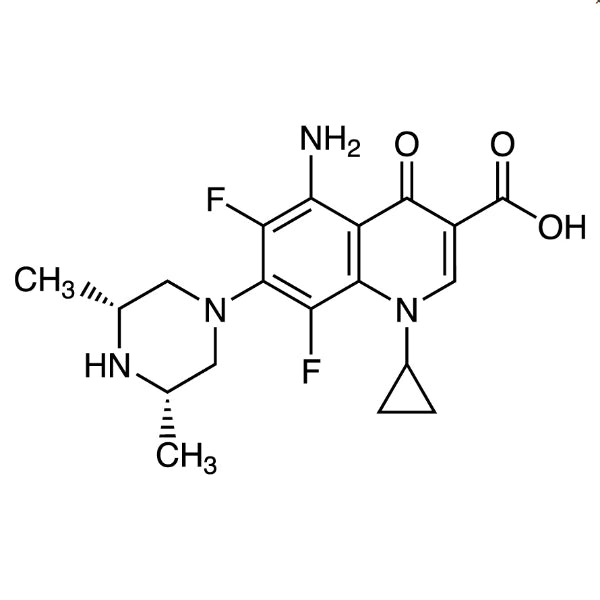
Sparfloxacin is a chemical compound classified under the category of fluoroquinolone antibiotics. It plays a crucial role in laboratory settings by inhibiting bacterial growth, particularly effective against gram-negative bacteria. As a biochemical reagent, it is widely used in microbiological, pharmacological, and biochemical research. Its ability to interfere with DNA gyrase makes it a valuable tool for studying bacterial resistance and antibiotic efficacy. Sparfloxacin is commonly employed in experiments that require precise control over microbial growth, making it an essential component in various scientific investigations.
Sparfloxacin is preferred due to its chemical stability under specific conditions and its solubility in organic solvents such as ethyl acetate or acetone. These properties make it easy to handle and integrate into different analytical methods. Its strong antibacterial activity ensures reliable results in sensitivity testing and antibiotic effectiveness studies. The compound's consistent performance and availability in international markets further enhance its appeal for researchers. Its solubility and stability contribute to its effectiveness in a wide range of laboratory applications.
In Indonesian laboratories, Sparfloxacin is utilized for infection control research, drug development, and clinical laboratory testing. Its reliability in inhibiting bacterial growth and its presence in global supply chains make it a relevant choice for scientific studies. It supports both academic and industrial research by providing a dependable reagent for antibiotic-related experiments. Its application is particularly important in areas where microbial resistance is a growing concern.
TCI brochures (PDF)
- Pharmaceutical Ingredients for Research and Experimental Use 2026-03-09 · p. 6
- Microbiological research utilizes Sparfloxacin to test bacterial susceptibility and resistance patterns due to its strong antibacterial activity.
- Pharmacological studies benefit from Sparfloxacin as it helps evaluate the effectiveness of antibiotics against various bacterial strains.
- Biochemical experiments often incorporate Sparfloxacin to study DNA gyrase inhibition and its impact on bacterial replication.
- Clinical laboratory testing employs Sparfloxacin for antibiotic sensitivity testing to guide treatment decisions in infection management.
- Drug development programs use Sparfloxacin to assess the potential of new compounds against gram-negative bacterial infections.
| Brand | TCI |
|---|---|
| CAS number | 110871-86-8 |
| Molecular formula | — |
| Purity | — |
| Category | Life Science > Biochemicals and Reagents > Antibiotics |
| Pack sizes | Available in standard laboratory quantities |
| Physical form | Solid powder |
| Storage | Store in a cool, dry place away from light |
Sparfloxacin should be stored in a cool, dry environment to maintain its chemical stability. It is recommended to keep the compound in a tightly sealed container to prevent moisture absorption. Due to its solubility in organic solvents, it should be stored away from incompatible materials. Proper labeling is essential to ensure safe handling and prevent accidental exposure. Laboratory personnel should wear appropriate personal protective equipment when handling Sparfloxacin. Regular monitoring of storage conditions helps maintain the integrity of the compound for reliable experimental results.
—
Product Categories
- Biochemicals and ReagentsAntibioticsAntibiotics (Chemical Structure Class)
- Biochemicals and ReagentsPharmaceutical Research Reagents (for Experimental Use)Antimicrobial Ingredients (for Research and Experimental Use)
- MicrobiologyAntibioticsAntibiotics (Chemical Structure Class)
- Pharmaceutical Development and Drug Discovery ResearchPharmaceutical Research Reagents (for Experimental Use)Antimicrobial Ingredients (for Research and Experimental Use)
- Pharmaceutical Development and Drug Discovery ResearchAntibioticsAntibiotics (Chemical Structure Class)
Produk Terkait
-
Norfloxacin TCI N0817
Regular price From Rp 1.378.650,00Regular priceRp 979.650,00Sale price From Rp 1.378.650,00 -
4-AminosalicylicAcid TCI A0420
Regular price From Rp 822.150,00Regular priceRp 590.100,00Sale price From Rp 822.150,00 -
Sodium4-AminosalicylateDihydrate TCI A0423
Regular price From Rp 928.200,00Regular priceRp 664.650,00Sale price From Rp 928.200,00 -
Wortmannin TCI W0007
Regular price Rp 11.632.950,00Regular priceRp 8.150.100,00Sale price Rp 11.632.950,00 -
ValganciclovirHydrochloride TCI V0158
Regular price From Rp 1.618.050,00Regular priceRp 1.146.600,00Sale price From Rp 1.618.050,00 -
ValnemulinHydrochloride TCI V0144
Regular price From Rp 4.982.250,00Regular priceRp 3.499.650,00Sale price From Rp 4.982.250,00 -
Sulfamerazine TCI U0176
Regular price From Rp 2.411.850,00Regular priceRp 1.702.050,00Sale price From Rp 2.411.850,00 -
SulfadiazineSodium TCI U0171
Regular price Rp 1.220.100,00Regular priceRp 868.350,00Sale price Rp 1.220.100,00


