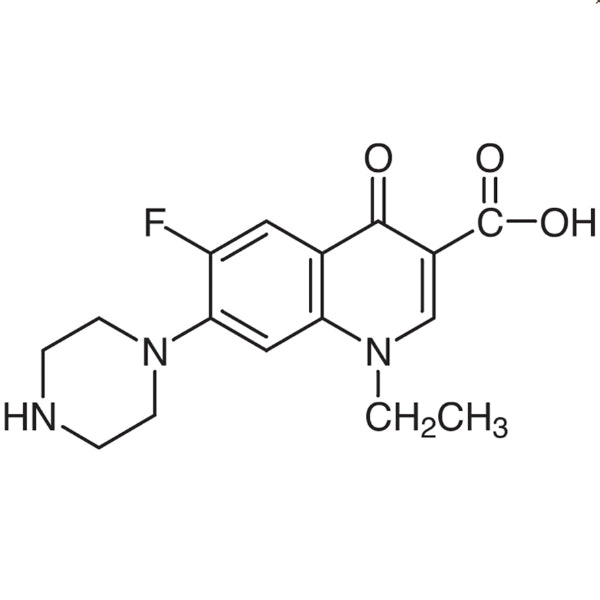
TCI N0817 Norfloxacin (CAS 70458-96-7) is a synthetic antibiotic from the fluoroquinolone class. Fluoroquinolones are quinolones that carry a fluorine atom and a piperazine ring on their core structure. In the laboratory, norfloxacin serves as a reference compound and a biochemical reagent. Researchers use it to study antibacterial activity, how quinolones work, and microbial resistance. It works by inhibiting two bacterial enzymes, DNA gyrase and topoisomerase IV. Both enzymes are essential for DNA replication, so blocking them stops bacterial growth.
Researchers often choose norfloxacin because its mechanism of action is well documented. This makes it a reliable positive control in antibacterial assays and a useful comparison compound when new antibiotic candidates are evaluated. Its fluoroquinolone structure also interests medicinal chemists. The piperazine and carboxylic acid groups can be modified to make new derivatives, so the molecule is a practical starting point for structure-activity studies. Norfloxacin is also often used as a target analyte when developing analytical methods for antibiotic residues in environmental and food samples.
In Indonesia, this material is relevant to microbiology, pharmaceutical, analytical chemistry and environmental laboratories. University research groups can use it in antibacterial screening and in studies of quinolone resistance in local bacterial isolates. Pharmaceutical laboratories can use it as a comparison compound during research and development. Analytical and environmental laboratories can use it as a target compound when they build and validate methods to detect antibiotic residues in water, soil and food.
- Positive control in antibacterial assays: its well-documented inhibition of DNA gyrase and topoisomerase IV gives a dependable baseline for comparing test results.
- Studies of the quinolone mechanism of action: it shows how enzyme inhibition stops bacterial DNA replication, which makes it well suited to mechanistic and biochemical investigations.
- Microbial resistance research: it is an established fluoroquinolone for examining how bacterial strains develop reduced susceptibility to the quinolone class of antibiotics.
- Medicinal chemistry and derivative synthesis: its piperazine and carboxylic acid groups can be modified, which makes it a useful scaffold for designing and synthesising new fluoroquinolone derivatives.
- Analytical method development for antibiotic residues: it is commonly used as a target analyte when developing and validating detection methods for environmental and food samples.
| Brand | TCI (product code N0817) |
|---|---|
| CAS number | 70458-96-7 |
| Molecular formula | — |
| Purity | — |
| Category | Life Science > Biochemicals and Reagents > Antibiotics |
| Pack sizes | as listed on the product page |
| Physical form | solid; see the TCI product label and certificate of analysis |
| Storage | follow the conditions stated on the TCI label and Safety Data Sheet |
Store norfloxacin in its original, tightly closed container in a cool, dry and well-ventilated place, away from direct light and moisture. Always follow the storage conditions on the TCI label and in the Safety Data Sheet. After use, reseal the container quickly so the material does not absorb moisture or become contaminated. Handle the compound as an active pharmaceutical substance. Wear suitable personal protective equipment, including a lab coat, gloves and safety glasses, and avoid breathing in dust or letting it touch your skin. Weigh and prepare solutions in a well-ventilated area or a fume hood. Dispose of residues and contaminated materials according to local regulations for antibiotic and chemical waste.
—
Produk Terkait
-
TCI B5774 5,10-Bis(4,4,5,5-tetramethyl-1,3,2-dioxaborolan-2-yl)naphtho[1,2-c:5,6-c']bis([1,2,5]oxadiazole)
Regular price Rp 10.255.350,00Regular price -
Dihydroiodide TCI B6569
Regular price From Rp 1.936.200,00Regular price -
Trifluoromethanesulfonate TCI B7003
Regular price From Rp 1.936.200,00Regular price
![5,10-Bis(4,4,5,5-tetramethyl-1,3,2-dioxaborolan-2-yl)naphtho[1,2-c:5,6-c']bis([1,2,5]oxadiazole) - TCI B5774 - AMI Scientific](http://amiscientific.com/cdn/shop/files/TCI2510B5774.jpg?v=1769180228&width=533)