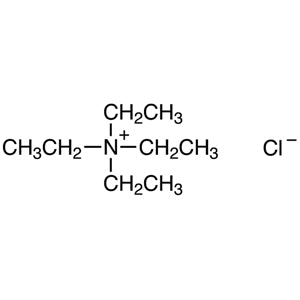
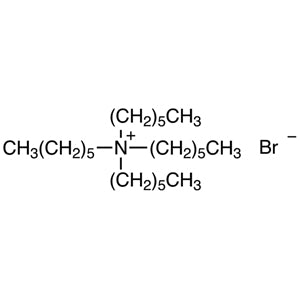
Tetraethylammonium Bromide (TEAB) is a chemical compound widely used in various chemical reactions, particularly in phase transfer reactions. It functions as an effective phase transfer catalyst, facilitating reactions between immiscible phases such as water and organic solvents. In the laboratory, TEAB plays a crucial role in accelerating chemical reactions that require interaction between polar and non-polar molecules. Its ability to bridge different phases makes it indispensable in synthetic chemistry processes. This compound is favored for its stability and controlled reactivity, making it a reliable choice for a wide range of chemical applications.
TEAB is characterized by its ability to act as an ionic species that can move between phases. Its cationic structure enables efficient interaction with both polar and non-polar molecules, enhancing reaction efficiency. The compound exhibits relatively stable chemical properties, which means it remains effective under common laboratory conditions without significant degradation. This stability ensures that TEAB is suitable for applications requiring a catalyst that resists side reactions. Its reliability and performance make it a preferred choice in both research and industrial settings.
In Indonesian laboratories, TEAB is extensively used in chemical research, particularly in the field of synthetic chemistry. It is commonly employed in reactions that require phase transfer catalysis, such as those involving aqueous and organic phases. Its widespread use reflects its importance in advancing chemical processes and supporting scientific investigations in the region. TEAB is a fundamental reagent in many laboratory protocols, contributing to the efficiency and success of various chemical experiments.
TCI brochures (PDF)
- Quaternary Ammonium Salts 2025-11-10 · p. 5
- Colloidal Quantum Dot (QD) Research Reagents 2026-05-21 · p. 9
Related TCI products
- Phase Transfer Catalysis in Organic Synthesis: TEAB is ideal for promoting reactions between immiscible phases, enhancing reaction efficiency and yield in organic synthesis.
- Aqueous-Organic Reaction Systems: Its ability to move between aqueous and organic phases makes it suitable for reactions that require efficient mass transfer between these two phases.
- Polymerization Reactions: TEAB can facilitate the formation of polymers by enabling interactions between polar and non-polar components in the reaction mixture.
- Analytical Chemistry Applications: It is used in analytical techniques where phase transfer is necessary for sample preparation and separation processes.
- Catalytic Reactions in Green Chemistry: TEAB supports environmentally friendly chemical processes by improving reaction efficiency and reducing the need for harsh conditions.
| Brand | TCI |
|---|---|
| CAS number | 71-91-0 |
| Molecular formula | — |
| Purity | — |
| Category | Chemistry > Synthetic Reagents > Phase Transfer Catalysts |
| Pack sizes | Available in various quantities as per standard laboratory reagent packaging |
| Physical form | Solid powder or crystalline solid, depending on the packaging |
| Storage | Store in a cool, dry place away from moisture and direct sunlight |
TEAB should be stored in a cool, dry environment to maintain its chemical stability and prevent degradation. It is recommended to keep the compound in airtight containers to avoid moisture exposure, which can affect its performance. Suitable storage conditions include a controlled room temperature, typically between 15°C and 25°C, to ensure long-term usability. General laboratory precautions include handling with care to prevent inhalation or skin contact, and storing away from incompatible substances. Proper labeling and safe storage practices are essential to ensure the safety of laboratory personnel and the integrity of the compound.
—
Produk Terkait
-
TetraethylammoniumChloride TCI T0095
Regular price From Rp 1.167.600,00Regular priceRp 831.600,00Sale price From Rp 1.167.600,00 -
TrimethylpropylammoniumBromide TCI T2762
Regular price Rp 6.704.250,00Regular priceRp 4.704.000,00Sale price Rp 6.704.250,00 -
TrimethylnonylammoniumBromide TCI T2734
Regular price Rp 1.801.800,00Regular priceRp 1.275.750,00Sale price Rp 1.801.800,00 -
Tetra-n-octylammoniumBromide TCI T1603
Regular price From Rp 1.618.050,00Regular priceRp 1.146.600,00Sale price From Rp 1.618.050,00 -
TetraheptylammoniumBromide TCI T1602
Regular price From Rp 1.298.850,00Regular priceRp 924.000,00Sale price From Rp 1.298.850,00 -
TetrahexylammoniumBromide TCI T1599
Regular price Rp 2.889.600,00Regular priceRp 2.035.950,00Sale price Rp 2.889.600,00 -
TetraamylammoniumBromide TCI T1432
Regular price From Rp 1.326.150,00Regular priceRp 942.900,00Sale price From Rp 1.326.150,00 -
Tetra(decyl)ammoniumBromide TCI T1142
Regular price From Rp 4.796.400,00Regular priceRp 3.369.450,00Sale price From Rp 4.796.400,00