

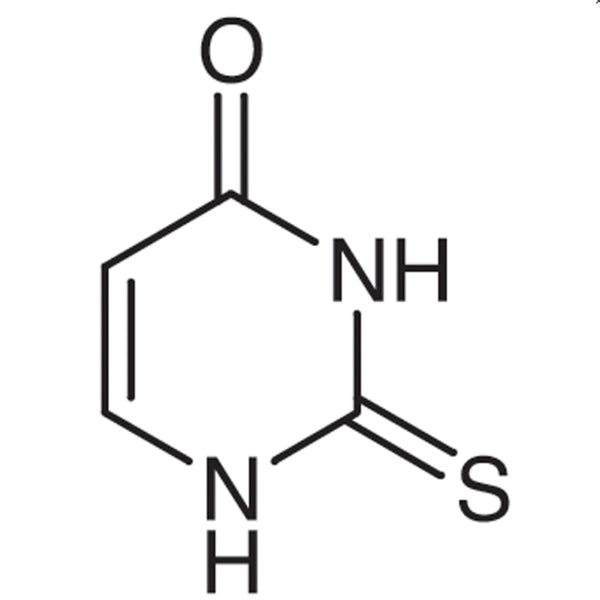
2-Thiouracil is a chemical compound widely used in biochemical and biomedical experiments. As a derivative of uracil, one of the key components of nucleic acids like RNA, it plays a crucial role in various scientific investigations. In the laboratory, it serves as a building block for the synthesis of compounds with specific biological activities. Its unique chemical structure, where a sulfur atom replaces an oxygen atom in the second position of uracil, gives it distinct reactivity and functionality. This makes it an essential reagent in research focused on nucleotide metabolism and drug development.
The stability and controlled reactivity of 2-Thiouracil make it a preferred choice for researchers. Its high purity and consistent quality ensure reliable results in experiments that demand precision. The compound’s ability to form bonds with various molecules enhances its versatility in different applications. These properties make it suitable for advanced studies in biochemistry and molecular biology. Its chemical stability also allows for long-term storage and use in multiple experimental setups without compromising its integrity.
In Indonesian laboratories, 2-Thiouracil is extensively used in biomedical, pharmacological, and biotechnological research. It is a key component in experiments involving the synthesis of active compounds and the study of nucleotide-related processes. Many research institutions and universities rely on this compound for its reliability and effectiveness in various scientific applications. Its widespread use underscores its importance in modern laboratory practices in Indonesia.
TCI brochures (PDF)
- Nucleosides, Nucleotides, Nucleic Acids and Related Reagents 2026-03-23 · p. 8
- Reagents for Biological Research 2025-03-11 · p. 60
- Biochemical Synthesis: 2-Thiouracil is used in the synthesis of nucleotide derivatives and other bioactive compounds due to its unique sulfur-containing structure.
- Drug Development: It is a valuable reagent in the development of pharmaceuticals, particularly in the study of nucleotide-based therapies and metabolic pathways.
- Nucleotide Metabolism Research: Its role as a nucleotide analog makes it essential for studying metabolic processes and enzyme interactions in nucleic acid metabolism.
- Molecular Biology Studies: It is frequently used in molecular biology experiments to investigate DNA and RNA interactions and modifications.
- Biotechnology Applications: It supports biotechnological research by enabling the creation of modified nucleic acids for various genetic and biochemical applications.
| Brand | TCI |
|---|---|
| CAS number | 141-90-2 |
| Molecular formula | — |
| Purity | — |
| Category | Life Science > Biochemicals and Reagents > Nucleosides, Nucleotides, Oligonucleotides |
| Pack sizes | Available in various quantities as per standard laboratory requirements |
| Physical form | Solid powder |
| Storage | Store in a cool, dry place away from light and moisture |
2-Thiouracil should be stored in a cool, dry environment, away from direct sunlight and moisture. It is recommended to keep it in a sealed container to prevent exposure to air and humidity. Due to its chemical nature, it should be handled with care, using appropriate personal protective equipment such as gloves and safety goggles. It is important to ensure that the storage area is well-ventilated to avoid any potential accumulation of airborne particles. Regular inspection of the container and storage conditions is advised to maintain the compound’s integrity and safety in the laboratory.
—
Produk Terkait
-
4-Thiouracil TCI T2757
Regular price Rp 2.835.000,00Regular priceRp 1.998.150,00Sale price Rp 2.835.000,00 -
6-Propyl-2-thiouracil TCI P0533
Regular price Rp 3.100.650,00Regular priceRp 2.184.000,00Sale price Rp 3.100.650,00 -
6-Phenyl-2-thiouracil TCI P0236
Regular price From Rp 1.723.050,00Regular priceRp 1.220.100,00Sale price From Rp 1.723.050,00 -
5-Methyl-2-thiouracil TCI M0994
Regular price From Rp 1.961.400,00Regular priceRp 1.387.050,00Sale price From Rp 1.961.400,00 -
6-Methyl-2-thiouracil TCI M0443
Regular price From Rp 795.900,00Regular priceRp 572.250,00Sale price From Rp 795.900,00 -
6-Azauracil TCI A0558
Regular price From Rp 610.050,00Regular priceRp 442.050,00Sale price From Rp 610.050,00 -
AdenineSulfateDihydrate TCI A0151
Regular price From Rp 3.074.400,00Regular priceRp 2.165.100,00Sale price From Rp 3.074.400,00 -
AdenineHydrochlorideHemihydrate TCI A0150
Regular price From Rp 717.150,00Regular priceRp 516.600,00Sale price From Rp 717.150,00


