

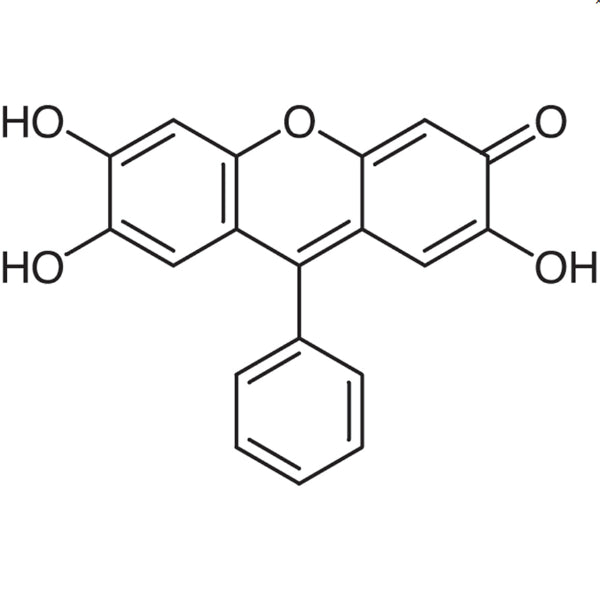
Phenylfluorone is an organic compound widely used in scientific applications, particularly in the fields of chemistry and materials science. It plays a crucial role in laboratories as a foundational material for the synthesis of fluorescent compounds. These compounds are essential for both quantitative and qualitative analysis in various research settings. Its ability to absorb light and re-emit it in a different wavelength makes it highly valuable in spectroscopic techniques. This property allows researchers to study molecular interactions and structural changes with high precision.
The compound's strong fluorescence and stable chemical structure make it a preferred choice for optical and material research. Its chemical stability enables it to adapt to a wide range of reaction conditions, enhancing its versatility in laboratory settings. Additionally, its relatively high safety profile ensures ease of use in experimental procedures. The compound’s non-reactive nature also simplifies storage and handling, making it suitable for use in different scales of experimentation.
In Indonesian laboratories, Phenylfluorone is commonly utilized in analytical chemistry and optical material research. It is an essential component in studies related to fluorescence spectroscopy and material characterization. Its reliability and consistent performance make it a trusted material for scientific investigations in both academic and industrial research environments.
Related TCI products
- Fluorescence Spectroscopy: Phenylfluorone is ideal for fluorescence spectroscopy due to its strong emission properties, allowing precise measurement of molecular interactions and structural changes.
- Optical Material Development: The compound is used in the development of optical materials because of its stable chemical structure and ability to emit light at specific wavelengths.
- Quantitative Analysis: Its fluorescent characteristics make it suitable for quantitative analysis in analytical chemistry, enabling accurate detection of substances in complex mixtures.
- Material Characterization: Phenylfluorone is employed in material characterization studies to assess optical properties and behavior under different conditions.
- Research in Photonic Materials: Its role in photonic materials research is significant, as it contributes to the creation of advanced optical components and sensors.
| Brand | TCI |
|---|---|
| CAS number | 975-17-7 |
| Molecular formula | — |
| Purity | — |
| Category | Materials Science > Photonic Materials and Optical Materials > Xanthene Dyes |
| Pack sizes | Available in various quantities as per standard laboratory supply |
| Physical form | Solid |
| Storage | Store in a cool, dry place away from direct light |
Phenylfluorone should be stored in a cool, dry place away from direct light to maintain its chemical stability and fluorescence properties. It is recommended to use airtight containers to prevent moisture absorption and contamination. Since it is non-reactive, it can be safely handled with standard laboratory precautions. However, it is advisable to work in a well-ventilated area to minimize exposure. The compound does not require special handling beyond standard safety practices, making it suitable for routine use in laboratory environments. Always ensure proper labeling and storage to maintain its integrity and usability for research purposes.
—
Product Categories
Produk Terkait
-
9,9-Diphenylfluorene TCI D3586
Regular price From Rp 2.518.950,00Regular priceRp 1.760.850,00Sale price From Rp 2.518.950,00
