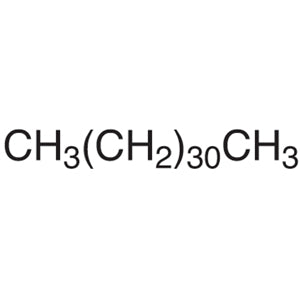
Tetratriacontane is a long-chain alkane with the molecular formula C34H70. It is a non-heterocyclic compound, meaning it does not contain any heteroatoms such as oxygen, nitrogen, or sulfur. This makes it highly stable and suitable for use in various chemical experiments where structural integrity is crucial. In laboratory settings, Tetratriacontane is often used as a building block for synthesizing more complex organic compounds. Its inert nature allows it to act as a non-reactive medium or a stabilizing agent in certain chemical reactions.
One of the key properties that make Tetratriacontane a preferred choice is its non-polar character and chemical inertness. These properties ensure that it does not interact with other substances under normal laboratory conditions, making it ideal for use in environments where reactivity needs to be minimized. Additionally, it has a high melting and boiling point, which allows it to remain stable under elevated temperatures. This thermal stability is particularly valuable in experiments that require high-temperature conditions without compromising the integrity of the compound.
In Indonesian laboratories, Tetratriacontane is commonly used in organic synthesis and physical chemistry studies. Its role as a structural component in hydrocarbon research makes it a valuable tool for understanding molecular behavior and chemical properties. Due to its stability and inert nature, it is also used as a reference material or a medium in various analytical procedures. Its application is widespread in both academic and industrial research settings across Indonesia.
- Organic synthesis as a structural building block for creating complex hydrocarbon molecules due to its linear and stable structure.
- Physical chemistry experiments to study the thermal and physical properties of long-chain alkanes under controlled conditions.
- As a non-reactive solvent in reactions where minimal interaction with other compounds is required to maintain reaction specificity.
- In analytical chemistry for use as a reference standard in chromatographic and spectroscopic analyses due to its well-defined molecular structure.
- For use in polymer science research as a model compound to study the behavior of long-chain hydrocarbons in different environments.
| Brand | TCI |
|---|---|
| CAS number | 14167-59-0 |
| Molecular formula | — |
| Purity | — |
| Category | Chemistry > Building Blocks > Non-Heterocyclic Building Blocks |
| Pack sizes | Available in various quantities as per standard laboratory supply options |
| Physical form | Solid at room temperature |
| Storage | Store in a cool, dry place away from direct sunlight and sources of heat |
Tetratriacontane should be stored in a cool, dry environment to maintain its stability and prevent degradation. It is recommended to keep it in a sealed container to minimize exposure to air and moisture. Due to its non-polar and inert nature, it does not react with most common laboratory materials, but it is still important to handle it with care to avoid contamination. Suitable containers for storage include glass or high-density polyethylene vessels. In laboratory settings, it is advisable to store it away from reactive or flammable substances to ensure safety. Regular inspection of storage conditions is recommended to maintain optimal properties for experimental use.
—
Produk Terkait
-
Tetratriacontane TCI T2938
Regular price From Rp 3.260.250,00Regular priceRp 2.279.550,00Sale price From Rp 3.260.250,00 -
Triacontane TCI T0594
Regular price From Rp 2.094.750,00Regular priceRp 1.464.750,00Sale price From Rp 2.094.750,00 -
Dotriacontane TCI D0998
Regular price From Rp 1.167.600,00Regular priceRp 815.850,00Sale price From Rp 1.167.600,00 -
Hexatriacontane TCI H0120
Regular price Rp 3.630.900,00Regular priceRp 2.538.900,00Sale price Rp 3.630.900,00 -
Tritriacontane TCI T0968
Regular price From Rp 3.155.250,00Regular priceRp 2.206.050,00Sale price From Rp 3.155.250,00 -
Hentriacontane TCI H0012
Regular price From Rp 3.683.400,00Regular priceRp 2.575.650,00Sale price From Rp 3.683.400,00 -
Pentatriacontane TCI P0062
Regular price From Rp 3.976.350,00Regular priceRp 2.780.400,00Sale price From Rp 3.976.350,00 -
Heptatriacontane TCI H0920
Regular price From Rp 3.100.650,00Regular priceRp 2.168.250,00Sale price From Rp 3.100.650,00