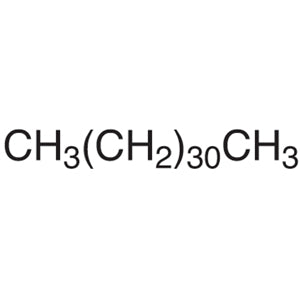
Tritriacontane is a long-chain alkane with a linear structure, belonging to the family of saturated hydrocarbons. It is commonly used in laboratory settings as a fundamental building block for the synthesis of complex organic compounds. Its chemical stability makes it a reliable material for experiments requiring consistent chemical behavior. As a non-reactive and non-polar compound, Tritriacontane is widely utilized in chemical reactions and purification processes. Its inert nature ensures that it does not interfere with the chemical processes it supports.
The key properties of Tritriacontane include its high melting and boiling points, which make it suitable for use in high-temperature applications. Its low solubility in polar solvents such as water, combined with its solubility in organic solvents like ether and chloroform, makes it ideal for dissolving and isolating non-polar substances. This characteristic is particularly useful in chromatographic techniques and solvent extraction methods. Additionally, its chemical inertness ensures that it does not react with other compounds under typical laboratory conditions.
In Indonesian laboratories, Tritriacontane is frequently used in organic chemistry research, especially in the synthesis of complex molecules and in the isolation and identification of organic compounds. Its stability and non-reactive nature make it a preferred choice for a wide range of experimental procedures. It is also used as a reference material in analytical chemistry due to its consistent properties and predictable behavior under various conditions.
- Organic synthesis as a non-reactive building block for complex molecule creation due to its chemical stability and inert nature.
- Solvent for dissolving non-polar compounds in chromatography and extraction techniques because of its solubility in organic solvents.
- Reference material in analytical chemistry for consistent and predictable behavior in experimental conditions.
- Use in high-temperature applications due to its high melting and boiling points.
- Support in isolation and identification of organic compounds through its inert properties and low reactivity.
| Brand | TCI |
|---|---|
| CAS number | 630-05-7 |
| Molecular formula | — |
| Purity | — |
| Category | Chemistry > Building Blocks > Non-Heterocyclic Building Blocks |
| Pack sizes | Available in various quantities as per supplier specifications |
| Physical form | Solid at room temperature |
| Storage | Store in a cool, dry place away from direct sunlight |
Tritriacontane should be stored in a cool, dry environment to maintain its chemical stability and prevent degradation. It is recommended to use airtight containers to minimize exposure to moisture and air. Due to its non-reactive nature, it does not require special handling beyond standard laboratory safety practices. However, it is advisable to keep it away from heat sources to prevent melting. In laboratories, Tritriacontane is typically stored in a designated chemical storage cabinet, ensuring it is easily accessible but securely contained. Always ensure proper labeling and follow standard safety protocols when handling this compound.
—
Produk Terkait
-
Triacontane TCI T0594
Regular price From Rp 2.094.750,00Regular priceRp 1.464.750,00Sale price From Rp 2.094.750,00 -
Dotriacontane TCI D0998
Regular price From Rp 1.167.600,00Regular priceRp 815.850,00Sale price From Rp 1.167.600,00 -
Tetratriacontane TCI T2938
Regular price From Rp 3.260.250,00Regular priceRp 2.279.550,00Sale price From Rp 3.260.250,00 -
Tetratriacontane TCI T0687
Regular price From Rp 1.881.600,00Regular priceRp 1.315.650,00Sale price From Rp 1.881.600,00 -
Pentatriacontane TCI P0062
Regular price From Rp 3.976.350,00Regular priceRp 2.780.400,00Sale price From Rp 3.976.350,00 -
Heptatriacontane TCI H0920
Regular price From Rp 3.100.650,00Regular priceRp 2.168.250,00Sale price From Rp 3.100.650,00 -
Hexatriacontane TCI H0120
Regular price Rp 3.630.900,00Regular priceRp 2.538.900,00Sale price Rp 3.630.900,00 -
Hentriacontane TCI H0012
Regular price From Rp 3.683.400,00Regular priceRp 2.575.650,00Sale price From Rp 3.683.400,00