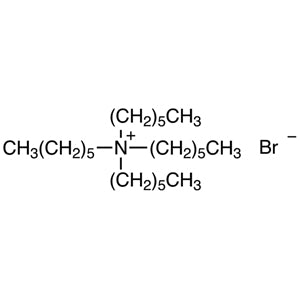
Tetrapropylammonium Bromide (TPAB) is a chemical compound widely used as a phase transfer catalyst in various chemical reactions. It plays a crucial role in laboratory settings by facilitating the transfer of electrons or protons between different phases, such as organic and aqueous phases. This property makes it particularly valuable in reactions where phase transfer is essential for the reaction to proceed efficiently. TPAB is commonly employed in the synthesis of complex compounds, especially in reactions requiring non-alcoholic catalysts. Its ability to enhance reaction efficiency and speed up chemical processes is vital for reducing experimental time and minimizing the use of reagents.
TPAB is favored for its stable chemical properties and resistance to degradation under various conditions. These characteristics allow it to be reused in certain applications, making it a cost-effective and reliable choice for laboratories. It is non-toxic and odorless, ensuring a safe working environment. Its insolubility in water and solubility in organic solvents make it ideal for a wide range of chemical reactions. The compound’s stability and effectiveness across different reaction conditions further solidify its position as a preferred catalyst in both research and industrial settings.
In Indonesian laboratories, TPAB is frequently used in both pure and applied chemical research. Its versatility and reliability make it an essential reagent for chemists working on complex synthesis processes. The compound’s consistent performance and safety profile contribute to its widespread use in academic and industrial laboratories across Indonesia. Its ability to enhance reaction efficiency and reduce waste makes it a valuable tool in modern chemical research.
TCI brochures (PDF)
- Quaternary Ammonium Salts 2025-11-10 · p. 5
- Colloidal Quantum Dot (QD) Research Reagents 2026-05-21 · p. 9
Related TCI products
- Phase transfer catalysis in organic synthesis reactions due to its ability to mediate between aqueous and organic phases.
- Accelerating reactions that require non-alcoholic catalysts in the production of complex chemical compounds.
- Enhancing the efficiency of reactions involving electron or proton transfer across different phases in aqueous systems.
- Supporting the development of new chemical compounds in both academic and industrial research settings.
- Facilitating the synthesis of pharmaceuticals and specialty chemicals where phase transfer is critical to reaction success.
| Brand | TCI |
|---|---|
| CAS number | 1941-30-6 |
| Molecular formula | — |
| Purity | — |
| Category | Chemistry > Synthetic Reagents > Phase Transfer Catalysts |
| Pack sizes | Available in various quantities as per supplier specifications |
| Physical form | Solid powder |
| Storage | Store in a cool, dry place away from moisture and direct sunlight |
TPAB should be stored in a cool, dry environment to maintain its chemical stability and effectiveness. It is recommended to keep it in airtight containers to prevent exposure to moisture, which can affect its performance. Since it is non-toxic and odorless, it does not pose significant health risks, but standard laboratory safety protocols should still be followed. The compound is stable under normal storage conditions and does not require refrigeration. It is advisable to avoid prolonged exposure to high temperatures or direct sunlight to preserve its properties. Proper labeling and storage in designated chemical cabinets are essential for safe handling and easy access in a laboratory setting.
—
Produk Terkait
-
TetrapropylammoniumChloride TCI T2106
Regular price Rp 1.908.900,00Regular priceRp 1.350.300,00Sale price Rp 1.908.900,00 -
TetrapropylammoniumIodide TCI T0172
Regular price From Rp 1.405.950,00Regular priceRp 998.550,00Sale price From Rp 1.405.950,00 -
TrimethylpropylammoniumBromide TCI T2762
Regular price Rp 6.704.250,00Regular priceRp 4.704.000,00Sale price Rp 6.704.250,00 -
TrimethylnonylammoniumBromide TCI T2734
Regular price Rp 1.801.800,00Regular priceRp 1.275.750,00Sale price Rp 1.801.800,00 -
Tetra-n-octylammoniumBromide TCI T1603
Regular price From Rp 1.618.050,00Regular priceRp 1.146.600,00Sale price From Rp 1.618.050,00 -
TetraheptylammoniumBromide TCI T1602
Regular price From Rp 1.298.850,00Regular priceRp 924.000,00Sale price From Rp 1.298.850,00 -
TetrahexylammoniumBromide TCI T1599
Regular price Rp 2.889.600,00Regular priceRp 2.035.950,00Sale price Rp 2.889.600,00 -
TetraamylammoniumBromide TCI T1432
Regular price From Rp 1.326.150,00Regular priceRp 942.900,00Sale price From Rp 1.326.150,00