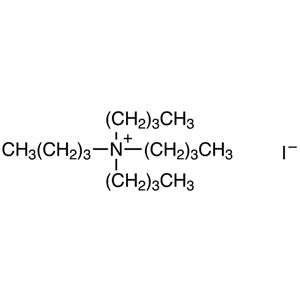
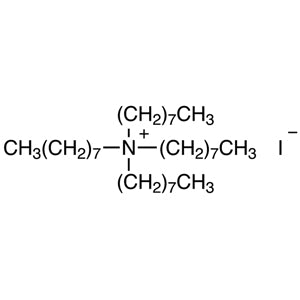
Tetrapropylammonium Iodide from TCI is a quaternary ammonium salt made up of a tetrapropylammonium cation and an iodide anion. Chemists know it mainly as a phase transfer catalyst, a reagent that carries anions from the aqueous phase into the organic phase so that reactions between two immiscible phases can proceed. It is also used as a source of iodide ions, as a supporting electrolyte in electrochemistry, and as a structure-directing agent in the synthesis of porous materials. Because it does so many jobs, both synthesis and characterization laboratories keep it in regular use.
Researchers choose tetrapropylammonium iodide because its quaternary cation balances hydrophobic and hydrophilic character. That balance lets the salt dissolve reasonably well in a range of polar solvents and in some organic solvents. The tetrapropylammonium cation is fairly stable and rarely takes part in the reaction itself, so the iodide ion is free to act as a nucleophile or co-catalyst. In electrochemistry, the salt supplies charge-carrying ions over a usable potential window. It is also a solid, so it can be weighed accurately for reproducible results.
In Indonesia, this salt is useful to laboratories working in synthetic organic chemistry, electrochemistry and materials research. University research groups use it for two-phase reactions with sensitive or poorly soluble reactants, for preparing electrolyte solutions in electrochemical studies, and for synthesizing porous materials that need a structure-directing agent. Teaching laboratories can also use it to show how a phase transfer catalyst works, which makes it a practical reagent for both research and education.
TCI brochures (PDF)
- Solar Cell Materials 2026-04-21 · p. 12
- Quaternary Ammonium Salts 2025-11-10 · p. 7
- Colloidal Quantum Dot (QD) Research Reagents 2026-05-21 · p. 8
- Phase transfer catalysis: the tetrapropylammonium cation carries anions from the aqueous phase into the organic phase, so reactions between immiscible phases can proceed efficiently.
- Iodide ion source: the salt provides iodide that can act as a nucleophile or co-catalyst, and the stable cation does not interfere with the main reaction.
- Supporting electrolyte in electrochemistry: in solution, the salt supplies charge-carrying ions with a usable potential window, which suits electrochemical measurements and studies.
- Structure-directing agent for porous materials: the quaternary ammonium cation guides how the framework forms during synthesis, which helps researchers working on porous material preparation.
- Teaching and method development: the salt is solid, easy to weigh accurately and dissolves in many solvents, so it works well for demonstrating phase transfer concepts and for repeatable method development.
| Brand | TCI |
|---|---|
| CAS number | 631-40-3 |
| Molecular formula | — |
| Purity | — |
| Category | Chemistry > Synthetic Reagents > Phase Transfer Catalysts |
| Pack sizes | as listed for this product on this page |
| Physical form | solid; store according to the manufacturer's label and safety data sheet |
| Storage | — |
- Product code: T0172
Keep tetrapropylammonium iodide in its original tightly closed container, in a cool, dry, well-ventilated place away from direct light and moisture. Close the container straight after use to protect the material from humidity and contamination. Store it apart from incompatible substances, as described in the manufacturer's safety data sheet. When handling it, wear standard laboratory protective equipment: safety glasses, gloves and a lab coat. Weigh and transfer the solid carefully to avoid creating dust. Do not inhale, ingest or let it touch your skin. Read the safety data sheet before use, and dispose of residues according to local laboratory waste rules.
—
Product Categories
Produk Terkait
-
TetrahexylammoniumIodide TCI T1010
Regular price From Rp 1.167.600,00Regular priceRp 831.600,00Sale price From Rp 1.167.600,00 -
TetramethylammoniumIodide TCI T0139
Regular price From Rp 900.900,00Regular priceRp 645.750,00Sale price From Rp 900.900,00 -
TetrabutylammoniumIodide TCI T0057
Regular price From Rp 769.650,00Regular priceRp 553.350,00Sale price From Rp 769.650,00 -
EthyltrimethylammoniumIodide TCI E0190
Regular price Rp 2.677.500,00Regular priceRp 1.887.900,00Sale price Rp 2.677.500,00 -
TetrapropylammoniumChloride TCI T2106
Regular price Rp 1.908.900,00Regular priceRp 1.350.300,00Sale price Rp 1.908.900,00 -
TetrapropylammoniumBromide TCI T0694
Regular price From Rp 637.350,00Regular priceRp 460.950,00Sale price From Rp 637.350,00 -
Tetra-n-octylammoniumIodide TCI T1155
Regular price Rp 6.598.200,00Regular priceRp 4.629.450,00Sale price Rp 6.598.200,00 -
TetraamylammoniumIodide TCI T1011
Regular price From Rp 1.643.250,00Regular priceRp 1.164.450,00Sale price From Rp 1.643.250,00