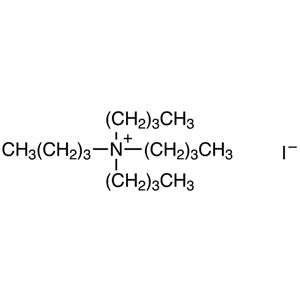
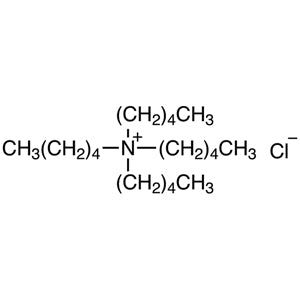
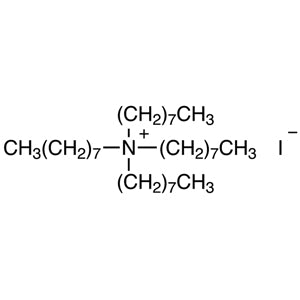
Tetraamylammonium Iodide from TCI, catalog code T1011, is a quaternary ammonium salt. Its cation carries four amyl (pentyl) chains bonded to a single nitrogen atom, and its anion is iodide. The compound belongs to the group of organic salts used in ionic liquid research and specialty synthesis chemistry. In the laboratory, it serves as a phase-transfer catalyst, as a supporting electrolyte in electrochemical measurements, and as a source of iodide ions that dissolves well in organic solvents.
Researchers choose this salt because its cation is large and lipophilic. A cation of this kind helps carry anions from an aqueous phase into an organic phase, so reactions between two immiscible phases can proceed more efficiently. The long alkyl chains give it better solubility in organic solvents than smaller tetraalkylammonium salts. The iodide anion is also useful as a nucleophile or co-catalyst in certain substitution reactions, which makes this compound an interesting point of comparison within a series of tetraalkylammonium salts.
Organic chemistry and physical chemistry laboratories at universities and research institutions in Indonesia can use Tetraamylammonium Iodide in synthesis development, electrochemical studies and comparative work on quaternary ammonium salts. It suits teams that need a reliable reagent from a recognized brand for bench-scale experiments, and it can be ordered through AMI Scientific as part of a wider range of specialty synthesis chemicals.
TCI brochures (PDF)
- Ionic Liquids 2026-06-08 · p. 6
- Solar Cell Materials 2026-04-21 · p. 12
- Quaternary Ammonium Salts 2025-11-10 · p. 7
- Colloidal Quantum Dot (QD) Research Reagents 2026-05-21 · p. 8
- Phase-transfer catalysis: the large, lipophilic tetraamylammonium cation helps move anions from an aqueous phase into an organic phase, allowing reactions between immiscible phases to run more efficiently.
- Supporting electrolyte in electrochemistry: as an organic-soluble quaternary ammonium salt, it can supply ionic conductivity in non-aqueous electrochemical measurements without taking part directly in the reaction under study.
- Source of iodide ions: the salt dissolves well in organic solvents, so it provides iodide for reactions in non-aqueous media where inorganic iodide salts would dissolve poorly.
- Nucleophile or co-catalyst in substitution reactions: the iodide anion can act as a nucleophile or co-catalyst in certain substitution reactions, and the organic-soluble cation keeps it available in the reaction mixture.
- Comparative studies of tetraalkylammonium salts: its four long amyl chains make it a useful reference point against smaller salts when examining how chain length affects solubility and ion behavior.
| Brand | TCI |
|---|---|
| CAS number | 2498-20-6 |
| Molecular formula | — |
| Purity | — |
| Category | Chemistry > Specialty Synthesis > Ionic Liquids [Specialty Synthesis] |
| Pack sizes | please confirm the available sizes with AMI Scientific when ordering |
| Physical form | — |
| Storage | keep tightly closed in a cool, dry place, away from light |
- Catalog code: T1011
Store Tetraamylammonium Iodide in its original, tightly closed container in a cool, dry and well-ventilated place. Because iodide salts can be sensitive to light and moisture, keep the container away from direct light and close it promptly after each use. Glass or other chemically compatible containers with secure caps are suitable. Follow general laboratory precautions: wear gloves, safety glasses and a laboratory coat, handle the material in a fume hood or well-ventilated area, and avoid creating dust. Do not eat, drink or smoke in the work area. Wash hands after handling and keep the material away from strong oxidizing agents. Consult the supplier's safety data sheet for full hazard information and disposal guidance, and dispose of waste according to institutional and local regulations.
—
Product Categories
- Battery MaterialsIonic Liquids [Battery Materials]Ammonium Salts [Ionic Liquids]
- Electronic MaterialsBattery MaterialsIonic Liquids [Battery Materials]
- Electronic MaterialsColloidal Quantum Dot (QD) Research ReagentsCapping Agents [Colloidal Quantum Dot (QD) Research Reagents]
- Electronic MaterialsDye-Sensitized Solar Cell (DSSC) MaterialsElectrolytes [Dye-Sensitized Solar Cell (DSSC) Materials]
Produk Terkait
-
TetrahexylammoniumIodide TCI T1010
Regular price From Rp 1.167.600,00Regular priceRp 831.600,00Sale price From Rp 1.167.600,00 -
TetrabutylammoniumIodide TCI T0057
Regular price From Rp 769.650,00Regular priceRp 553.350,00Sale price From Rp 769.650,00 -
TetraamylammoniumChloride TCI T1433
Regular price From Rp 3.551.100,00Regular priceRp 2.499.000,00Sale price From Rp 3.551.100,00 -
TetraamylammoniumBromide TCI T1432
Regular price From Rp 1.326.150,00Regular priceRp 942.900,00Sale price From Rp 1.326.150,00 -
TributylmethylammoniumIodide TCI T3692
Regular price From Rp 1.908.900,00Regular priceRp 1.350.300,00Sale price From Rp 1.908.900,00 -
Tetra-n-octylammoniumIodide TCI T1155
Regular price Rp 6.598.200,00Regular priceRp 4.629.450,00Sale price Rp 6.598.200,00 -
TetrapropylammoniumChloride TCI T2106
Regular price Rp 1.908.900,00Regular priceRp 1.350.300,00Sale price Rp 1.908.900,00 -
Tetra-n-octylammoniumBromide TCI T1603
Regular price From Rp 1.618.050,00Regular priceRp 1.146.600,00Sale price From Rp 1.618.050,00