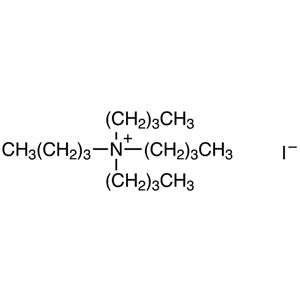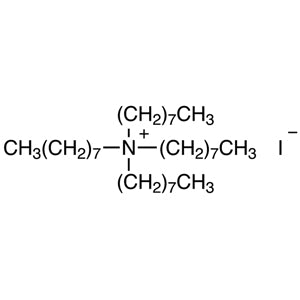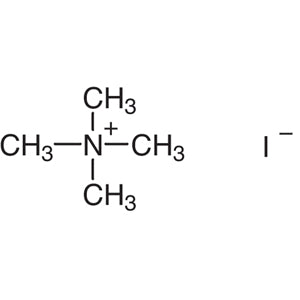
TCI T0139 Tetramethylammonium Iodide (CAS 75-58-1) is a quaternary ammonium salt made of a tetramethylammonium cation and an iodide anion. Laboratories use it as a phase transfer catalyst, a soluble source of iodide ions, an electrolyte, and a starting material for other tetramethylammonium salts through anion exchange. Iodide is both a good nucleophile and a good leaving group. For that reason, tetramethylammonium iodide is also a common additive for speeding up substitution reactions, including through in situ halide exchange.
Chemists choose this compound because it pairs a small, stable quaternary cation with a reactive, easily polarized iodide anion. In many systems, the iodide salt is more nucleophilic than its bromide and chloride analogues, so it is useful when a reaction needs a more active halide. The iodide–triiodide couple also makes it suitable for redox studies. The material is usually a white to yellowish crystalline solid. Air and light slowly oxidize iodide, which can turn the solid more yellow, so correct storage is important for keeping its quality during use.
In Indonesian laboratories, tetramethylammonium iodide supports research in organic synthesis and electrochemistry. University research groups, industrial R&D teams, and quality control laboratories can use it for catalysis studies, substitution chemistry, and salt preparation. Because it is supplied under the TCI brand, it suits work where consistent reagent quality matters. It is a practical choice for researchers who need a dependable quaternary ammonium iodide for routine reactions and for exploratory method development.
TCI brochures (PDF)
- Solar Cell Materials 2026-04-21 · p. 12
- Quaternary Ammonium Salts 2025-11-10 · p. 7
- Colloidal Quantum Dot (QD) Research Reagents 2026-05-21 · p. 8
- Phase transfer catalysis: the quaternary ammonium cation helps move reactive anions between immersible phases, which allows reactions to proceed under mild biphasic conditions.
- Rate-enhancing additive in substitution reactions: iodide is both a good nucleophile and a good leaving group, so it can speed up alkylation and other substitution steps through in situ halide exchange.
- Soluble iodide ion source: the salt supplies iodide in a convenient form for reactions and analytical procedures that need a reliable, well-defined iodide reagent.
- Electrolyte and redox studies: the compound can serve as an electrolyte, and the iodide–triiodide couple is useful for investigating redox behavior in electrochemical research.
- Preparation of other tetramethylammonium salts: anion exchange lets chemists convert this iodide into different tetramethylammonium salts for specialized synthetic or electrochemical work.
| Brand | TCI (product code T0139) |
|---|---|
| CAS number | 75-58-1 |
| Molecular formula | — |
| Purity | — |
| Category | Chemistry > Synthetic Reagents > Phase Transfer Catalysts |
| Pack sizes | Available pack sizes are listed on the product page |
| Physical form | White to yellowish crystalline solid |
| Storage | Protect from air and light, because iodide slowly oxidizes and can turn yellow |
Store tetramethylammonium iodide in a tightly closed container in a cool, dry, well-ventilated place, away from direct light and strong oxidizing agents. Keep it in the original supplier container, or use an amber glass bottle with a secure cap to limit exposure to air and light. Close the container promptly after each use to slow oxidation and discoloration. Handle the solid with standard laboratory precautions: wear gloves, safety glasses, and a lab coat, and avoid creating or inhaling dust. Work in a fume hood where possible, and wash your hands after handling. Before use, consult the supplier's Safety Data Sheet for hazard information and first-aid measures, and follow local regulations when disposing of the material.
—
Product Categories
Produk Terkait
-
TetrahexylammoniumIodide TCI T1010
Regular price From Rp 1.167.600,00Regular priceRp 831.600,00Sale price From Rp 1.167.600,00 -
TetrapropylammoniumIodide TCI T0172
Regular price From Rp 1.405.950,00Regular priceRp 998.550,00Sale price From Rp 1.405.950,00 -
TetrabutylammoniumIodide TCI T0057
Regular price From Rp 769.650,00Regular priceRp 553.350,00Sale price From Rp 769.650,00 -
EthyltrimethylammoniumIodide TCI E0190
Regular price Rp 2.677.500,00Regular priceRp 1.887.900,00Sale price Rp 2.677.500,00 -
TetramethylammoniumChloride TCI T0136
Regular price From Rp 530.250,00Regular priceRp 386.400,00Sale price From Rp 530.250,00 -
TetramethylammoniumBromide TCI T0135
Regular price From Rp 582.750,00Regular priceRp 423.150,00Sale price From Rp 582.750,00 -
Tetra-n-octylammoniumIodide TCI T1155
Regular price Rp 6.598.200,00Regular priceRp 4.629.450,00Sale price Rp 6.598.200,00 -
TetraamylammoniumIodide TCI T1011
Regular price From Rp 1.643.250,00Regular priceRp 1.164.450,00Sale price From Rp 1.643.250,00