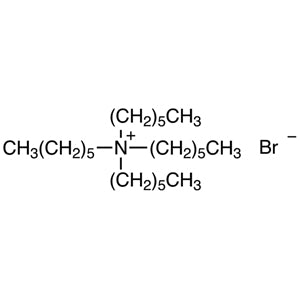
TCI T0135 Tetramethylammonium Bromide (CAS 64-20-0) is the simplest quaternary ammonium salt. It consists of a tetramethylammonium cation paired with a bromide anion. In the laboratory, its main use is as a phase transfer catalyst. A phase transfer catalyst moves reactive ions between an aqueous phase and an organic phase, which makes two-phase reactions run more efficiently. Tetramethylammonium bromide is also used as a supporting electrolyte, as a source of bromide ions, and as a structure-directing agent in the synthesis of porous materials.
Chemists choose this compound because its cation is small, symmetrical, and stable. It has no hydrogen atoms in the beta position, so it does not break down easily through Hofmann elimination the way long-chain alkyl quaternary salts do. It is usually a white crystalline solid that dissolves well in water and in polar solvents. The tetramethylammonium cation is more hydrophilic than its tetrabutyl analogue. That makes it a better fit for systems that need a more polar catalyst, and for studies of how cation size affects a reaction. The material is hygroscopic, so it must be stored properly to keep measurements accurate.
For laboratories in Indonesia, tetramethylammonium bromide is a useful reagent for university research groups, industrial R&D teams, and analytical laboratories that work on organic synthesis, electrochemistry, or materials chemistry. Researchers can use it in biphasic reaction studies, as a polar reference catalyst alongside larger quaternary ammonium salts, and in preparing porous materials. Because it is a well-defined and simple quaternary salt from TCI, results from it can be easily compared with published studies. That makes it suitable for teaching, method development, and routine research work.
TCI brochures (PDF)
- Safe and Easy-to-handle Trifluoromethoxylating Agent TFNf 2026-08-07 · p. 1
- Quaternary Ammonium Salts 2025-11-10 · p. 5
- Colloidal Quantum Dot (QD) Research Reagents 2026-05-21 · p. 9
Related TCI products
- Phase transfer catalysis: the quaternary ammonium cation carries reactive anions between the aqueous and organic phases, which makes biphasic reactions faster and more efficient.
- Supporting electrolyte: its ionic nature and stable cation make it a good choice for raising solution conductivity in electrochemical studies run in water or polar solvents.
- Bromide ion source: it supplies bromide ions in a simple, well-defined salt form for reactions and studies that need a soluble bromide source.
- Structure-directing agent: the small, symmetrical tetramethylammonium cation can guide pore formation during the synthesis of porous materials, which makes it useful in materials chemistry research.
- Cation size studies: because it is more hydrophilic than tetrabutylammonium analogues, it serves as a useful comparison point when studying how cation size and polarity affect catalytic performance.
| Brand | TCI (product code T0135) |
|---|---|
| CAS number | 64-20-0 |
| Molecular formula | — |
| Purity | — |
| Category | Chemistry > Synthetic Reagents > Phase Transfer Catalysts |
| Pack sizes | available in TCI's standard pack sizes; please confirm options with AMI Scientific |
| Physical form | generally a white crystalline solid, readily soluble in water and polar solvents |
| Storage | hygroscopic; keep tightly sealed and protected from moisture |
Store tetramethylammonium bromide in a tightly closed original container in a cool, dry, well-ventilated place. Because the material is hygroscopic, close the container promptly after each use. A desiccator is recommended so that moisture uptake does not affect weighing accuracy. Keep it away from incompatible substances such as strong oxidizing agents. Follow standard laboratory precautions when handling it: wear gloves, safety glasses, and a lab coat, avoid creating or breathing in dust, and wash your hands after use. Always check the supplier's Safety Data Sheet for detailed hazard and disposal information.
—
Produk Terkait
-
TetramethylammoniumIodide TCI T0139
Regular price From Rp 900.900,00Regular priceRp 645.750,00Sale price From Rp 900.900,00 -
TetramethylammoniumChloride TCI T0136
Regular price From Rp 530.250,00Regular priceRp 386.400,00Sale price From Rp 530.250,00 -
TrimethylpropylammoniumBromide TCI T2762
Regular price Rp 6.704.250,00Regular priceRp 4.704.000,00Sale price Rp 6.704.250,00 -
TrimethylnonylammoniumBromide TCI T2734
Regular price Rp 1.801.800,00Regular priceRp 1.275.750,00Sale price Rp 1.801.800,00 -
Tetra-n-octylammoniumBromide TCI T1603
Regular price From Rp 1.618.050,00Regular priceRp 1.146.600,00Sale price From Rp 1.618.050,00 -
TetraheptylammoniumBromide TCI T1602
Regular price From Rp 1.298.850,00Regular priceRp 924.000,00Sale price From Rp 1.298.850,00 -
TetrahexylammoniumBromide TCI T1599
Regular price Rp 2.889.600,00Regular priceRp 2.035.950,00Sale price Rp 2.889.600,00 -
TetraamylammoniumBromide TCI T1432
Regular price From Rp 1.326.150,00Regular priceRp 942.900,00Sale price From Rp 1.326.150,00