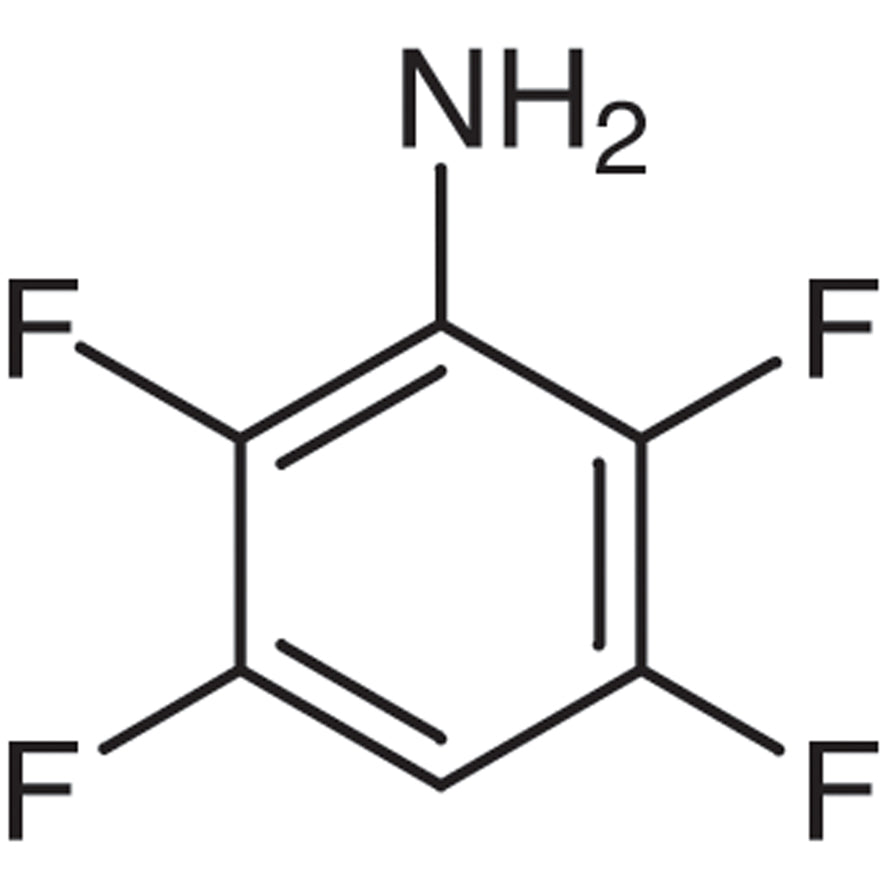
2,3,5,6-Tetrafluoroaniline from TCI, catalog code T1028, is a fluorinated aniline carrying four fluorine atoms on the benzene ring. Only the position para to the amino group still bears a hydrogen atom. The compound belongs to the class of fluorinated building blocks, which laboratories use to construct fluorine-rich aromatic molecules. In the laboratory it serves as a starting material for the synthesis of pharmaceuticals, agrochemicals, dyes, and functional materials.
The compound is chosen for its distinctive substitution pattern. The amino group can be acylated, alkylated, or converted through a diazonium salt into a variety of other groups. The single C–H position on the ring provides a well-defined point for further functionalization. The four fluorine atoms lower the basicity of the amine and change the electronic character of the ring. Fluorine also tends to improve the metabolic stability and lipophilicity of derived compounds, which are properties sought after in the design of bioactive molecules.
Medicinal chemistry, materials chemistry, and organic synthesis laboratories in Indonesia can use 2,3,5,6-Tetrafluoroaniline to prepare fluorinated amides, imines, and heterocycles. It is also useful for studies of how fluorine substitution affects molecular properties, making it a practical reagent for both research and teaching laboratories working with fluorinated aromatic compounds.
TCI brochures (PDF)
- Fluorination Reagents, Fluorinated Building Blocks 2026-03-18 · p. 34
- Pharmaceutical intermediate synthesis: the reactive amino group and the fluorinated ring let chemists build fluorine-containing scaffolds that are commonly explored in drug discovery programs.
- Agrochemical research: fluorinated aromatic amines are useful starting points for new active structures, and this compound offers a defined substitution pattern that supports systematic structure-activity studies.
- Dye and functional material development: the electron-poor tetrafluorinated ring changes the electronic behavior of derived compounds, which makes this aniline suitable for preparing specialty dyes and functional materials.
- Preparation of fluorinated amides, imines, and heterocycles: the amino group reacts readily in acylation, condensation, and cyclization steps, so this building block suits the construction of a wide range of fluorinated products.
- Studies of fluorine effects on molecular properties: with four fluorine atoms and one remaining C–H site, the compound provides a clear model for examining how fluorine changes basicity, lipophilicity, and reactivity.
| Brand | TCI |
|---|---|
| CAS number | 700-17-4 |
| Molecular formula | — |
| Purity | — |
| Category | Chemistry > Building Blocks > Fluorinated Building Blocks |
| Pack sizes | please refer to the product listing for available sizes |
| Physical form | — |
| Storage | keep tightly closed in a cool, dry, well-ventilated place; consult the supplier's safety data sheet for exact conditions |
- Catalog code: T1028
Store 2,3,5,6-Tetrafluoroaniline in its original, tightly closed container in a cool, dry, and well-ventilated area, away from direct sunlight, heat sources, and incompatible materials such as strong oxidizing agents. Glass or other chemically resistant containers with secure closures are generally suitable. Handle the material inside a fume hood and wear appropriate personal protective equipment, including safety goggles, chemical-resistant gloves, and a laboratory coat. Avoid inhaling dust or vapors and avoid contact with skin and eyes. Label all secondary containers clearly, and dispose of waste according to institutional and local regulations. Always consult the safety data sheet before use for the exact hazard information and storage requirements.
—
Produk Terkait
-
2,3,4,5-Tetrafluoroaniline TCI T2782
Regular price From Rp 1.803.900,00Regular priceRp 1.261.050,00Sale price From Rp 1.803.900,00 -
2,2,2,4'-Tetrafluoroacetophenone TCI T3257
Regular price From Rp 1.829.100,00Regular priceRp 1.294.650,00Sale price From Rp 1.829.100,00 -
3,4,5-Trifluoroaniline TCI T2355
Regular price From Rp 1.035.300,00Regular priceRp 723.450,00Sale price From Rp 1.035.300,00 -
2,4,5-Trifluoroaniline TCI T1645
Regular price Rp 3.155.250,00Regular priceRp 2.206.050,00Sale price Rp 3.155.250,00 -
2,3,4-Trifluoroaniline TCI T1385
Regular price From Rp 769.650,00Regular priceRp 537.600,00Sale price From Rp 769.650,00 -
2-Bromo-6-fluoroaniline TCI B4803
Regular price From Rp 1.724.100,00Regular priceRp 1.205.400,00Sale price From Rp 1.724.100,00 -
2-Bromo-6-chloro-4-fluoroaniline TCI B3681
Regular price Rp 1.485.750,00Regular priceRp 1.038.450,00Sale price Rp 1.485.750,00 -
4-Bromo-3,5-difluoroaniline TCI B3416
Regular price From Rp 1.538.250,00Regular priceRp 1.075.200,00Sale price From Rp 1.538.250,00