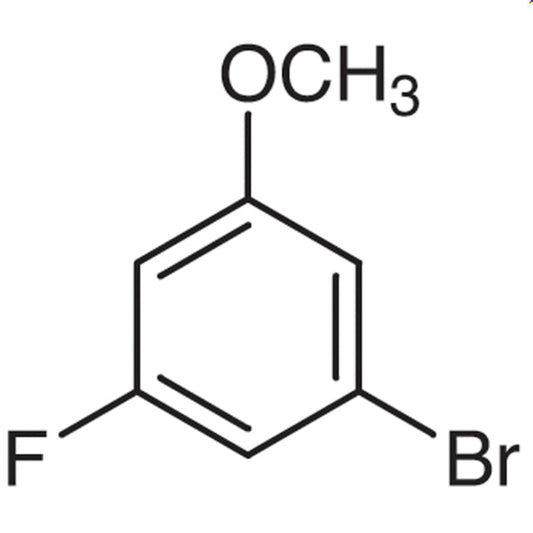
TCI T1041 is 2,3,5,6-Tetrafluoroanisole, CAS number 2324-98-3, an aromatic ether in which the anisole ring has four of its positions substituted with fluorine atoms. It belongs to the family of fluorinated building blocks and is used in synthesis laboratories as a precursor for preparing highly fluorinated aromatic molecules. The methoxy group provides its own chemical handle, while the tetrafluorophenyl ring contributes electronic characteristics that differ sharply from those of ordinary, non-fluorinated anisole.
The four fluorine atoms make the ring far more electron-poor than conventional anisole. This opens up reaction pathways that are not typical for plain anisole, such as nucleophilic aromatic substitution or functionalization at the ring position that still carries a hydrogen atom. Researchers working in organofluorine chemistry value compounds like this because the structure is simple yet the reactivity is rich, which makes it a suitable model substrate for studying how fluorine influences an aromatic ring and the neighboring methoxy group.
In Indonesian research laboratories working in organic chemistry and materials chemistry, this material is useful for the early exploration of synthetic routes toward fluorinated compounds. Groups that need a compact, well-defined fluorinated aromatic starting point can use it to test reaction conditions before moving to more elaborate substrates. It is supplied by AMI Scientific in a 5 g pack, which suits small-scale method development.
TCI brochures (PDF)
- Fluorination Reagents, Fluorinated Building Blocks 2026-03-18 · p. 34
Related TCI products
- Precursor for highly fluorinated aromatics: the tetrafluorinated ring and the methoxy group give synthetic chemists a defined starting point for building more complex, heavily fluorinated aromatic molecules.
- Nucleophilic aromatic substitution studies: because four fluorine atoms make the ring strongly electron-poor, this compound is a suitable substrate for exploring substitution reactions that ordinary anisole does not undergo readily.
- Functionalization at the remaining ring hydrogen: the single hydrogen-bearing position on the ring offers a site for selective modification, allowing researchers to examine how the surrounding fluorine atoms direct reactivity.
- Model substrate in organofluorine research: its simple structure and rich reactivity make it well suited for investigating how fluorine affects an aromatic ring and the adjacent methoxy group.
- Early-stage exploration of fluorinated synthesis routes: laboratories in organic and materials chemistry can use the 5 g pack to screen reaction conditions before committing to larger quantities or more elaborate starting materials.
| Brand | TCI |
|---|---|
| CAS number | 2324-98-3 |
| Molecular formula | — |
| Purity | — |
| Category | Chemistry > Building Blocks > Fluorinated Building Blocks |
| Pack sizes | 5 g |
| Physical form | — |
| Storage | follow the storage instructions on the label and the supplier safety data sheet |
- Product code: T1041
Store the product in its original, tightly closed container, following the storage conditions printed on the label and in the supplier safety data sheet. Keep it in a cool, dry, well-ventilated place away from heat sources, direct sunlight, and incompatible materials. Use glass or other chemically compatible containers if the material is transferred. As with any fluorinated organic reagent, handle it in a fume hood and wear suitable gloves, safety glasses, and a laboratory coat. Avoid inhalation and skin or eye contact, label any secondary containers clearly, and dispose of waste according to institutional and local regulations.
—
Produk Terkait
-
2,2,2,4'-Tetrafluoroacetophenone TCI T3257
Regular price From Rp 1.829.100,00Regular priceRp 1.294.650,00Sale price From Rp 1.829.100,00 -
5-Bromo-2-chloro-4-fluoroanisole TCI B5354
Regular price From Rp 664.650,00Regular priceRp 464.100,00Sale price From Rp 664.650,00 -
2-Bromo-5-fluoroanisole TCI B3875
Regular price Rp 2.016.000,00Regular priceRp 1.409.100,00Sale price Rp 2.016.000,00 -
4-Bromo-3-fluoroanisole TCI B3743
Regular price From Rp 1.670.550,00Regular priceRp 1.167.600,00Sale price From Rp 1.670.550,00 -
4-Bromo-3,5-difluoroanisole TCI B3392
Regular price Rp 2.625.000,00Regular priceRp 1.835.400,00Sale price Rp 2.625.000,00 -
4-Bromo-2,6-difluoroanisole TCI B3391
Regular price Rp 4.320.750,00Regular priceRp 3.020.850,00Sale price Rp 4.320.750,00 -
4-Bromo-2,5-difluoroanisole TCI B3097
Regular price Rp 1.298.850,00Regular priceRp 908.250,00Sale price Rp 1.298.850,00 -
3-Bromo-5-fluoroanisole TCI B2945
Regular price Rp 1.510.950,00Regular priceRp 1.056.300,00Sale price Rp 1.510.950,00