

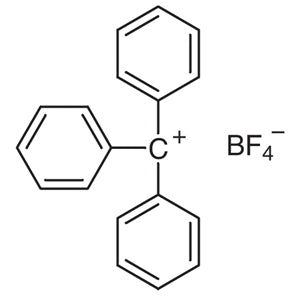
TCI T1173 Triphenylmethylium Tetrafluoroborate, commonly called trityl tetrafluoroborate, is an organic salt made of a triphenylmethyl (trityl) cation paired with a tetrafluoroborate anion. In the laboratory it is classed as a non-heterocyclic organic building block and is used as a reagent that supplies a relatively stable carbocation. Its main roles are as a hydride acceptor and as an organic Lewis acid in a range of synthetic transformations. Because the salt can be weighed and handled as a solid, chemists can use it as a dependable source of carbocation reactivity instead of generating such species in situ.
The trityl cation is stable because its positive charge is delocalized across three phenyl rings. This is why it can be stored and weighed as a salt, and it is the property that makes the reagent attractive for hydride abstraction reactions, for initiating cationic polymerization, and for forming other organic cations from suitable precursors. The tetrafluoroborate anion is non-nucleophilic, so the cation is not readily attacked by its own counterion. Salts of this kind are generally sensitive to moisture, because the cation can react with water, so careful handling is part of working with this reagent.
For laboratories in Indonesia working in synthetic organic chemistry or polymer chemistry, this reagent is most useful to users who are already comfortable with moisture-free techniques. It suits research groups, university teaching laboratories and industrial development teams that need a well-defined carbocation source for method development or specialized synthesis. It is supplied under the TCI brand in 5 g and 25 g packs, so a small exploratory quantity or a larger working quantity can be chosen according to the scale of the work.
TCI brochures (PDF)
- Boron Compounds 2025-10-07 · p. 25
Related TCI products
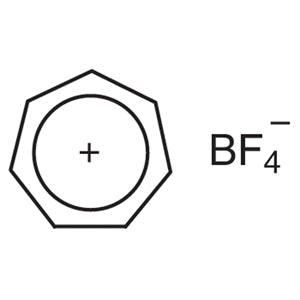
- TCI T1121 27081-10-3 Tropylium Tetrafluoroborate
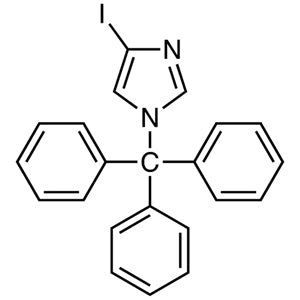
- TCI I0890 96797-15-8 4-Iodo-1-(triphenylmethyl)imidazole
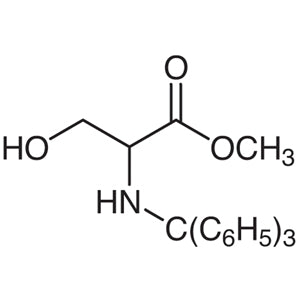
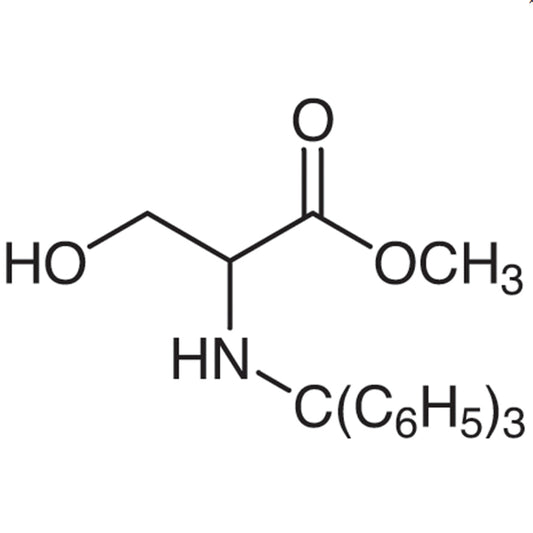
- TCI T2870 4465-44-5 N-(Triphenylmethyl)-L-serine Methyl Ester
- TCI T2500 13515-76-9 N-(Triphenylmethyl)-DL-serine Methyl Ester
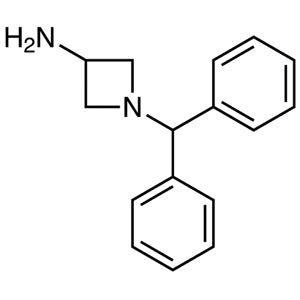
- TCI A3283 40432-52-8 3-Amino-1-(diphenylmethyl)azetidine
- TCI F1145 135610-90-1 Nalpha-[(9H-Fluoren-9-ylmethoxy)carbonyl]-tele-(triphenylmethyl)-D-histidine
- Hydride abstraction reactions: the stabilized trityl cation acts as an effective hydride acceptor, so this salt is a practical choice for removing hydride from suitable substrates in synthetic sequences.
- Initiation of cationic polymerization: as a solid source of a stable carbocation, the salt can start cationic polymerization, which makes it relevant to polymer chemistry research on suitable monomers.
- Generation of other organic cations: the reagent can be used to form further organic cations from appropriate precursors, giving synthetic chemists a controlled route to reactive intermediates for their reaction schemes.
- Organic Lewis acid chemistry: the trityl cation can serve as an organic Lewis acid in various transformations, offering an alternative to metal-based Lewis acids where a metal-free reagent is preferred.
- Moisture-free synthetic method development: because the salt reacts with water, it is well suited to laboratories developing and refining anhydrous procedures, where its reactivity also shows how well the technique excludes moisture.
| Brand | TCI (product code T1173) |
|---|---|
| CAS number | 341-02-6 |
| Molecular formula | — |
| Purity | — |
| Category | Chemistry > Building Blocks > Non-Heterocyclic Building Blocks |
| Pack sizes | 5 g and 25 g |
| Physical form | — |
| Storage | moisture-sensitive; keep tightly closed and protected from water. Consult the supplier label and safety data sheet for exact conditions. |
- Chemical type: organic salt (trityl cation with tetrafluoroborate anion)
Because the trityl cation can react with water, store this reagent in a tightly closed container in a dry place, away from humidity. A desiccator or a dry inert atmosphere is a sensible choice for laboratories that have one. Open the container only when needed, and reseal it promptly after each use. Weigh and transfer the solid using dry glassware and dry tools, ideally with moisture-free techniques. Wear standard protective equipment such as a lab coat, gloves and eye protection, and work in a well-ventilated area or fume hood. Avoid contact with skin and eyes and avoid inhaling dust. Always consult the safety data sheet from the supplier for precise hazard information, storage conditions and disposal requirements before use.
—
Produk Terkait
-
TropyliumTetrafluoroborate TCI T1121
Regular price Rp 1.193.850,00Regular priceRp 834.750,00Sale price Rp 1.193.850,00 -
4-Iodo-1-(triphenylmethyl)imidazole TCI I0890
Regular price Rp 1.351.350,00Regular priceRp 960.750,00Sale price Rp 1.351.350,00 -
N-(Triphenylmethyl)-L-serineMethylEster TCI T2870
Regular price Rp 1.431.150,00Regular priceRp 1.016.400,00Sale price Rp 1.431.150,00 -
N-(Triphenylmethyl)-DL-serineMethylEster TCI T2500
Regular price Rp 2.650.200,00Regular priceRp 1.869.000,00Sale price Rp 2.650.200,00 -
3-Amino-1-(diphenylmethyl)azetidine TCI A3283
Regular price From Rp 637.350,00Regular price -
Nalpha-[(9H-Fluoren-9-ylmethoxy)carbonyl]-tele-(triphenylmethyl)-D-histidine TCI F1145
Regular price From Rp 1.829.100,00Regular price -
Nalpha-[(9H-Fluoren-9-ylmethoxy)carbonyl]-tele-(triphenylmethyl)-L-histidine TCI F0653
Regular price From Rp 1.035.300,00Regular price -
N-[(9H-Fluoren-9-ylmethoxy)carbonyl]-S-(triphenylmethyl)-L-cysteine TCI F0652
Regular price From Rp 1.167.600,00Regular price

![Nalpha-[(9H-Fluoren-9-ylmethoxy)carbonyl]-tele-(triphenylmethyl)-D-histidine (CAS 135610-90-1) - TCI F1145 - AMI Scientific](http://amiscientific.com/cdn/shop/files/TCI2510F1145.jpg?v=1769142458&width=533)
![Nalpha-[(9H-Fluoren-9-ylmethoxy)carbonyl]-tele-(triphenylmethyl)-L-histidine (CAS 109425-51-6) - TCI F0653 - AMI Scientific](http://amiscientific.com/cdn/shop/files/TCI2510F0653.jpg?v=1768360191&width=533)
![N-[(9H-Fluoren-9-ylmethoxy)carbonyl]-S-(triphenylmethyl)-L-cysteine (CAS 103213-32-7) - TCI F0652 - AMI Scientific](http://amiscientific.com/cdn/shop/files/TCI2510F0652.jpg?v=1769142405&width=533)