

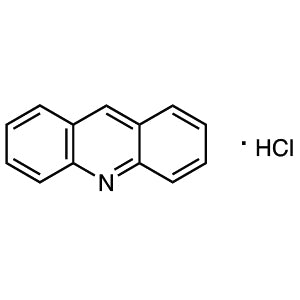
TCI A0131 Acridine Hydrochloride is the hydrochloride salt of acridine, an aromatic heterocyclic compound built from three fused rings and containing a nitrogen atom. Acridine itself is widely known in dye chemistry, analytical chemistry, and molecular biology. In the TCI catalogue this material is grouped under Heterocyclic Building Blocks, so its main role in the laboratory is as a starting material for constructing acridine derivatives, or as a reference compound in studies of optical properties and molecular interactions.
The hydrochloride form is commonly chosen because the weakly basic heterocyclic nitrogen can be protonated, which means its solubility and handling behaviour differ from those of the free base. The flat, aromatic acridine framework can interact with other molecules through pi stacking, and its derivatives are known to be fluorescent. These characteristics make acridine and its derivatives attractive for developing probes, dyes, and compounds that interact with nucleic acids, which is why the material is relevant to both chemistry and biology researchers.
In Indonesia, the 5 g pack suits organic chemistry, analytical chemistry, and biochemistry research laboratories that need a measured quantity for small-scale experiments, method development, and exploratory synthesis. A pack of this size lets a laboratory work with the reagent without committing to a large inventory. It is a practical option for university research groups and industrial R&D teams that work with heterocyclic chemistry and need a consistently sourced TCI reagent.
Related TCI products
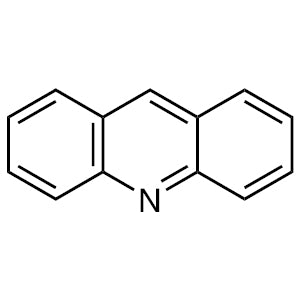
- TCI A3436 260-94-6 Acridine (purified by sublimation)
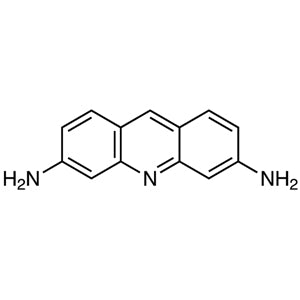
- TCI A3219 92-62-6 Acridine-3,6-diamine
- TCI A0294 260-94-6 Acridine
- TCI T4163 2493975-78-1 3,7,11-Trimesitylquinolino[3,2,1-de]acridine-5,9-dione
- TCI B1926 1556-34-9 9-(Bromomethyl)acridine [for HPLC Labeling]
- TCI S0984 92638-81-8 10H-Spiro[acridine-9,9'-fluorene]
- Synthesis of acridine derivatives: as a heterocyclic building block, the compound serves as a starting point for introducing new substituents onto the acridine framework in organic synthesis research.
- Studies of optical and fluorescence properties: the aromatic three-ring structure and the known fluorescence of acridine derivatives make this salt a useful reference compound in spectroscopic investigations.
- Development of dyes and molecular probes: acridine-based structures are recognised in dye chemistry, so this material can support the design and evaluation of new colourants and probe molecules.
- Research on nucleic acid interactions: the planar aromatic core can interact with other molecules through pi stacking, which makes the compound relevant to biochemical studies of how small molecules associate with nucleic acids.
- Analytical chemistry method development: acridine chemistry has a long history in analytical work, and this salt provides a defined, measurable starting material for exploratory methods and comparative testing.
| Brand | TCI |
|---|---|
| CAS number | 17784-47-3 |
| Molecular formula | — |
| Purity | — |
| Category | Chemistry > Building Blocks > Heterocyclic Building Blocks |
| Pack sizes | 5 g |
| Physical form | — |
| Storage | keep in a tightly closed container, following the storage conditions on the supplier label and safety data sheet |
- Product code: A0131
Store TCI A0131 Acridine Hydrochloride in its original, tightly closed container in a clean, dry laboratory storage area, away from direct sunlight, heat sources, and incompatible chemicals. Always confirm the exact storage conditions on the product label and in the safety data sheet. Handle the powder in a well-ventilated space or fume hood, and wear appropriate personal protective equipment such as gloves, safety glasses, and a laboratory coat. Avoid generating dust, prevent contact with skin and eyes, and wash hands after use. Reseal the container promptly after each weighing, label any transferred portions clearly, and dispose of waste according to the laboratory's chemical waste procedures and local regulations.
—
Produk Terkait
-
Acridine(purifiedbysublimation) TCI A3436
Regular price From Rp 1.458.450,00Regular price -
Acridine-3,6-diamine TCI A3219
Regular price From Rp 2.147.250,00Regular price -
Acridine TCI A0294
Regular price Rp 3.472.350,00Regular price -
3,7,11-Trimesitylquinolino[3,2,1-de]acridine-5,9-dione TCI T4163
Regular price Rp 4.399.500,00Regular priceRp 3.092.250,00Sale price Rp 4.399.500,00 -
9-(Bromomethyl)acridine[forHPLCLabeling] TCI B1926
Regular price From Rp 2.254.350,00Regular price -
10H-Spiro[acridine-9,9'-fluorene] TCI S0984
Regular price Rp 4.823.700,00Regular priceRp 3.388.350,00Sale price Rp 4.823.700,00 -
10-[4-[4,6-Di(1-adamantyl)-1,3,5-triazin-2-yl]phenyl]-10H-spiro[acridine-9,9'-fluorene](purifiedbysublimation) TCI D5747
Regular price Rp 5.114.550,00Regular priceRp 3.592.050,00Sale price Rp 5.114.550,00

![1556-34-9 9-(Bromomethyl)acridine [for HPLC Labeling] - AMI Scientific](http://amiscientific.com/cdn/shop/files/TCI2510B1926.jpg?v=1769179695&width=533)
![92638-81-8 10H-Spiro[acridine-9,9'-fluorene] - AMI Scientific](http://amiscientific.com/cdn/shop/files/TCI2510S0984.jpg?v=1769057715&width=533)
![10-[4-[4,6-Di(1-adamantyl)-1,3,5-triazin-2-yl]phenyl]-10H-spiro[acridine-9,9'-fluorene] (purified by sublimation) (CAS 2250187-16-5) - TCI D5747 - AMI Scientific](http://amiscientific.com/cdn/shop/files/TCI2510D5747.jpg?v=1768818505&width=533)