

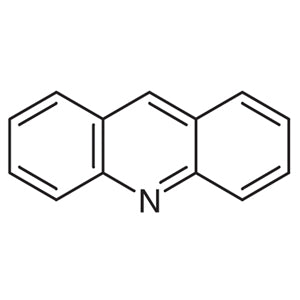
Acridine is a chemical compound classified under the heterocyclic category, featuring a fundamental structure composed of three interconnected aromatic rings. It plays a crucial role in laboratory settings as a building block for the synthesis of complex compounds, particularly in organic chemistry and pharmacology. Its versatility allows chemists to modify it into various compounds with specific biological activities. In research environments, Acridine is highly valued for its ability to participate in a wide range of chemical reactions, making it an essential component in the development of new pharmaceuticals and chemical products.
Acridine is prized for its stable chemical properties and controlled reactivity, which enable it to be used in diverse synthetic pathways. Its aromatic nature facilitates substitution and electrophilic reactions, making it ideal for the synthesis of heterocyclic compounds. The compound’s ability to form bonds with various functional groups further enhances its utility in chemical synthesis. Additionally, its solid form and solubility in organic solvents make it easy to handle and incorporate into laboratory procedures, contributing to its widespread use in both academic and industrial research.
In Indonesian laboratories, Acridine is commonly used in research focused on drug development and chemical synthesis. Its role in creating compounds with antitumor and antiviral properties makes it a valuable resource for scientists working in pharmacology and biochemistry. The compound’s availability and ease of use have made it a staple in many research facilities across Indonesia, supporting ongoing scientific advancements in various fields.
Related TCI products
- TCI A3436 260-94-6 Acridine (purified by sublimation)
- TCI A3219 92-62-6 Acridine-3,6-diamine
- TCI A0131 17784-47-3 Acridine Hydrochloride
- TCI T4163 2493975-78-1 3,7,11-Trimesitylquinolino[3,2,1-de]acridine-5,9-dione
- TCI B1926 1556-34-9 9-(Bromomethyl)acridine [for HPLC Labeling]
- TCI S0984 92638-81-8 10H-Spiro[acridine-9,9'-fluorene]
- Drug development and synthesis of antitumor and antiviral compounds due to its ability to form heterocyclic derivatives.
- Organic chemistry research for the creation of complex molecules through substitution and electrophilic reactions.
- Pharmacological studies to investigate the biological activity of modified acridine derivatives.
- Chemical synthesis of pharmaceutical intermediates requiring stable and reactive building blocks.
- Analytical chemistry applications for testing the reactivity and solubility of heterocyclic compounds.
| Brand | TCI |
|---|---|
| CAS number | 260-94-6 |
| Molecular formula | — |
| Purity | — |
| Category | Chemistry > Building Blocks > Heterocyclic Building Blocks |
| Pack sizes | — |
| Physical form | Solid |
| Storage | Store in a cool, dry place away from light and incompatible materials. |
Acridine should be stored in a cool, dry place, away from direct light and incompatible substances such as strong oxidizers. It is recommended to use airtight containers made of glass or high-density polyethylene to prevent contamination and maintain purity. Due to its chemical stability, it does not require refrigeration but should be protected from moisture and heat. In laboratory settings, proper personal protective equipment (PPE) should be worn when handling the compound to ensure safety. Regular inspection of storage conditions is advised to maintain the integrity of the material and ensure safe usage in research applications.
—
Produk Terkait
-
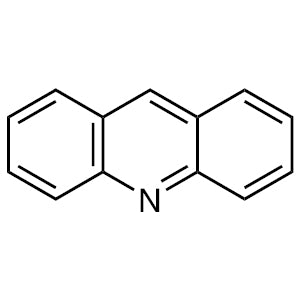
Acridine(purifiedbysublimation) TCI A3436
Regular price From Rp 1.458.450,00Regular price -
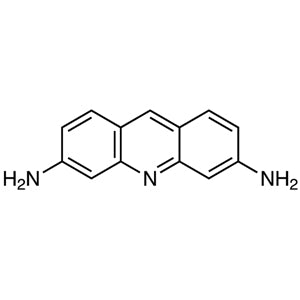
Acridine-3,6-diamine TCI A3219
Regular price From Rp 2.147.250,00Regular price -
AcridineHydrochloride TCI A0131
Regular price Rp 2.545.200,00Regular price -
3,7,11-Trimesitylquinolino[3,2,1-de]acridine-5,9-dione TCI T4163
Regular price Rp 4.399.500,00Regular priceRp 3.092.250,00Sale price Rp 4.399.500,00 -
9-(Bromomethyl)acridine[forHPLCLabeling] TCI B1926
Regular price From Rp 2.254.350,00Regular price -
10H-Spiro[acridine-9,9'-fluorene] TCI S0984
Regular price Rp 4.823.700,00Regular priceRp 3.388.350,00Sale price Rp 4.823.700,00 -
10-[4-[4,6-Di(1-adamantyl)-1,3,5-triazin-2-yl]phenyl]-10H-spiro[acridine-9,9'-fluorene](purifiedbysublimation) TCI D5747
Regular price Rp 5.114.550,00Regular priceRp 3.592.050,00Sale price Rp 5.114.550,00

![1556-34-9 9-(Bromomethyl)acridine [for HPLC Labeling] - AMI Scientific](http://amiscientific.com/cdn/shop/files/TCI2510B1926.jpg?v=1769179695&width=533)
![92638-81-8 10H-Spiro[acridine-9,9'-fluorene] - AMI Scientific](http://amiscientific.com/cdn/shop/files/TCI2510S0984.jpg?v=1769057715&width=533)
![10-[4-[4,6-Di(1-adamantyl)-1,3,5-triazin-2-yl]phenyl]-10H-spiro[acridine-9,9'-fluorene] (purified by sublimation) (CAS 2250187-16-5) - TCI D5747 - AMI Scientific](http://amiscientific.com/cdn/shop/files/TCI2510D5747.jpg?v=1768818505&width=533)