


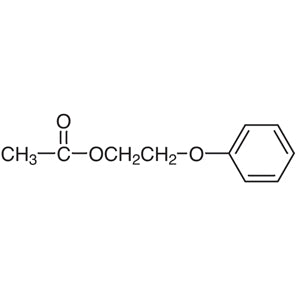
2-Phenoxyethyl Acetate is a chemical compound widely used as a building block in various chemical reactions and the synthesis of complex molecules. It plays a crucial role in organic chemistry by enabling the formation of new compounds through its ability to react with different functional groups. This compound is essential in laboratory settings where the creation of specific molecular structures is required. Its versatility makes it a valuable tool for researchers in multiple scientific disciplines.
The key properties that make 2-Phenoxyethyl Acetate a preferred choice include its stability under certain conditions and its reactivity in various chemical processes such as esterification, hydrolysis, and substitution reactions. Its non-polar nature facilitates mixing and separation in laboratory procedures, making it ideal for a wide range of applications. Additionally, its chemical stability ensures consistent performance in different experimental environments, enhancing the reliability of research outcomes.
In Indonesian laboratories, 2-Phenoxyethyl Acetate is commonly used in pharmaceutical, material science, and scientific research contexts. Its ability to participate in diverse chemical reactions makes it a go-to compound for developing new substances with specific properties. It is frequently employed in the synthesis of pharmaceutical intermediates and in the development of advanced materials, supporting innovation in both academic and industrial research.
Related TCI products
- Organic synthesis applications benefit from 2-Phenoxyethyl Acetate due to its ability to participate in esterification and substitution reactions, enabling the creation of complex molecular structures.
- Pharmaceutical research utilizes this compound as an intermediate in the synthesis of various drug molecules, offering flexibility in modifying molecular frameworks.
- Material science experiments rely on its non-polar characteristics to facilitate the preparation of polymers and coatings with desired physical properties.
- Analytical chemistry procedures take advantage of its stability and reactivity for the development of calibration standards and reaction intermediates.
- Environmental studies use it as a model compound to investigate the behavior of organic pollutants in different chemical environments.
| Brand | TCI |
|---|---|
| CAS number | 6192-44-5 |
| Molecular formula | — |
| Purity | — |
| Category | Chemistry > Building Blocks > Non-Heterocyclic Building Blocks |
| Pack sizes | Available in various quantities as per standard laboratory supply options |
| Physical form | Liquid |
| Storage | Store in a cool, dry place away from direct sunlight and incompatible materials |
2-Phenoxyethyl Acetate should be stored in a cool, dry place, away from direct sunlight and sources of heat. It is recommended to use airtight containers made of glass or polyethylene to prevent contamination and evaporation. Due to its chemical nature, it should be kept away from strong oxidizing agents and incompatible substances to avoid unwanted reactions. Proper labeling of containers is essential for safety and traceability. In laboratory settings, it is important to ensure adequate ventilation when handling this compound to minimize exposure. Always follow standard chemical safety protocols when working with this material to maintain a safe and controlled environment.
—
Produk Terkait
-
2-PhenoxyethylAcrylate(stabilizedwithMEHQ) TCI A1400
Regular price From Rp 530.250,00Regular priceRp 370.650,00Sale price From Rp 530.250,00 -
2-PhenoxyethylIsobutyrate TCI P1822
Regular price From Rp 530.250,00Regular priceRp 386.400,00Sale price From Rp 530.250,00 -
ButylAcetate[forSpectrophotometry] TCI A0228
Regular price Rp 1.538.250,00Regular priceRp 1.075.200,00Sale price Rp 1.538.250,00 -
VinylAcetateMonomer(stabilizedwithHQ) TCI A0045
Regular price Rp 477.750,00Regular priceRp 333.900,00Sale price Rp 477.750,00 -
PropylAcetate TCI A0044
Regular price From Rp 477.750,00Regular priceRp 333.900,00Sale price From Rp 477.750,00 -
PhenylAcetate TCI A0043
Regular price Rp 452.550,00Regular priceRp 316.050,00Sale price Rp 452.550,00 -
n-OctylAcetate TCI A0042
Regular price From Rp 505.050,00Regular priceRp 352.800,00Sale price From Rp 505.050,00 -
NonylAcetate TCI A0041
Regular price From Rp 505.050,00Regular priceRp 352.800,00Sale price From Rp 505.050,00


