


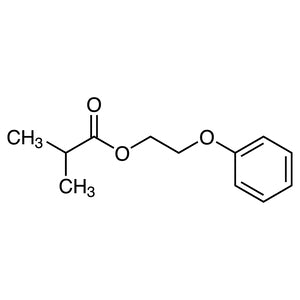
2-Phenoxyethyl Isobutyrate is a chemical compound widely used in laboratory settings for the synthesis of complex molecules. As a building block in organic chemistry, it plays a crucial role in the development of pharmaceutical and industrial compounds. Its versatility makes it a valuable tool for researchers aiming to create new chemical structures through various reaction mechanisms. This compound is particularly useful in substitution and condensation reactions, where its reactivity and stability contribute to the success of synthetic pathways.
The compound’s stable molecular structure and moderate reactivity make it a preferred choice for laboratory applications. Its consistent chemical and physical properties ensure reliable results across different experimental conditions. The solid form of this compound also simplifies handling and integration into standard laboratory protocols. Its ease of use and compatibility with a wide range of reagents and solvents further enhance its appeal for both academic and industrial research.
In Indonesian laboratories, 2-Phenoxyethyl Isobutyrate is commonly used in organic chemistry research. It is frequently employed by educational institutions and research organizations focused on the development of new compounds. Its availability and reliability make it a staple in the chemical inventory of local laboratories, supporting a wide array of synthetic and analytical experiments.
- Organic synthesis applications benefit from this compound’s ability to participate in a variety of reaction mechanisms, making it ideal for creating complex molecular structures.
- Pharmaceutical research utilizes this compound as a precursor for the synthesis of active pharmaceutical ingredients, supporting drug development initiatives.
- Analytical chemistry experiments often incorporate this compound as a standard reference material for calibration and testing procedures.
- Industrial chemical processes rely on its stability and reactivity to produce intermediate compounds used in manufacturing.
- Educational laboratories use this compound to teach fundamental concepts in organic chemistry and synthetic methodology.
| Brand | TCI |
|---|---|
| CAS number | 103-60-6 |
| Molecular formula | — |
| Purity | — |
| Category | Chemistry > Building Blocks > Non-Heterocyclic Building Blocks |
| Pack sizes | Available in various quantities as per standard laboratory supply |
| Physical form | Solid |
| Storage | Store in a cool, dry place away from direct sunlight |
This compound should be stored in a cool, dry environment to maintain its stability and prevent degradation. It is recommended to use airtight containers to minimize exposure to moisture and air, which could affect its chemical integrity. Laboratory personnel should handle the compound with appropriate personal protective equipment, such as gloves and safety goggles, to ensure safety during use. The compound is non-hazardous under normal conditions but should be kept away from incompatible materials. Proper labeling and storage conditions are essential to ensure safe handling and long-term usability in laboratory settings.
—
Produk Terkait
-
2-PhenoxyethylAcrylate(stabilizedwithMEHQ) TCI A1400
Regular price From Rp 530.250,00Regular priceRp 370.650,00Sale price From Rp 530.250,00 -
2-PhenoxyethylAcetate TCI A0935
Regular price From Rp 1.140.300,00Regular priceRp 796.950,00Sale price From Rp 1.140.300,00 -
IsoamylIsobutyrate TCI I0676
Regular price From Rp 662.550,00Regular priceRp 478.800,00Sale price From Rp 662.550,00 -
PhenylIsobutyrate TCI I0482
Regular price Rp 2.625.000,00Regular priceRp 1.835.400,00Sale price Rp 2.625.000,00 -
BenzylIsobutyrate TCI I0424
Regular price Rp 477.750,00Regular priceRp 333.900,00Sale price Rp 477.750,00 -
p-TolylIsobutyrate TCI I0396
Regular price From Rp 875.700,00Regular priceRp 612.150,00Sale price From Rp 875.700,00 -
IsobutylIsobutyrate TCI I0316
Regular price From Rp 477.750,00Regular priceRp 333.900,00Sale price From Rp 477.750,00 -
ButylIsobutyrate TCI I0315
Regular price From Rp 477.750,00Regular priceRp 333.900,00Sale price From Rp 477.750,00


