

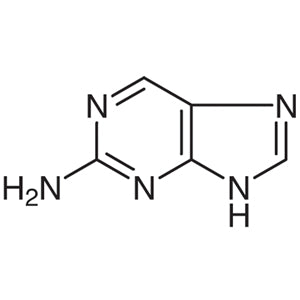
2-Aminopurine is a chemical compound classified under the heterocyclic category, featuring a purine base structure. It serves as a fundamental building block in chemical synthesis, particularly in the creation of complex molecules and organic compound modifications. In laboratory settings, this compound plays a crucial role in the development of bioactive substances, including pharmaceuticals and biochemical research materials. Its reactivity makes it ideal for substitution and atom-joining reactions, enabling the design of novel chemical structures with specific functional properties.
The compound’s chemical properties make it a preferred choice for high-precision molecular modifications. Its complex structure allows for versatile interactions with various reagents, facilitating a wide range of chemical reactions. Despite its reactivity, 2-Aminopurine exhibits stability under controlled conditions, which is essential for maintaining the integrity of synthesized compounds. Its sensitivity to moisture and air exposure requires careful handling, but this also ensures that it remains effective in targeted applications.
In Indonesian laboratories, 2-Aminopurine is widely used in organic and biochemical research. It is a key component in experiments related to the synthesis of complex compounds, especially those with biological activity. Its role in molecular modification and chemical reactivity makes it an essential tool for researchers working on drug development and biochemical processes.
TCI brochures (PDF)
- Nucleosides, Nucleotides, Nucleic Acids and Related Reagents 2026-03-23 · p. 9
- Organic synthesis experiments benefit from 2-Aminopurine due to its reactivity and ability to form complex molecular structures.
- Biochemical research utilizes this compound for the development of bioactive substances and pharmaceutical compounds.
- Molecular modification studies rely on 2-Aminopurine for precise structural changes in organic molecules.
- Drug development projects incorporate this compound to create new therapeutic agents with specific biological functions.
- Analytical chemistry applications use 2-Aminopurine as a standard reference material for chemical analysis and reaction testing.
| Brand | TCI |
|---|---|
| CAS number | 452-06-2 |
| Molecular formula | — |
| Purity | — |
| Category | Chemistry > Building Blocks > Heterocyclic Building Blocks |
| Pack sizes | Available in various quantities as per standard laboratory supply |
| Physical form | Solid powder |
| Storage | Store in a dry, cool place away from moisture and air exposure |
2-Aminopurine should be stored in a dry, cool environment to prevent moisture absorption and degradation. It is recommended to use airtight containers to minimize exposure to air, which can affect its stability. Due to its reactivity, it should be handled with care, using appropriate personal protective equipment such as gloves and safety goggles. Avoid contact with moisture during handling, as it can lead to unwanted chemical reactions. Proper labeling and storage conditions are essential to maintain the compound’s integrity and ensure safe laboratory practices.
—
Produk Terkait
-
2,6-DiaminopurineMonohydrate TCI D1625
Regular price Rp 1.060.500,00Regular priceRp 757.050,00Sale price Rp 1.060.500,00 -
AdenineHydrochlorideHemihydrate TCI A0150
Regular price Rp 717.150,00Regular priceRp 516.600,00Sale price Rp 717.150,00 -
Uracil TCI U0013
Regular price Rp 742.350,00Regular priceRp 534.450,00Sale price Rp 742.350,00 -
4-Thiouracil TCI T2757
Regular price Rp 2.835.000,00Regular priceRp 1.998.150,00Sale price Rp 2.835.000,00 -
8-Bromo-7-(2-butyn-1-yl)-3-methylxanthine TCI B4454
Regular price Rp 1.458.450,00Regular priceRp 1.035.300,00Sale price Rp 1.458.450,00 -
O~6~-Benzylguanine TCI B4208
Regular price From Rp 1.220.100,00Regular priceRp 868.350,00Sale price From Rp 1.220.100,00 -
6-Benzyloxypurine TCI B3355
Regular price Rp 2.650.200,00Regular priceRp 1.869.000,00Sale price Rp 2.650.200,00 -
N4-Benzoylcytosine TCI B3169
Regular price Rp 875.700,00Regular priceRp 627.900,00Sale price Rp 875.700,00


