


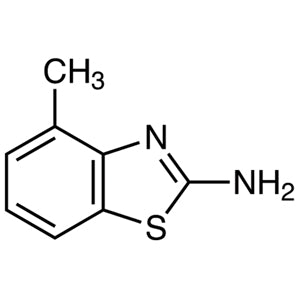
2-Amino-4-methylbenzothiazole is a chemical compound widely used as a building block in the synthesis of heterocyclic compounds. Its unique molecular structure, featuring a benzothiazole ring with amino and methyl substituents, makes it a versatile reagent in organic chemistry. In the laboratory, this compound plays a crucial role in the development of bioactive molecules and other organic substances. Its chemical reactivity allows it to participate in various reactions such as substitution, condensation, and nucleophilic reactions, making it an essential component in synthetic pathways.
The compound’s high reactivity and structural versatility make it a preferred choice for researchers. Its ability to engage in multiple chemical transformations enhances its utility in both academic and industrial settings. The presence of both amino and methyl groups contributes to its functional diversity, enabling it to be modified into a wide range of derivatives. These properties make it particularly valuable in pharmaceutical and materials science research.
In Indonesian laboratories, 2-Amino-4-methylbenzothiazole is commonly used in scientific research at universities and research institutions. It supports the development of new compounds with potential applications in pharmaceuticals, materials science, and environmental chemistry. Its availability through reliable suppliers like AMI Scientific ensures that researchers have access to this essential building block for their experiments.
Related TCI products
- Bioactive Compound Development: This compound is ideal for synthesizing new bioactive molecules due to its reactivity and structural adaptability.
- Organic Synthesis Research: Its participation in various chemical reactions makes it a key reagent in organic synthesis experiments.
- Pharmaceutical Research: The compound's functional groups enable it to be modified into drug-like molecules, supporting pharmaceutical studies.
- Materials Science Applications: Its structural properties make it useful in the development of new materials with specific chemical functionalities.
- Environmental Chemistry Studies: It is used in the synthesis of compounds for environmental monitoring and remediation research.
| Brand | TCI |
|---|---|
| CAS number | 1477-42-5 |
| Molecular formula | — |
| Purity | — |
| Category | Chemistry > Building Blocks > Heterocyclic Building Blocks |
| Pack sizes | Available in various quantities as per supplier specifications |
| Physical form | Solid |
| Storage | Store in a cool, dry place away from light |
This compound should be stored in a cool, dry environment, away from direct sunlight and sources of heat. It is recommended to use airtight containers to prevent moisture absorption and contamination. Due to its chemical reactivity, it should be handled with appropriate personal protective equipment, such as gloves and safety goggles. Storage in a well-ventilated area is essential to minimize exposure to vapors. It is important to keep the compound away from incompatible materials to ensure safety in the laboratory setting. Proper labeling and storage practices help maintain the integrity and usability of the compound for research purposes.
—
Produk Terkait
-
2-Amino-6-methylbenzothiazole TCI A0714
Regular price Rp 1.378.650,00Regular priceRp 979.650,00Sale price Rp 1.378.650,00 -
5-Methoxy-2-methylbenzothiazole TCI M1281
Regular price From Rp 3.472.350,00Regular priceRp 2.443.350,00Sale price From Rp 3.472.350,00 -
2-Methylbenzothiazole TCI M0516
Regular price From Rp 3.074.400,00Regular priceRp 2.165.100,00Sale price From Rp 3.074.400,00 -
2,5,6-Trimethylbenzothiazole TCI T1738
Regular price Rp 4.531.800,00Regular priceRp 3.184.650,00Sale price Rp 4.531.800,00 -
2-Amino-5,6-dimethylbenzothiazole TCI A1461
Regular price From Rp 5.485.200,00Regular priceRp 3.851.400,00Sale price From Rp 5.485.200,00 -
2-Phenylbenzothiazole TCI P1130
Regular price Rp 2.889.600,00Regular priceRp 2.035.950,00Sale price Rp 2.889.600,00 -
3-Ethyl-2-methylbenzothiazoliumIodide TCI E0476
Regular price From Rp 1.458.450,00Regular priceRp 1.035.300,00Sale price From Rp 1.458.450,00 -
3-EthylbenzothiazoliumBromide TCI E0395
Regular price Rp 3.735.900,00Regular priceRp 2.628.150,00Sale price Rp 3.735.900,00


