


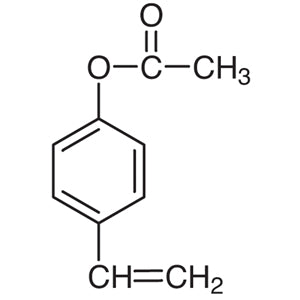
4-Vinylphenyl Acetate (stabilized with TBC) is a chemical compound widely used in polymerization reactions to synthesize polymers with specific structural characteristics. This material plays a crucial role in materials science laboratories, where it serves as a monomer for creating polymers with tailored mechanical and chemical properties. Its versatility makes it an essential component in research focused on macromolecular chemistry and polymer synthesis.
The compound is stabilized with tert-Butylcatechol (TBC), which enhances its chemical stability by preventing degradation due to oxidation or unwanted side reactions. This stabilization ensures the material remains effective over extended periods, making it a reliable choice for repeated use in laboratory settings. Its reactivity also allows it to participate in both radical and cationic polymerization processes, expanding its applicability across various experimental conditions.
In Indonesian laboratories, 4-Vinylphenyl Acetate is commonly utilized in the development of new materials, particularly in the fields of chemical engineering and advanced materials research. Its ability to form diverse polymers makes it a valuable tool for researchers aiming to innovate in polymer science and related industries.
TCI brochures (PDF)
- Biomaterials Research Reagents 2025-02-19 · p. 13
- Monomers 2025-05-28 · p. 14
Related TCI products
- TCI A1550 63600-35-1 2-Vinylphenyl Acetate (stabilized with Phenothiazine)
- TCI T4061 870004-04-9 4,4,5,5-Tetramethyl-2-(4-vinylphenyl)-1,3,2-dioxaborolane
- TCI M3600 7786-61-0 2-Methoxy-4-vinylphenol (stabilized with TBC)
- TCI V0059 1075-49-6 4-Vinylbenzoic Acid (stabilized with BHT)
- TCI V0028 25013-15-4 Vinyltoluene Monomer (m- and p- mixture) (stabilized with TBC)
- TCI B1877 1746-23-2 4-tert-Butylstyrene (stabilized with TBC)
- Polymer synthesis research in materials science laboratories due to its role as a versatile monomer in creating polymers with specific structural and functional properties.
- Development of new polymer-based materials in chemical engineering and nanotechnology applications, where controlled polymerization is essential.
- Investigation of radical and cationic polymerization mechanisms, as the compound readily participates in these reaction types.
- Formulation of specialty polymers for industrial applications, leveraging its reactivity and stability under various reaction conditions.
- Support for academic and industrial research in Indonesia focused on sustainable and high-performance material development.
| Brand | TCI |
|---|---|
| CAS number | 2628-16-2 |
| Molecular formula | — |
| Purity | — |
| Category | Materials Science > Polymer/Macromolecule Reagents > Monomers |
| Pack sizes | Available in standard laboratory quantities as per supplier specifications |
| Physical form | Liquid |
| Storage | Store in a cool, dark place away from heat and direct sunlight |
This material should be stored in a cool, dark location, away from heat and direct sunlight to maintain its stability. It is recommended to use suitable containers that are resistant to chemical reactions, such as glass or high-density polyethylene vessels. Proper ventilation is essential when handling the compound to minimize exposure. Due to its chemical nature, it should be kept away from incompatible substances like strong oxidizers. Regular monitoring of storage conditions ensures the material remains effective for its intended applications. Always follow standard laboratory safety protocols when handling and using this compound.
—
Product Categories
- Polymer/Macromolecule ReagentsMonomersStyrene Monomers
- Polymer/Macromolecule ReagentsPhotopolymer Reagents
- Biomaterials/Biocompatible Materials Research ReagentsMonomers and Macromonomers [Biomaterials/Biocompatible Materials Research Reagents]Styrene Monomers [Biomaterials/Biocompatible Materials Research Reagents]
Produk Terkait
-
2-VinylphenylAcetate(stabilizedwithPhenothiazine) TCI A1550
Regular price Rp 7.598.000,00Regular priceRp 5.186.000,00Sale price Rp 7.598.000,00 -
4,4,5,5-Tetramethyl-2-(4-vinylphenyl)-1,3,2-dioxaborolane TCI T4061
Regular price From Rp 4.020.000,00Regular priceRp 2.751.000,00Sale price From Rp 4.020.000,00 -
2-Methoxy-4-vinylphenol(stabilizedwithTBC) TCI M3600
Regular price From Rp 2.852.000,00Regular priceRp 1.956.000,00Sale price From Rp 2.852.000,00 -
4-VinylbenzoicAcid(stabilizedwithBHT) TCI V0059
Regular price From Rp 803.000,00Regular priceRp 562.000,00Sale price From Rp 803.000,00 -
VinyltolueneMonomer(m-andp-mixture)(stabilizedwithTBC) TCI V0028
Regular price From Rp 442.000,00Regular priceRp 301.000,00Sale price From Rp 442.000,00 -
4-tert-Butylstyrene(stabilizedwithTBC) TCI B1877
Regular price From Rp 520.000,00Regular priceRp 353.000,00Sale price From Rp 520.000,00 -
4-tert-Butoxystyrene(stabilizedwithTBC) TCI B1443
Regular price From Rp 1.714.000,00Regular priceRp 1.165.000,00Sale price From Rp 1.714.000,00 -
2,4,6-Trimethylstyrene(stabilizedwithTBC) TCI T0493
Regular price From Rp 883.000,00Regular priceRp 601.000,00Sale price From Rp 883.000,00


